
Advanced Green Catalytic Route for High-Purity 2-Diarylmethyl Indole Derivatives Manufacturing
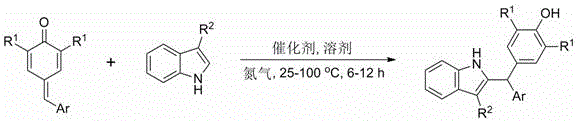
The pharmaceutical and fine chemical industries are constantly seeking robust, environmentally benign methodologies for constructing complex heterocyclic scaffolds, particularly indole derivatives which serve as critical building blocks for numerous bioactive molecules. Patent CN112574092B introduces a groundbreaking approach to synthesizing 2-diarylmethyl substituted indole compounds, addressing long-standing challenges regarding selectivity, environmental impact, and cost-efficiency in organic synthesis. This innovation leverages a Brønsted acid catalytic system, specifically utilizing phosphoric acid, to facilitate the coupling of 3-substituted indoles with 4-arylmethylene-2,6-dialkyl-2,5-cyclohexadien-1-ones in an aqueous medium. By shifting away from traditional transition metal catalysis and hazardous organic solvents, this technology offers a compelling value proposition for manufacturers aiming to streamline their production of high-purity pharmaceutical intermediates. The reported methodology not only achieves yields approaching quantitative levels but also ensures exceptional regioselectivity, directly targeting the difficult-to-functionalize 2-position of the indole ring. For global supply chain leaders and R&D directors, this patent represents a significant opportunity to optimize manufacturing protocols while adhering to increasingly stringent environmental regulations.
The Limitations of Conventional Methods vs. The Novel Approach
The Limitations of Conventional Methods
Historically, the construction of 2-diarylmethyl substituted indole frameworks has relied heavily on transition metal-catalyzed cross-coupling reactions or intramolecular cyclizations involving precious metals such as Palladium, Silver, Rhodium, and Ruthenium. These conventional pathways often necessitate the use of complex, multi-step synthetic sequences that require rigorously anhydrous conditions and expensive ligands to maintain catalytic activity. Furthermore, the reliance on halogenated starting materials and volatile organic compounds (VOCs) as solvents introduces significant safety hazards, including flammability and toxicity, which complicate industrial handling and waste disposal protocols. A major drawback of these traditional methods is the difficulty in removing trace metal residues from the final product, a critical quality attribute for pharmaceutical intermediates intended for human consumption. Additionally, the atom economy of these processes is frequently compromised by the generation of stoichiometric amounts of salt byproducts, leading to higher raw material costs and increased environmental burden. The sensitivity of these catalytic systems to air and moisture often results in inconsistent batch-to-batch reproducibility, posing a severe risk to supply chain continuity for large-scale manufacturing operations.
The Novel Approach
In stark contrast to the complexities of metal-mediated synthesis, the novel method disclosed in the patent utilizes a simple yet highly effective phosphoric acid catalyst in water, fundamentally altering the economic and ecological landscape of indole functionalization. This approach capitalizes on the inherent reactivity of 4-arylmethylene-2,6-dialkyl-2,5-cyclohexadien-1-ones as electrophilic partners, which react efficiently with 3-substituted indoles under mild thermal conditions ranging from 25°C to 100°C. The use of water as the sole reaction solvent not only eliminates the costs associated with purchasing, recovering, and disposing of organic solvents but also enhances the safety profile of the operation by removing fire hazards. The catalytic system demonstrates remarkable tolerance to a wide variety of functional groups, including halogens, nitro groups, and heterocycles, allowing for the synthesis of diverse libraries of indole derivatives without the need for protecting group strategies. By achieving selectivity close to 100%, this method drastically simplifies the downstream purification process, reducing the need for extensive chromatographic separations and thereby lowering the overall cost of goods sold. This paradigm shift towards organocatalysis in aqueous media provides a sustainable, scalable, and economically superior alternative for the production of high-value chemical intermediates.
Mechanistic Insights into Phosphoric Acid-Catalyzed Electrophilic Substitution
The core of this synthetic breakthrough lies in the activation of the quinone methide precursor by the phosphoric acid catalyst, which acts as a proton donor to generate a highly reactive carbocationic intermediate in situ. Upon protonation of the exocyclic double bond of the 4-arylmethylene-2,6-dialkyl-2,5-cyclohexadien-1-one, the electron density is shifted, creating a potent electrophile at the benzylic position that is primed for nucleophilic attack. The 3-substituted indole, acting as a nucleophile, attacks this activated species preferentially at the C2 position due to the steric hindrance at the C3 position and the electronic distribution of the indole ring system. This electrophilic aromatic substitution is facilitated by the hydrogen-bonding network of the aqueous solvent, which stabilizes the transition state and assists in the proton transfer steps required to restore aromaticity in the final product. The mild acidity of phosphoric acid is sufficient to drive the reaction forward without causing decomposition of sensitive functional groups or promoting polymerization side reactions that are common with stronger mineral acids. Understanding this mechanism allows process chemists to fine-tune reaction parameters, such as pH and temperature, to maximize throughput while maintaining the structural integrity of complex molecular architectures.
Furthermore, the impurity profile of the reaction is exceptionally clean due to the high specificity of the acid-catalyzed pathway, which minimizes the formation of regioisomers or over-alkylated byproducts. The absence of transition metals eliminates the risk of metal-catalyzed oxidative degradation or homocoupling of the indole substrates, which are common failure modes in palladium-catalyzed variants. The reaction kinetics are favorable, typically reaching completion within 6 to 12 hours, which indicates a low activation energy barrier and high turnover frequency for the catalytic cycle. Post-reaction analysis confirms that the phosphoric acid remains largely intact or is easily neutralized, allowing for potential recycling of the aqueous phase in subsequent batches, further enhancing the green chemistry metrics of the process. This mechanistic clarity provides R&D teams with the confidence to adapt the protocol for continuous flow processing or telescoped synthesis routes, enabling rapid scale-up from laboratory discovery to commercial manufacturing without extensive re-optimization.
How to Synthesize 2-Diarylmethyl Indole Efficiently
To implement this synthesis effectively, operators must adhere to precise stoichiometric ratios and environmental controls to ensure optimal yield and purity. The process begins by charging a reaction vessel with the 3-substituted indole and the quinone methide derivative under an inert nitrogen atmosphere to prevent any potential oxidative side reactions, although the system is relatively robust. Phosphoric acid is then introduced along with water, serving as both the solvent and the medium for proton transfer, with the molar ratio of catalyst to substrate carefully controlled between 0.05 and 0.3 equivalents to balance reaction rate and cost. The mixture is heated to a temperature between 25°C and 100°C depending on the specific reactivity of the substrates, with stirring maintained for a duration of 6 to 12 hours to ensure complete conversion. Detailed standardized operating procedures for scaling this reaction from gram to kilogram scale are provided in the technical documentation below to ensure consistency and safety.
- Combine 3-substituted indole and 4-arylmethylene-2,6-dialkyl-2,5-cyclohexadien-1-one in a reaction vessel under a nitrogen atmosphere.
- Add phosphoric acid catalyst and water as the green solvent to the mixture, ensuring a molar ratio of substrate to catalyst between 1: 0.05 and 1:0.3.
- Stir the reaction mixture at temperatures ranging from 25°C to 100°C for 6 to 12 hours, followed by isolation and purification via column chromatography.
Commercial Advantages for Procurement and Supply Chain Teams
For procurement managers and supply chain directors, the adoption of this aqueous phosphoric acid catalytic system translates into tangible strategic benefits that extend far beyond simple chemical transformation. By eliminating the dependency on scarce and price-volatile precious metals like palladium and rhodium, manufacturers can decouple their production costs from the fluctuations of the commodities market, ensuring more stable pricing for long-term contracts. The simplified workup procedure, driven by the high selectivity and water-soluble nature of the catalyst, significantly reduces the consumption of silica gel and organic eluents required for purification, leading to substantial savings in consumable materials and waste treatment fees. Moreover, the use of water as a solvent removes the regulatory burdens and safety costs associated with storing and handling large volumes of flammable organic solvents, thereby lowering insurance premiums and facility compliance overheads. This streamlined process inherently shortens the manufacturing cycle time by removing complex metal scavenging and solvent exchange steps, allowing facilities to increase throughput and respond more agilely to market demand fluctuations without compromising product quality.
- Cost Reduction in Manufacturing: The elimination of expensive transition metal catalysts and the associated ligand systems removes a significant portion of the raw material cost structure, while the ability to use technical grade water instead of anhydrous organic solvents further drives down operational expenditures. The high selectivity of the reaction minimizes the loss of valuable starting materials to byproduct formation, improving the overall mass balance and yield efficiency of the process. Additionally, the reduced need for complex purification infrastructure, such as metal scavenger columns or distillation units for solvent recovery, lowers the capital expenditure required for setting up new production lines. These cumulative efficiencies result in a markedly lower cost of goods sold, providing a competitive margin advantage in the global marketplace for pharmaceutical intermediates.
- Enhanced Supply Chain Reliability: Sourcing phosphoric acid and water is logistically trivial compared to securing specialized transition metal catalysts, which often face supply bottlenecks and long lead times due to geopolitical factors. The robustness of the reaction conditions means that production is less susceptible to disruptions caused by minor variations in raw material quality or environmental conditions, ensuring consistent output. By simplifying the synthetic route, the risk of batch failures is significantly mitigated, guaranteeing a steady flow of material to downstream customers and strengthening supplier relationships. This reliability is crucial for just-in-time manufacturing models where any delay in intermediate delivery can halt the entire production schedule of the final active pharmaceutical ingredient.
- Scalability and Environmental Compliance: The aqueous nature of the reaction makes it inherently safer to scale up, as there is no risk of thermal runaway associated with exothermic reactions in volatile organic solvents, facilitating easier heat management in large reactors. The process aligns perfectly with green chemistry principles by minimizing hazardous waste generation, making it easier to obtain environmental permits and maintain compliance with increasingly strict discharge regulations. The simplicity of the isolation process, often involving simple filtration or extraction, allows for seamless transition from pilot plant to full commercial scale without the need for specialized equipment. This scalability ensures that the technology can meet the growing global demand for indole-based therapeutics without encountering the technical barriers typical of complex metal-catalyzed processes.
Frequently Asked Questions (FAQ)
The following questions address common technical and commercial inquiries regarding the implementation of this green synthesis technology, derived directly from the patent specifications and experimental data. These insights are designed to clarify the operational feasibility and strategic benefits for stakeholders evaluating this method for integration into their existing manufacturing portfolios. Understanding these details is essential for making informed decisions about process adoption and supply chain optimization.
Q: What are the primary advantages of using water as a solvent in indole synthesis compared to traditional organic solvents?
A: Using water eliminates the safety hazards associated with flammable and explosive organic solvents, significantly reduces environmental pollution, and simplifies the post-reaction workup process, leading to a greener and more cost-effective manufacturing protocol.
Q: How does the phosphoric acid catalytic system improve selectivity over transition metal catalysts?
A: The phosphoric acid system avoids the use of expensive and toxic transition metals like Palladium or Rhodium, preventing metal residue contamination in the final API intermediate and achieving near 100% selectivity without requiring complex metal scavenging steps.
Q: Is this synthetic route scalable for industrial production of pharmaceutical intermediates?
A: Yes, the method utilizes cheap, readily available raw materials and mild reaction conditions (25-100°C), making it highly suitable for commercial scale-up with excellent reproducibility and minimal safety risks regarding pressure or temperature control.
Partnering with NINGBO INNO PHARMCHEM: Your Reliable 2-Diarylmethyl Indole Supplier
At NINGBO INNO PHARMCHEM, we recognize the transformative potential of this phosphoric acid-catalyzed aqueous synthesis for producing high-quality 2-diarylmethyl indole derivatives efficiently. As a dedicated CDMO partner, we possess extensive experience scaling diverse pathways from 100 kgs to 100 MT/annual commercial production, ensuring that your transition from lab-scale discovery to market-ready supply is seamless and secure. Our state-of-the-art facilities are equipped with rigorous QC labs capable of meeting stringent purity specifications, guaranteeing that every batch of intermediate delivered meets the exacting standards required for pharmaceutical applications. We are committed to leveraging this green technology to provide our clients with a sustainable, cost-effective, and reliable source of critical indole building blocks.
We invite you to engage with our technical procurement team to discuss how this innovative synthetic route can be tailored to your specific project needs and volume requirements. By requesting a Customized Cost-Saving Analysis, you can quantify the potential economic benefits of switching to this metal-free, aqueous process for your supply chain. We encourage you to contact us today to obtain specific COA data and route feasibility assessments that will demonstrate the viability of this approach for your next-generation therapeutic programs.