
Advanced Synthesis of Trans-Aromatic Tertiary Amine Azo Compounds for Commercial Scale Pharmaceutical Manufacturing
Introduction to Next-Generation Azo Compound Synthesis
The landscape of fine chemical manufacturing is undergoing a significant transformation driven by the need for safer, more selective, and environmentally sustainable synthetic methodologies. A pivotal advancement in this domain is documented in Chinese Patent CN107935882B, which discloses a highly efficient method for preparing trans-aromatic tertiary amine azo compounds through the selective activation of para-C-H bonds. This technology represents a paradigm shift from traditional diazotization processes that rely on hazardous reagents and extreme conditions, offering instead a robust catalytic system utilizing Bronsted acids and stable aryl diazonium tetrafluoroborate salts. For R&D directors and procurement strategists in the pharmaceutical and agrochemical sectors, this innovation addresses critical pain points regarding impurity profiles, operational safety, and overall process economics. By leveraging stable precursors and mild catalytic conditions, this approach ensures the production of high-value intermediates with exceptional stereochemical integrity, positioning it as a cornerstone technology for reliable pharmaceutical intermediates supplier networks aiming to modernize their production capabilities.
The Limitations of Conventional Methods vs. The Novel Approach
The Limitations of Conventional Methods
Historically, the synthesis of organic aromatic amine azo compounds has been plagued by significant technical and safety challenges that hinder efficient commercial scale-up. Traditional routes typically involve the in situ generation of diazonium salts using sodium nitrite and strong mineral acids like hydrochloric acid at cryogenic temperatures, often below zero degrees Celsius. This legacy methodology presents severe drawbacks, including the requirement for specialized corrosion-resistant reactors, rigorous temperature control systems to prevent explosive decomposition, and the generation of substantial acidic wastewater. Furthermore, these conventional processes frequently suffer from poor regioselectivity, leading to complex mixtures of ortho- and para-substituted isomers that are difficult and costly to separate. The reliance on air-sensitive reagents and the inherent instability of intermediate diazonium species also contribute to low atom economy and inconsistent batch-to-batch reproducibility, creating bottlenecks for cost reduction in fine chemical manufacturing where purity and yield are paramount.
The Novel Approach
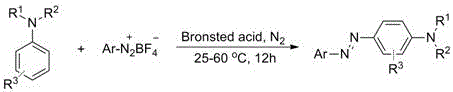
In stark contrast to these archaic methods, the novel approach detailed in the patent utilizes pre-formed, stable aryl diazonium tetrafluoroborate salts coupled with organic aromatic tertiary amines in the presence of a Bronsted acid catalyst. This strategy eliminates the need for hazardous in situ diazotization, allowing the reaction to proceed under remarkably mild thermal conditions ranging from 25 to 60 degrees Celsius. The use of stable diazonium salts not only enhances operational safety by removing the risk of uncontrolled exotherms but also significantly broadens the substrate scope to include functional groups that would otherwise be incompatible with harsh acidic environments. As illustrated in the reaction scheme below, this method achieves near-perfect para-selectivity and stereoselectivity, fundamentally simplifying the downstream purification workflow.
Mechanistic Insights into Bronsted Acid-Catalyzed C-H Activation
The core of this technological breakthrough lies in the precise mechanistic pathway facilitated by the Bronsted acid catalyst, which activates the electrophilic aromatic substitution without compromising the stability of the sensitive diazonium moiety. Unlike Lewis acids that might coordinate unpredictably with the tertiary amine nitrogen, Bronsted acids such as diphenylphosphoric acid or trifluoroacetic acid provide a controlled proton source that enhances the electrophilicity of the diazonium species while maintaining the nucleophilicity of the aromatic ring. This delicate balance is crucial for achieving the observed high stereoselectivity, where the trans-isomer (E-isomer) is favored with a ratio exceeding 99:1 over the cis-isomer. The mechanism likely involves the formation of a hydrogen-bonded complex that directs the attack specifically to the para-position of the aromatic tertiary amine, effectively suppressing ortho-substitution and other side reactions that typically degrade product quality in non-catalyzed systems.
From an impurity control perspective, this catalytic system offers distinct advantages by minimizing the formation of azo-hydrazones and other decomposition byproducts common in traditional syntheses. The mild reaction environment prevents the thermal degradation of the diazonium salt, which is a frequent source of phenolic impurities in high-temperature processes. Additionally, the use of tetrafluoroborate counterions contributes to the stability of the diazonium intermediate, allowing for longer reaction times (approximately 12 hours) without significant loss of material integrity. For quality assurance teams, this translates to a much cleaner crude reaction profile, reducing the burden on analytical laboratories and enabling faster release times for high-purity OLED material or pharmaceutical intermediates. The robustness of this mechanism across various substituents, including electron-withdrawing and electron-donating groups, underscores its versatility for synthesizing complex molecular architectures required in advanced material science.
How to Synthesize Trans-Aromatic Tertiary Amine Azo Compounds Efficiently
Implementing this synthesis route in a laboratory or pilot plant setting requires adherence to specific procedural guidelines to maximize yield and selectivity while maintaining safety standards. The process is designed to be operationally simple, avoiding the need for inert atmosphere gloveboxes for the entire duration, although initial mixing may benefit from nitrogen protection to exclude moisture depending on the specific solvent choice. The key to success lies in the precise stoichiometric balance between the diazonium salt, the amine substrate, and the catalyst, as well as the selection of an appropriate organic solvent such as dichloroethane or acetonitrile. Detailed standard operating procedures for this transformation are critical for ensuring reproducibility, particularly when scaling from gram-scale experiments to multi-kilogram production batches.
- Mix aryl diazonium tetrafluoroborate, organic aromatic tertiary amine, Bronsted acid catalyst, and organic solvent in a reaction vessel under inert or air conditions.
- Stir the reaction mixture at a controlled temperature range of 25 to 60 degrees Celsius for approximately 12 hours to ensure complete conversion.
- Purify the resulting crude product via column chromatography to isolate the high-purity trans-isomer with E/Z selectivity greater than 99: 1.
Commercial Advantages for Procurement and Supply Chain Teams
For procurement managers and supply chain directors, the adoption of this patented methodology offers compelling economic and logistical benefits that directly impact the bottom line. By shifting away from corrosive mineral acids and cryogenic cooling requirements, manufacturers can significantly reduce capital expenditure on specialized reactor linings and refrigeration infrastructure. The elimination of hazardous reagents like alkyl nitrites and concentrated hydrochloric acid also lowers the costs associated with waste disposal and environmental compliance, aligning with increasingly stringent global regulations on chemical manufacturing. Furthermore, the high stereoselectivity achieved by this process means that less material is lost during purification, effectively increasing the overall mass balance and reducing the cost of goods sold for high-value intermediates.
- Cost Reduction in Manufacturing: The transition to stable aryl diazonium tetrafluoroborate salts and Bronsted acid catalysts removes the necessity for expensive cryogenic equipment and corrosion-resistant alloys, leading to substantial capital and operational cost savings. The mild reaction conditions allow for the use of standard glass-lined or stainless steel reactors, drastically simplifying the engineering requirements for commercial scale-up of complex polymer additives or pharmaceutical intermediates. Additionally, the high yield and selectivity reduce the consumption of raw materials and solvents per kilogram of finished product, optimizing the overall process efficiency without compromising quality standards.
- Enhanced Supply Chain Reliability: Utilizing stable, shelf-stable diazonium salts mitigates the risks associated with the on-demand generation of unstable intermediates, ensuring a more consistent and reliable supply of key starting materials. This stability allows for better inventory management and reduces the likelihood of production delays caused by reagent decomposition or supply shortages of hazardous gases. The robustness of the reaction across a wide range of substrates ensures that supply chains remain resilient even when specific raw material grades vary, providing a buffer against market volatility for critical electronic chemical or agrochemical intermediate supplies.
- Scalability and Environmental Compliance: The process operates under atmospheric pressure and moderate temperatures, making it inherently safer and easier to scale from pilot plants to full commercial production facilities without significant re-engineering. The reduction in hazardous waste streams, particularly acidic effluents and heavy metal contaminants often found in alternative catalytic systems, simplifies wastewater treatment and enhances the environmental sustainability profile of the manufacturing site. This alignment with green chemistry principles not only reduces regulatory burdens but also appeals to end-customers who prioritize eco-friendly sourcing in their supply chain audits.
Frequently Asked Questions (FAQ)
The following questions address common technical and commercial inquiries regarding the implementation of this Bronsted acid-catalyzed synthesis method. These insights are derived directly from the experimental data and claims presented in the patent literature, providing a factual basis for evaluating the technology's fit within your existing manufacturing portfolio. Understanding these nuances is essential for making informed decisions about process adoption and supplier qualification.
Q: What are the primary advantages of using Bronsted acid catalysts over traditional mineral acids for azo synthesis?
A: Bronsted acid catalysts, such as diphenylphosphoric acid, offer superior control over stereoselectivity, achieving trans/cis ratios greater than 99:1, while operating under milder conditions that reduce equipment corrosion and safety risks compared to hydrochloric acid methods.
Q: How does this method improve the purity profile of aromatic tertiary amine azo derivatives?
A: The method utilizes stable aryl diazonium tetrafluoroborate salts which minimize side reactions and decomposition, resulting in target product selectivity close to 100% and significantly simplifying downstream purification processes.
Q: Is this synthesis route scalable for industrial production of pharmaceutical intermediates?
A: Yes, the process operates at ambient to moderate temperatures (25-60°C) without requiring cryogenic cooling or specialized pressure vessels, making it highly suitable for large-scale commercial manufacturing with enhanced safety profiles.
Partnering with NINGBO INNO PHARMCHEM: Your Reliable Trans-Aromatic Tertiary Amine Azo Compounds Supplier
At NINGBO INNO PHARMCHEM, we recognize the transformative potential of the synthetic route described in CN107935882B and have integrated similar advanced catalytic technologies into our CDMO service offerings. Our team possesses extensive experience scaling diverse pathways from 100 kgs to 100 MT/annual commercial production, ensuring that the transition from laboratory discovery to industrial reality is seamless and efficient. We maintain stringent purity specifications and operate rigorous QC labs equipped with state-of-the-art analytical instrumentation to guarantee that every batch of trans-aromatic tertiary amine azo compounds meets the exacting standards required by the global pharmaceutical and fine chemical industries.
We invite you to collaborate with us to leverage these cutting-edge synthetic methods for your next project. Contact our technical procurement team today to request a Customized Cost-Saving Analysis tailored to your specific volume requirements. We are prepared to provide specific COA data and comprehensive route feasibility assessments to demonstrate how our capabilities can enhance your supply chain resilience and drive down manufacturing costs while delivering the highest quality intermediates available in the market.