
Advanced Pyriminostrobin Manufacturing: High-Purity Route for Global Agrochemical Supply Chains
The global demand for high-efficacy acaricides continues to drive innovation in agrochemical intermediate manufacturing, with Pyriminostrobin standing out as a critical active ingredient for mite control. As detailed in Chinese Patent CN103387547A, a novel preparation method has been developed that fundamentally alters the synthetic landscape for this compound, offering a robust alternative to legacy processes. This technical breakthrough addresses long-standing challenges in impurity profiles and yield optimization, positioning it as a vital asset for reliable agrochemical intermediate supplier networks seeking to enhance their portfolio. By shifting from a direct alkylation approach to a pre-activation salt-formation strategy, the patent outlines a pathway that not only simplifies purification but also ensures consistent batch-to-batch quality essential for regulatory compliance. For R&D directors and procurement specialists alike, understanding the nuances of this patented route is key to securing a competitive edge in the cost reduction in agrochemical manufacturing sector. The following analysis dissects the chemical engineering principles behind this innovation, demonstrating how strategic process design can translate into tangible supply chain resilience and operational efficiency.
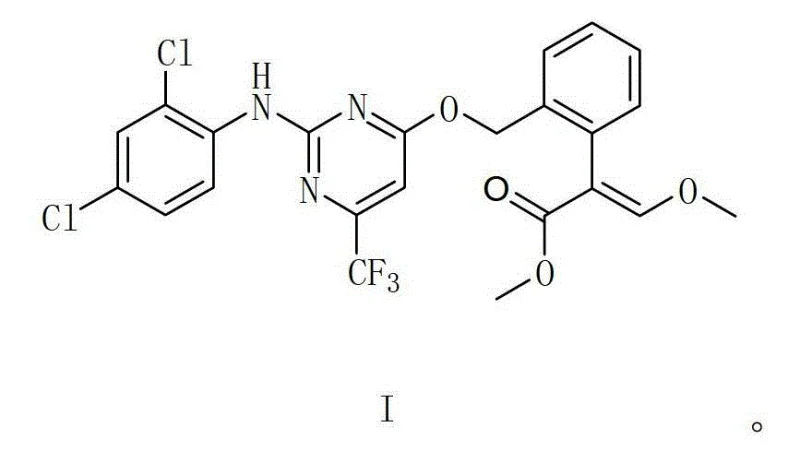
The Limitations of Conventional Methods vs. The Novel Approach
The Limitations of Conventional Methods
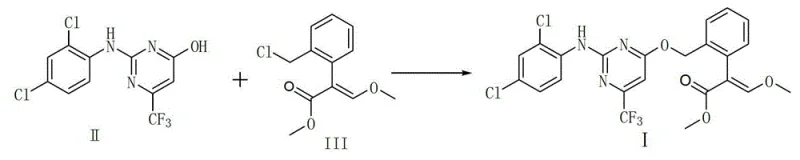
Historically, the synthesis of Pyriminostrobin relied on the direct condensation of pyrimidinol (Compound II) with benzyl chloride (Compound III), a route fraught with significant chemical inefficiencies that hindered large-scale adoption. As illustrated in the prior art reaction scheme, this direct approach suffers from poor regioselectivity, leading to the concurrent formation of unwanted N-alkylated isomers alongside the desired O-alkylated product. These structural analogs possess similar physical properties to the target molecule, making their removal via standard crystallization or chromatography exceptionally difficult and costly. Furthermore, literature reports indicate that this conventional method typically yields suboptimal conversion rates, necessitating extensive recycling of unreacted starting materials and driving up the overall cost of goods sold. The prolonged reaction times and harsh conditions often required to push equilibrium towards the product further exacerbate energy consumption and equipment wear, rendering the process economically unviable for modern, high-volume commercial scale-up of complex acaricides. Consequently, manufacturers relying on this legacy technology face persistent bottlenecks in achieving the high purity standards demanded by global regulatory bodies.
The Novel Approach
In stark contrast to the limitations of direct alkylation, the methodology disclosed in Patent CN103387547A introduces a sophisticated two-step sequence that prioritizes selectivity and yield through intermediate salt formation. The core innovation lies in the initial conversion of the pyrimidinol phenol group into a metal salt using a strong base, effectively transforming the hydroxyl group into a highly nucleophilic oxyanion. This pre-activation step dramatically enhances the reactivity of the oxygen atom relative to the nitrogen atoms on the pyrimidine ring, thereby kinetically favoring the formation of the ether linkage over the amine linkage. As depicted in the optimized reaction pathway, this strategic modification virtually eliminates the generation of N-alkylated byproducts, streamlining the downstream purification process to a simple recrystallization. The result is a process capable of delivering yields exceeding 90% with purity levels consistently above 98%, a performance metric that directly supports reducing lead time for high-purity agrochemical intermediates. By decoupling the deprotonation and alkylation events, the process allows for precise control over reaction parameters, ensuring that the final high-purity agrochemical intermediates meet the stringent specifications required for formulation into end-user pesticides.
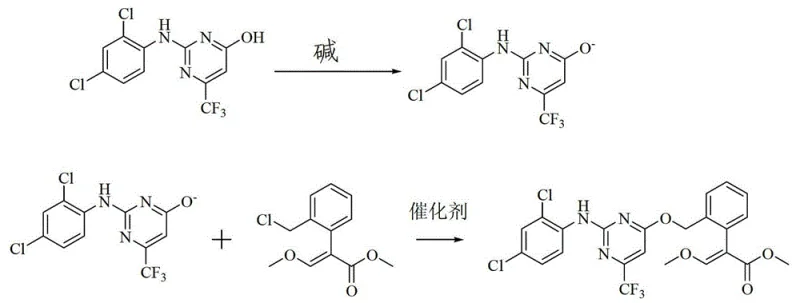
Mechanistic Insights into Salt-Mediated Nucleophilic Substitution
The mechanistic superiority of this novel route stems from the fundamental principles of nucleophilic substitution kinetics and the modulation of electronic effects within the heterocyclic system. In the first stage, the treatment of pyrimidinol with bases such as sodium methoxide, potassium carbonate, or sodium hydroxide in solvents like methanol or toluene generates a resonance-stabilized phenoxide anion. This anionic species is a significantly stronger nucleophile than the neutral phenol, allowing the subsequent alkylation with benzyl chloride to proceed rapidly even at moderate temperatures ranging from 60°C to 140°C. The choice of solvent plays a pivotal role in this mechanism; polar aprotic solvents like N,N-dimethylformamide (DMF) or N-methylpyrrolidone (NMP) used in the second step stabilize the transition state without solvating the nucleophile too strongly, thereby maintaining its high reactivity. Additionally, the inclusion of phase transfer catalysts or additives like polyethylene glycol (PEG) further facilitates the interaction between the ionic salt and the organic halide, ensuring homogeneous reaction conditions that maximize conversion efficiency. This careful orchestration of reagents prevents the competing nucleophilic attack by the ring nitrogens, which is the primary source of impurity in non-salt-mediated pathways.
From an impurity control perspective, the salt-formation method offers a distinct thermodynamic advantage by locking the reactive site onto the oxygen atom prior to the introduction of the electrophile. In traditional methods, the equilibrium between O-alkylation and N-alkylation is often governed by subtle differences in activation energy, leading to a mixture of products that complicates isolation. However, by pre-forming the salt, the concentration of the free phenol is minimized, and the electron density is directed almost exclusively towards the oxygen center. This kinetic control ensures that the reaction trajectory remains fixed on the desired ether synthesis, effectively shutting down the pathway to N-alkylated isomers. The subsequent workup procedure, involving extraction with toluene and water followed by methanol recrystallization, capitalizes on this high selectivity to remove trace inorganic salts and residual solvents. The outcome is a crystalline product with a defined melting point and spectral profile, free from the complex impurity matrices that typically plague direct alkylation routes, thus simplifying the analytical burden on quality control laboratories.
How to Synthesize Pyriminostrobin Efficiently
The implementation of this synthesis route requires strict adherence to the sequential addition of reagents and temperature controls to maximize the benefits of the salt-intermediate strategy. The process begins with the quantitative conversion of the starting phenol into its corresponding salt, followed by a controlled alkylation in a polar medium. Detailed operational parameters regarding solvent volumes, molar ratios, and specific temperature ramps are critical for reproducibility.
- React pyrimidinol with a base (such as sodium methoxide or potassium carbonate) in a suitable solvent like methanol or toluene at 60°C to reflux to form the pyrimidinol salt.
- Remove the initial solvent and add a polar aprotic solvent (like DMF), benzyl chloride, and a catalyst (like DMAP or PEG), then heat to 100°C for 6-10 hours.
- Work up the reaction by removing the solvent, extracting with toluene and water, and finally recrystallizing the crude product from methanol to achieve >98% purity.
Commercial Advantages for Procurement and Supply Chain Teams
For procurement managers and supply chain directors, the adoption of this patented synthesis method translates into immediate and substantial operational improvements that extend far beyond simple yield metrics. By fundamentally altering the reaction mechanism to suppress byproduct formation, the process eliminates the need for complex and expensive purification technologies such as preparative HPLC or multiple column chromatography steps. This simplification of the downstream processing train significantly reduces the consumption of silica gel, eluents, and energy, leading to a drastic reduction in the overall cost of manufacturing. Furthermore, the high selectivity of the reaction means that raw material utilization is optimized, with minimal waste generated from off-spec isomers that would otherwise require disposal or reprocessing. These efficiencies collectively contribute to a more lean and agile manufacturing operation, allowing suppliers to offer more competitive pricing structures without compromising on margin.
- Cost Reduction in Manufacturing: The elimination of N-alkylated isomers removes the most costly bottleneck in the traditional production of Pyriminostrobin, which is the separation of structurally similar impurities. Without the need for extensive purification cycles, the consumption of solvents and adsorbents is significantly lowered, directly impacting the variable cost per kilogram. Additionally, the use of common, commodity-grade solvents like toluene, methanol, and DMF ensures that raw material procurement remains stable and inexpensive, avoiding reliance on exotic or hazardous reagents. The high yield reported in the patent examples, consistently reaching above 90%, implies that less starting material is required to produce the same amount of finished goods, further enhancing the economic viability of the process for large-scale buyers.
- Enhanced Supply Chain Reliability: The robustness of this synthetic route ensures a consistent and predictable output, which is crucial for maintaining uninterrupted supply lines to formulators and distributors. Since the reaction conditions are mild and tolerant to slight variations in temperature or mixing, the risk of batch failure is minimized, providing supply chain heads with greater confidence in delivery schedules. The availability of all key starting materials, including pyrimidinol and benzyl chloride derivatives, from established chemical markets reduces the risk of raw material shortages that could disrupt production. This stability allows for better inventory planning and reduces the need for safety stock, freeing up working capital for other strategic investments within the organization.
- Scalability and Environmental Compliance: The process is inherently scalable, having been designed with industrial application in mind, utilizing standard reactor configurations and common unit operations like distillation and crystallization. The reduction in hazardous waste generation, stemming from higher selectivity and fewer purification steps, aligns with increasingly stringent environmental regulations and corporate sustainability goals. Easier waste management and lower solvent emissions simplify the permitting process for manufacturing sites, facilitating faster expansion of production capacity to meet growing market demand. This environmental compatibility not only mitigates regulatory risk but also enhances the brand reputation of the supplier as a responsible partner in the global agrochemical value chain.
Frequently Asked Questions (FAQ)
The following questions address common technical and commercial inquiries regarding the implementation and benefits of this advanced synthesis technology. These insights are derived directly from the experimental data and claims presented in the patent documentation, providing a factual basis for decision-making.
Q: How does the salt-formation method improve Pyriminostrobin purity compared to traditional methods?
A: Traditional direct alkylation often produces N-alkylated isomers which are difficult to separate. The salt-formation method activates the oxygen nucleophile specifically, suppressing N-alkylation and resulting in purity levels exceeding 98%.
Q: What are the critical reaction conditions for scaling up this synthesis?
A: Critical parameters include maintaining the salt formation temperature between 60°C and reflux, and controlling the alkylation step between 60°C and 140°C using polar aprotic solvents like DMF or NMP to ensure complete conversion.
Q: Is this process suitable for large-scale industrial production?
A: Yes, the patent explicitly states the method is suitable for industrialized production due to its high yield (over 90%), mild conditions, and the use of commercially available solvents and catalysts.
Partnering with NINGBO INNO PHARMCHEM: Your Reliable Pyriminostrobin Supplier
At NINGBO INNO PHARMCHEM, we recognize that the transition to superior manufacturing processes is the cornerstone of long-term success in the agrochemical industry. Our technical team possesses extensive experience scaling diverse pathways from 100 kgs to 100 MT/annual commercial production, ensuring that the theoretical advantages of Patent CN103387547A are fully realized in practical, large-volume operations. We maintain stringent purity specifications and operate rigorous QC labs equipped with state-of-the-art analytical instrumentation to guarantee that every batch of Pyriminostrobin meets the highest international standards. Our commitment to quality assurance means that clients receive a product that is not only chemically pure but also consistent in its physical properties, facilitating seamless formulation into final pesticide products.
We invite global partners to engage with our technical procurement team to discuss how this optimized synthesis route can be integrated into your supply chain. By requesting a Customized Cost-Saving Analysis, you can quantify the potential economic benefits specific to your volume requirements and logistical constraints. We encourage you to contact us today to obtain specific COA data and route feasibility assessments, allowing you to make informed decisions that drive efficiency and profitability in your agrochemical manufacturing operations.