
Advanced Rhodium Catalyzed Furan Synthesis for Commercial Scale-Up of Complex Pharmaceutical Intermediates
Introduction to Novel Furan Synthesis Technology
The development of efficient synthetic routes for heterocyclic compounds remains a cornerstone of modern pharmaceutical chemistry. Patent CN114773301A introduces a groundbreaking method for synthesizing furan compounds starting from terminal alkynes and iodine ylides. This technology leverages a specific dichloro(pentamethylcyclopentadienyl)rhodium(III) dimer catalyst system to achieve rapid cyclization under remarkably mild conditions. Unlike conventional approaches that often demand rigorous exclusion of moisture or extreme temperatures, this innovation allows for reactions to proceed at room temperature with high atom economy. For R&D directors and process chemists, this represents a significant leap forward in constructing the furan scaffold, a motif prevalent in countless bioactive natural products and therapeutic agents. The ability to access these structures quickly and reliably opens new avenues for library synthesis and lead optimization.
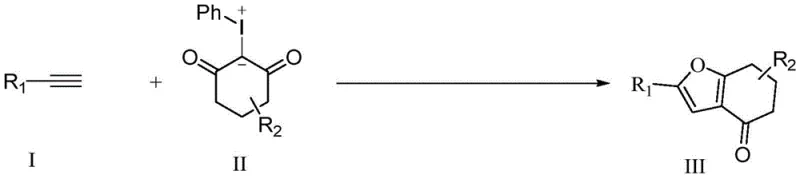
The Limitations of Conventional Methods vs. The Novel Approach
The Limitations of Conventional Methods
Historically, the construction of furan rings from alkyne precursors has been plagued by operational complexities and inefficiencies. Traditional methodologies, such as those relying on benzyne or naphthyne precursors generated from bis(oxydisilacene) compounds, impose severe constraints on the reaction environment. These processes typically necessitate an inert gas atmosphere to prevent catalyst deactivation and require cooling in ice-water baths to manage exothermicity or instability of intermediates. Furthermore, the reaction kinetics are often sluggish, demanding extended periods ranging from 8 to 26 hours to reach completion. A critical economic drawback is the reliance on a large excess of terminal alkyne to drive the equilibrium and suppress unwanted metal carbene self-coupling side reactions. This not only inflates raw material costs but also complicates downstream purification, as separating the excess starting material from the desired product can be challenging and wasteful.
The Novel Approach
The methodology disclosed in the patent data fundamentally shifts the paradigm by utilizing a robust Rhodium(III) catalytic system combined with a simple acidic additive. This new approach bypasses the cumbersome cyclopropanation-ring-opening pathway typical of older methods, instead favoring a direct and efficient cyclization mechanism. By employing dichloro(pentamethylcyclopentadienyl)rhodium(III) dimer, the reaction achieves high conversion rates at ambient temperatures (20-35°C) within a mere 2 hours. Crucially, this system operates effectively with a stoichiometric amount (1 equivalent) of terminal alkyne, eliminating the need for excess reagents. The compatibility with both solid and liquid alkynes further enhances its utility, allowing chemists to diversify their substrate scope without worrying about physical state limitations. This streamlined process translates directly into reduced operational expenditure and faster turnaround times for project milestones.
Mechanistic Insights into Rhodium(III)-Catalyzed Cyclization
Understanding the mechanistic underpinnings of this transformation is vital for process optimization and troubleshooting. The catalytic cycle initiates with the activation of the terminal alkyne by the Rhodium(III) species. In the presence of the acidic reagent, specifically acetic acid, an anion exchange occurs which facilitates the deprotonation of the terminal alkyne, generating a key alkynyl-rhodium intermediate. This step is distinct from traditional carbene pathways and sets the stage for the subsequent migratory insertion. The iodine ylide then interacts with this activated complex, undergoing a carbene migration insertion into the rhodium-carbon bond. This is followed by metal protonation and the final elimination step that closes the furan ring. The acidic additive plays a pivotal dual role here: it not only assists in the initial activation of the alkyne but also stabilizes the transition states leading to ring closure. This precise control over the reaction coordinate minimizes the formation of byproducts and ensures that the reaction proceeds through the lowest energy pathway, resulting in the high isolated yields observed in the experimental data.
From an impurity control perspective, this mechanism offers inherent advantages. By avoiding the generation of highly reactive free carbene species that are prone to dimerization or non-selective insertion, the process maintains a clean reaction profile. The use of 1,4-dioxane as the preferred solvent further supports this selectivity, providing a stable medium that solubilizes both organic substrates and the organometallic catalyst effectively. Screening data indicates that other solvents like water, DMSO, or DMF fail to support the reaction, highlighting the specific solvation requirements of the cationic rhodium intermediates. The tolerance for various functional groups on the alkyne component—ranging from electron-withdrawing nitro groups to bulky steroid skeletons—suggests that the steric and electronic demands of the transition state are well-balanced. This robustness is essential for maintaining high purity specifications in commercial manufacturing, as it reduces the burden on purification columns and crystallization steps.
How to Synthesize Furan Derivatives Efficiently
Implementing this synthesis route in a laboratory or pilot plant setting requires adherence to specific protocols to maximize yield and safety. The general procedure involves charging a pressure-resistant sealed tube with the terminal alkyne substrate, the iodine ylide precursor, and the rhodium catalyst in a 1,4-dioxane solvent system. Acetic acid is then added dropwise to initiate the catalytic cycle. The reaction mixture is stirred at room temperature, typically reaching completion within 2 hours as monitored by TLC or GC analysis. Upon completion, the solvent is removed under reduced pressure, and the crude residue is purified via silica gel column chromatography using a petroleum ether and ethyl acetate gradient. This straightforward workup procedure is amenable to scaling, as it avoids quenching hazardous reagents or dealing with pyrophoric materials. Detailed standardized operating procedures for specific substrate classes can be found in the technical documentation below.
- Combine terminal alkyne, iodine ylide, and the rhodium catalyst in 1,4-dioxane solvent within a sealed reaction vessel.
- Add acetic acid as an acidic additive to facilitate the formation of the alkynyl-rhodium intermediate and promote cyclization.
- Stir the mixture at room temperature (20-35°C) for approximately 2 hours, then purify the crude product using silica gel chromatography.
Commercial Advantages for Procurement and Supply Chain Teams
For procurement managers and supply chain heads, the adoption of this Rhodium-catalyzed technology presents compelling economic and logistical benefits. The shift from harsh, time-consuming conditions to a mild, room-temperature process drastically simplifies the infrastructure requirements for production. There is no longer a need for specialized cryogenic cooling systems or extensive inert gas blanketing, which reduces both capital expenditure on equipment and ongoing utility costs. Furthermore, the reduction in reaction time from nearly a day to just two hours significantly increases reactor throughput, allowing facilities to produce more batches within the same timeframe. This efficiency gain is critical for meeting tight delivery schedules and responding rapidly to market demand fluctuations. The ability to use stoichiometric amounts of expensive alkyne starting materials also directly impacts the bill of materials, leading to substantial cost savings on raw material procurement without compromising on output quality.
- Cost Reduction in Manufacturing: The elimination of excess alkyne reagents is a major driver for cost optimization. In traditional methods, using multiple equivalents of precious or complex alkynes inflates the cost of goods sold significantly. By achieving high yields with a 1:1 molar ratio, this new method ensures that every gram of starting material contributes to the final product. Additionally, the simplified workup and purification process reduces the consumption of chromatography media and solvents. The avoidance of expensive transition metals like Iridium or Ruthenium, which showed no activity in screening, ensures that the catalyst cost remains manageable while maintaining high performance. These factors combine to lower the overall manufacturing cost per kilogram, improving margin potential for high-volume commercial production.
- Enhanced Supply Chain Reliability: The robustness of the reaction conditions enhances supply chain resilience. Since the reaction does not require sensitive anhydrous conditions or strictly controlled low temperatures, it is less susceptible to variations in utility supply or environmental factors. The broad substrate scope means that a single manufacturing line can be adapted to produce a wide variety of furan intermediates simply by changing the alkyne feedstock. This flexibility allows suppliers to consolidate production and reduce the risk of bottlenecks associated with dedicated lines for specific difficult-to-make compounds. The use of commercially available and stable reagents like acetic acid and 1,4-dioxane further secures the supply chain against raw material shortages.
- Scalability and Environmental Compliance: Scaling this process from gram to ton scale is facilitated by the mild thermal profile. Exotherms are easily managed at room temperature, reducing the risk of thermal runaway incidents common in highly exothermic cyclizations. From an environmental standpoint, the higher atom economy and reduced solvent usage align with green chemistry principles. The shorter reaction time also implies lower energy consumption for heating or cooling, contributing to a smaller carbon footprint. Waste generation is minimized due to the high selectivity and yield, simplifying waste treatment protocols and ensuring compliance with increasingly stringent environmental regulations. This makes the technology not only economically attractive but also sustainable for long-term operations.
Frequently Asked Questions (FAQ)
The following questions address common technical inquiries regarding the implementation and scope of this furan synthesis technology. These answers are derived directly from the experimental data and mechanistic studies presented in the patent literature. They are intended to provide clarity for technical teams evaluating the feasibility of this route for their specific projects. Understanding these nuances helps in making informed decisions about process adoption and resource allocation.
Q: What are the primary advantages of this Rhodium(III) catalyzed method over traditional benzyne routes?
A: Unlike traditional methods requiring inert gas atmospheres, ice-water baths, and reaction times of 8 to 26 hours, this novel Rh(III) catalyzed process operates efficiently at room temperature within just 2 hours. It eliminates the need for excess alkyne reagents, significantly reducing raw material costs and simplifying the purification workflow.
Q: Is this synthesis method suitable for complex drug-like molecules?
A: Yes, the patent demonstrates exceptional substrate tolerance, successfully synthesizing furan derivatives from complex structures including steroid backbones and ferrocene units. This indicates high potential for late-stage functionalization in drug discovery pipelines.
Q: What is the role of acetic acid in this catalytic cycle?
A: Acetic acid serves a dual function: it facilitates anion exchange with the catalyst to generate the active alkynyl-rhodium species by removing the terminal alkyne proton, and it activates the triple bond to promote the final furan ring closure, ensuring high yields without harsh conditions.
Partnering with NINGBO INNO PHARMCHEM: Your Reliable Furan Compound Supplier
At NINGBO INNO PHARMCHEM, we recognize the strategic value of advanced synthetic methodologies like the Rhodium-catalyzed furan formation described in CN114773301A. As a leading CDMO partner, we possess the technical expertise to translate such innovative academic and patent discoveries into robust commercial processes. Our team has extensive experience scaling diverse pathways from 100 kgs to 100 MT/annual commercial production, ensuring that the transition from lab bench to manufacturing plant is seamless. We maintain stringent purity specifications and operate rigorous QC labs equipped with state-of-the-art analytical instrumentation to guarantee that every batch of furan intermediate meets the highest industry standards. Whether you require custom synthesis of complex steroid-furan conjugates or high-volume production of simple pharmacophores, our infrastructure is designed to deliver consistency and quality.
We invite you to collaborate with us to leverage this cutting-edge technology for your drug development programs. By partnering with our technical procurement team, you can request a Customized Cost-Saving Analysis tailored to your specific molecule. We encourage you to reach out for specific COA data and route feasibility assessments to determine how this efficient synthesis method can accelerate your timeline and reduce your overall development costs. Let us help you secure a reliable supply of high-purity furan compounds for your next breakthrough therapy.