
Advanced Stereoselective Synthesis of Beta-2-Deoxy Sugars for Pharmaceutical Applications
The pharmaceutical industry continuously seeks robust methodologies for constructing complex carbohydrate architectures, particularly beta-2-deoxy sugars which are critical motifs in numerous antibiotics and cardiac glycosides. Patent CN113527388A introduces a groundbreaking stereoselective synthesis method that addresses the longstanding challenge of controlling glycosidic bond configuration in the absence of neighboring group participation. By utilizing a specialized 2-diphenylacetylphosphino (DPPA) group on the glycosyl donor, this technology leverages hydrogen bonding interactions to direct the stereochemical outcome with exceptional precision. This approach not only solves the thermodynamic preference for alpha-isomers but also operates under remarkably mild conditions, making it highly attractive for the commercial scale-up of complex pharmaceutical intermediates. The ability to synthesize these challenging structures with high fidelity opens new avenues for developing next-generation therapeutic agents.
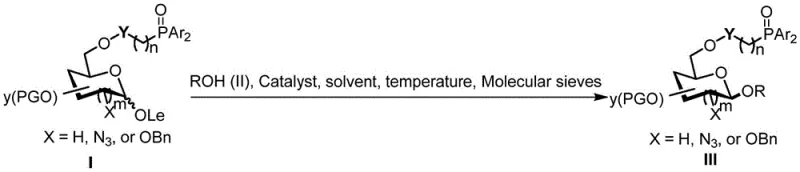
Traditional methods for synthesizing 2-deoxy glycosides often struggle with poor stereocontrol due to the lack of an electron-withdrawing group at the C-2 position, which typically directs the formation of the thermodynamically stable alpha-anomer via the anomeric effect. Conventional strategies might rely on harsh SN2-type displacements or specific conformational controls that limit substrate scope and operational simplicity. In contrast, the novel approach detailed in this patent utilizes an intramolecular aglycone delivery mechanism mediated by the phosphorus oxide side chain. This innovation effectively bypasses the limitations of the anomeric effect by physically positioning the acceptor hydroxyl group via hydrogen bonding, thereby enforcing a specific trajectory for nucleophilic attack. This results in the predominant formation of the beta-configured glycosidic bond, a feat that is notoriously difficult to achieve with standard activators and donors.
The Limitations of Conventional Methods vs. The Novel Approach
The Limitations of Conventional Methods
Historically, the synthesis of beta-2-deoxy sugars has been plagued by low stereoselectivity and rigorous reaction conditions that are incompatible with sensitive functional groups found in advanced drug candidates. Without a participating group at the C-2 position to lock the conformation, the reaction pathway is largely governed by kinetic and thermodynamic factors that favor the alpha-product. Furthermore, existing methods often require stoichiometric amounts of heavy metal promoters or extremely low temperatures that are energy-intensive and difficult to maintain on a large production scale. The instability of the 2-deoxyglycosidic bond under acidic conditions further complicates the deprotection sequences, often leading to hydrolysis or anomerization during downstream processing. These factors collectively increase the cost of goods and extend the timeline for process development, creating a significant bottleneck for cost reduction in API manufacturing.
The Novel Approach
The methodology disclosed in CN113527388A represents a paradigm shift by introducing a removable DPPA auxiliary that acts as a stereocontrolling element. This group is installed at the C-6 position (or potentially C-2, C-3, C-4) and features a phosphine oxide moiety capable of forming a transient hydrogen bond with the hydroxyl group of the glycosyl acceptor. This interaction creates a rigid transition state that favors the formation of the beta-glycoside with high facial selectivity. The reaction proceeds efficiently using catalytic amounts of Lewis acids like TMSOTf in solvents such as trifluorotoluene or chlorobenzene at temperatures ranging from -25°C to 25°C. Importantly, the DPPA group is not permanent; it can be chemoselectively cleaved using nickel triflate under mild conditions, preserving other acid-sensitive protecting groups. This modularity and efficiency make it a superior choice for reducing lead time for high-purity pharmaceutical intermediates.
Mechanistic Insights into DPPA-Mediated Intramolecular Aglycone Delivery
The core mechanistic advantage of this technology lies in the non-covalent interaction between the phosphoryl oxygen of the DPPA side chain and the proton of the acceptor's hydroxyl group. Upon activation of the glycosyl donor by the Lewis acid catalyst, an oxocarbenium ion-like intermediate is generated. Instead of the acceptor attacking randomly from either face of the sugar ring, the hydrogen bond tether holds the acceptor in close proximity to the beta-face of the anomeric center. This "pre-organization" significantly lowers the activation energy for the beta-pathway while sterically hindering the alpha-pathway. The result is a highly diastereoselective transformation that yields beta-2-deoxy sugars, 2-deoxy-2-azido sugars, and glucosides with ratios often exceeding 20:1. This level of control is achieved without the need for bulky temporary tethers that require additional synthetic steps to install and remove, streamlining the overall synthetic route.
Furthermore, the chemoselectivity of the DPPA group removal adds another layer of sophistication to the process design. In complex molecule synthesis, orthogonal protecting group strategies are essential. The patent highlights that the DPPA moiety can be removed using catalytic Ni(OTf)2, a condition that leaves benzyl, acetyl, and silyl ethers intact. This orthogonality allows chemists to build complex oligosaccharide chains or conjugate sugars to sensitive aglycones without fear of premature deprotection. The stability of the intermediate glycosyl donors, such as the N-phenyl-trifluoroacetimido esters described, ensures that the materials can be stored and handled with relative ease, enhancing the robustness of the supply chain. Such mechanistic elegance translates directly into higher purity profiles and reduced impurity burdens in the final active pharmaceutical ingredient.
How to Synthesize Beta-2-Deoxy Sugars Efficiently
The synthesis protocol outlined in the patent provides a clear roadmap for implementing this technology in a laboratory or pilot plant setting. The process begins with the preparation of the specific glycosyl donor bearing the DPPA side chain, which can be synthesized from readily available sugar precursors. The glycosylation reaction itself is operationally simple, requiring the mixing of donor and acceptor in a dry organic solvent with activated molecular sieves to scavenge moisture. Following a brief stirring period to allow for complexation, the catalyst is added at controlled temperatures to initiate the coupling. The reaction progress is monitored via TLC, and upon completion, the mixture is quenched and purified. For a detailed breakdown of the specific reagents, molar ratios, and workup procedures, please refer to the standardized guide below.
- Prepare the glycosyl donor containing the 2-diphenylacetylphosphino (DPPA) group and the glycosyl acceptor in an organic solvent like trifluorotoluene.
- Add activated molecular sieves and stir at room temperature, then cool the mixture to between -25°C and 25°C.
- Introduce a catalyst such as TMSOTf to initiate the reaction, monitoring progress until completion before quenching and purifying via column chromatography.
Commercial Advantages for Procurement and Supply Chain Teams
From a procurement and supply chain perspective, the adoption of this DPPA-mediated synthesis offers tangible benefits regarding cost efficiency and material availability. The reliance on commercially available catalysts like TMSOTf and common solvents such as toluene or dichloromethane eliminates the need for exotic or proprietary reagents that often carry high price tags and long lead times. The mild reaction conditions reduce energy consumption associated with cryogenic cooling, contributing to a lower carbon footprint and reduced utility costs. Moreover, the high stereoselectivity minimizes the formation of alpha-isomer byproducts, which simplifies the purification process and improves the overall yield of the desired beta-product. This efficiency is crucial for maintaining a steady supply of high-purity pharmaceutical intermediates required for clinical and commercial manufacturing.
- Cost Reduction in Manufacturing: The streamlined nature of this synthetic route significantly lowers the cost of goods by reducing the number of purification steps and improving atom economy. By avoiding the use of stoichiometric heavy metal promoters and enabling the use of catalytic amounts of Lewis acids, the process reduces waste disposal costs and raw material expenses. The ability to perform the reaction at near-ambient temperatures further decreases energy overheads compared to traditional cryogenic glycosylations. Additionally, the high selectivity reduces the loss of valuable starting materials to unwanted isomers, maximizing the output per batch and driving down the unit cost of the final intermediate.
- Enhanced Supply Chain Reliability: The broad substrate scope of this method ensures that a wide variety of sugar donors and acceptors can be utilized, providing flexibility in sourcing raw materials. Since the DPPA group can be installed on glucose, galactose, mannose, and azido sugars, manufacturers are not locked into a single supply line for specific precursors. The robustness of the reaction conditions means that the process is less susceptible to minor fluctuations in temperature or moisture, leading to more consistent batch-to-batch quality. This reliability is essential for reliable pharmaceutical intermediate suppliers who must guarantee uninterrupted delivery to their clients in the drug development sector.
- Scalability and Environmental Compliance: The use of standard organic solvents and the absence of toxic heavy metal residues in the final product facilitate easier scale-up from gram to kilogram scales. The chemoselective removal of the DPPA group under mild conditions avoids the generation of hazardous waste streams associated with harsh acidic or basic deprotections. This aligns well with modern green chemistry principles and regulatory requirements for environmental compliance in chemical manufacturing. The simplified workup procedure, involving filtration and column chromatography, is amenable to automation and continuous processing, supporting the commercial scale-up of complex pharmaceutical intermediates with minimal environmental impact.
Frequently Asked Questions (FAQ)
The following questions address common technical inquiries regarding the implementation and scope of this stereoselective synthesis technology. Understanding these details helps R&D and procurement teams evaluate the feasibility of integrating this method into their existing workflows. The answers are derived directly from the experimental data and claims presented in the patent documentation, ensuring accuracy and relevance for industrial application.
Q: What is the primary advantage of the DPPA group in this synthesis?
A: The DPPA group facilitates intramolecular aglycone delivery through hydrogen bonding, ensuring high beta-stereoselectivity even without traditional neighboring group participation.
Q: Can the DPPA protecting group be removed selectively?
A: Yes, the patent specifies that the DPPA group can be chemoselectively removed under mild catalysis using Ni(OTf)2 without affecting other common protecting groups like benzyl or acetyl.
Q: What types of sugar donors are compatible with this method?
A: The method demonstrates broad substrate applicability, working effectively with glucose, galactose, mannose, azido, and various 2-deoxy sugar donors of both pyranose and furanose types.
Partnering with NINGBO INNO PHARMCHEM: Your Reliable Beta-2-Deoxy Sugar Supplier
At NINGBO INNO PHARMCHEM, we recognize the critical importance of high-quality carbohydrate building blocks in the development of life-saving medicines. Our team of expert chemists possesses extensive experience scaling diverse pathways from 100 kgs to 100 MT/annual commercial production, ensuring that your project needs are met with precision and speed. We are equipped with stringent purity specifications and rigorous QC labs to verify the stereochemical integrity of every batch of beta-2-deoxy sugars we produce. By leveraging advanced technologies like the DPPA-mediated glycosylation described in CN113527388A, we can deliver complex intermediates that meet the exacting standards of the global pharmaceutical industry.
We invite you to collaborate with us to optimize your supply chain and accelerate your drug development timelines. Our technical procurement team is ready to provide a Customized Cost-Saving Analysis tailored to your specific molecule requirements. Please contact us today to request specific COA data and route feasibility assessments for your next project, and let us demonstrate how our expertise can become a strategic asset to your organization.