
Advanced Synthesis of 3,5-Dichlorobenzyl Alcohol: A Safer, Scalable Route for Pharmaceutical Manufacturing
The pharmaceutical industry constantly seeks robust synthetic routes that balance safety, cost, and purity, particularly for critical intermediates like 3,5-dichlorobenzyl alcohol. A recent technological breakthrough detailed in patent CN115819186B introduces a novel preparation method that fundamentally shifts the paradigm from hazardous reduction agents to a more controlled borane-based system. This innovation addresses long-standing challenges in the synthesis of this key building block, which is essential for various bioactive substances and drug candidates. By utilizing a borane complex, specifically borane tetrahydrofuran or borane dimethyl sulfide, the new method optimizes the reaction pathway to start directly from 3,5-dichlorobenzoic acid. This strategic change not only enhances the stability of the starting materials but also drastically simplifies the downstream purification process, eliminating the need for complex recrystallization steps that often bottleneck production efficiency. For global procurement and R&D teams, this represents a significant opportunity to secure a reliable pharmaceutical intermediates supplier capable of delivering high-purity materials with a reduced risk profile.
The Limitations of Conventional Methods vs. The Novel Approach
The Limitations of Conventional Methods
Historically, the synthesis of 3,5-dichlorobenzyl alcohol has relied on two primary routes, both of which carry substantial drawbacks for modern industrial application. The first conventional method involves the reduction of 3,5-dichlorobenzoic acid using lithium aluminum hydride (LiAlH4). As illustrated in the reaction scheme below, this traditional approach presents severe safety and economic hurdles.
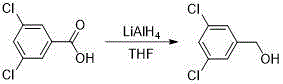
Lithium aluminum hydride is a solid reagent with a very expensive unit price and is classified as a dangerous chemical due to its propensity to generate hydrogen gas and cause explosions upon contact with water or during heating. In industrial settings, the direct use of solid LiAlH4 is often avoided in favor of tetrahydrofuran solutions; however, these solutions (typically 2.5mol/L) are approximately ten times more expensive by mass than the solid reagent, leading to inflated production costs. Furthermore, the quenching of excessive lithium aluminum hydride remains a high-risk operation prone to explosive incidents. The second conventional route, disclosed in earlier patents, utilizes potassium borohydride and zinc chloride to reduce 3,5-dichlorobenzoyl chloride. While milder than LiAlH4, this route introduces 3,5-dichlorobenzoyl chloride, an acyl halide with a warning structure known for genotoxic carcinogenic toxicity. This necessitates rigorous and costly toxicological evaluations to control potential genotoxic impurities (GTIs), adding significant regulatory burden and development expenditure.
The Novel Approach
The novel approach disclosed in patent CN115819186B circumvents these issues by employing a borane complex to reduce 3,5-dichlorobenzoic acid directly. Unlike the previous route that required the unstable and toxic 3,5-dichlorobenzoyl chloride, this method starts with the stable and safe 3,5-dichlorobenzoic acid. The reaction proceeds smoothly without the introduction of warning structure impurities, thereby simplifying the impurity control strategy and reducing the toxicology workload. Additionally, the process avoids the complex recrystallization steps required in previous iterations to remove trace impurities, resulting in a simpler production flow that is easier to control. This shift not only improves the overall product quality, ensuring it meets stringent medicinal requirements, but also enhances the operational safety profile by removing the need for handling highly reactive acyl chlorides or explosive hydride quenching procedures.
Mechanistic Insights into Borane-THF Catalyzed Reduction
The core of this technological advancement lies in the selective reduction capability of the borane tetrahydrofuran complex towards carboxylic acids. Mechanistically, borane acts as a Lewis acid, coordinating with the carbonyl oxygen of the carboxylic acid to form an acyloxyborane intermediate. This activation facilitates the subsequent hydride transfer from the boron atom to the carbonyl carbon, effectively reducing the carboxylic acid group to a primary alcohol while leaving other sensitive functional groups, such as the chlorine atoms on the aromatic ring, intact. This chemoselectivity is crucial for maintaining the structural integrity of the 3,5-dichlorobenzyl alcohol molecule. The reaction conditions are optimized to operate between 0°C and 70°C, with a preferred range of 20°C to 66°C, allowing for precise control over the reaction kinetics. By maintaining a specific mass-to-molar ratio of 3,5-dichlorobenzoic acid to borane complex (preferably 1g:7mmol), the process ensures complete conversion of the starting material without the accumulation of unreacted acid or over-reduction byproducts.
Furthermore, the impurity profile of the final product is significantly improved due to the absence of acyl chloride intermediates. In previous methods, incomplete reaction of 3,5-dichlorobenzoyl chloride could lead to residual genotoxic impurities carrying over into the final product, requiring extensive purification. In this novel borane-mediated pathway, the starting material is a stable solid that does not hydrolyze easily, minimizing the formation of side products. The purification strategy involves a straightforward extraction and pulping process rather than complex recrystallization. Specifically, the use of ethyl acetate for extraction followed by n-heptane for pulping effectively removes organic impurities and residual solvents. This streamlined purification mechanism ensures that known impurities (such as benzyl alcohol derivatives or chlorinated byproducts) are kept below detection limits, resulting in a product with HPLC purity exceeding 99% and a clean impurity spectrum suitable for sensitive pharmaceutical applications.
How to Synthesize 3,5-Dichlorobenzyl Alcohol Efficiently
The synthesis of 3,5-dichlorobenzyl alcohol via this novel borane reduction route offers a practical and scalable solution for manufacturing high-purity intermediates. The process begins with the careful addition of a borane tetrahydrofuran complex solution to a suspension of 3,5-dichlorobenzoic acid under an inert nitrogen atmosphere to prevent moisture interference. Following the reaction, the workup involves solvent recovery, extraction with an ethyl acetate-water system, and washing with sodium carbonate and sodium sulfate solutions to neutralize acidic byproducts and remove inorganic salts. The final purification is achieved through a pulping step with n-heptane, which yields a white solid product with exceptional purity. For detailed operational parameters, stoichiometry, and safety protocols required to implement this synthesis in a GMP environment, please refer to the standardized guide below.
- React 3,5-dichlorobenzoic acid with borane tetrahydrofuran complex (1-2 mol/L) at a mass ratio of 1g: 7-8 mmol under nitrogen protection.
- Maintain reaction temperature between 20-66°C for 2-9 hours to ensure complete conversion without side reactions.
- Purify the crude product via ethyl acetate-water extraction followed by n-heptane pulping to achieve >99% HPLC purity without complex recrystallization.
Commercial Advantages for Procurement and Supply Chain Teams
For procurement managers and supply chain directors, the adoption of this novel synthesis route translates into tangible strategic advantages regarding cost structure and supply reliability. The elimination of hazardous reagents like solid lithium aluminum hydride and the avoidance of expensive 2.5mol/L LiAlH4 solutions directly contribute to a reduction in raw material expenditures. Moreover, by bypassing the need for 3,5-dichlorobenzoyl chloride, the process removes the necessity for costly genotoxicity testing and the implementation of strict containment measures required for handling carcinogenic warning structures. This simplification of the regulatory compliance landscape allows for faster batch release and reduced quality control overhead.
- Cost Reduction in Manufacturing: The new process significantly lowers production costs by replacing expensive and dangerous reducing agents with more economical borane complexes. The removal of complex recrystallization steps further reduces energy consumption and solvent usage, leading to substantial operational savings. Additionally, the higher stability of the starting material minimizes waste associated with原料 degradation, optimizing the overall material balance and yield efficiency without compromising quality standards.
- Enhanced Supply Chain Reliability: Utilizing 3,5-dichlorobenzoic acid as the starting material enhances supply chain resilience because it is a stable solid that is easier to transport and store compared to the moisture-sensitive and unstable 3,5-dichlorobenzoyl chloride. This stability reduces the risk of supply disruptions caused by raw material degradation during transit or storage. Furthermore, the simplified process flow shortens the manufacturing cycle time, enabling faster turnaround for orders and improving the ability to respond to fluctuating market demands for high-purity pharmaceutical intermediates.
- Scalability and Environmental Compliance: The process is inherently scalable, having been demonstrated effectively from laboratory scale up to larger batches without loss of purity or yield. The avoidance of explosive quenching steps and the reduction in hazardous waste generation align with green chemistry principles, facilitating easier environmental compliance and permitting. This makes the technology ideal for commercial scale-up of complex pharmaceutical intermediates, ensuring a continuous and sustainable supply of critical materials for downstream drug synthesis.
Frequently Asked Questions (FAQ)
The following questions address common technical and commercial inquiries regarding the implementation of this borane-based reduction technology. These insights are derived directly from the experimental data and comparative analysis presented in the patent documentation, providing clarity on safety, purity, and scalability for potential partners and technical stakeholders.
Q: Why is the Borane-THF route superior to Lithium Aluminum Hydride reduction?
A: The Borane-THF route eliminates the safety hazards associated with solid LiAlH4, such as hydrogen explosion risks upon quenching, and significantly reduces reagent costs compared to expensive LiAlH4 solutions.
Q: How does this method address genotoxic impurity concerns?
A: By starting directly from 3,5-dichlorobenzoic acid instead of 3,5-dichlorobenzoyl chloride, the process avoids introducing acyl halides, which are warning structures with genotoxic carcinogenic potential, into the product stream.
Q: Is this process suitable for large-scale commercial production?
A: Yes, the process utilizes stable solid starting materials and avoids complex recrystallization steps, making it highly scalable and controllable for industrial manufacturing from kilogram to tonnage scales.
Partnering with NINGBO INNO PHARMCHEM: Your Reliable 3,5-Dichlorobenzyl Alcohol Supplier
At NINGBO INNO PHARMCHEM, we recognize the critical importance of adopting advanced synthetic methodologies to ensure the highest quality and safety standards for pharmaceutical intermediates. Our team possesses extensive experience scaling diverse pathways from 100 kgs to 100 MT/annual commercial production, ensuring that innovations like the borane-THF reduction route can be seamlessly transferred from the lab to full-scale manufacturing. We are committed to maintaining stringent purity specifications and operating rigorous QC labs to guarantee that every batch of 3,5-dichlorobenzyl alcohol meets the exacting requirements of global regulatory bodies. Our infrastructure is designed to handle complex chemistries safely, providing our clients with a secure and reliable source for their key synthetic building blocks.
We invite you to collaborate with us to leverage this cutting-edge technology for your supply chain. By partnering with NINGBO INNO PHARMCHEM, you gain access to a Customized Cost-Saving Analysis tailored to your specific volume requirements and quality needs. We encourage you to contact our technical procurement team today to request specific COA data and route feasibility assessments. Let us help you optimize your production costs and secure a sustainable supply of high-purity 3,5-dichlorobenzyl alcohol for your next-generation pharmaceutical projects.