
Advanced Carbazole-Based Hole Transport Materials for High-Efficiency Perovskite Solar Cell Manufacturing
The rapid evolution of perovskite solar cell technology has created an urgent demand for hole transport materials that balance high performance with economic viability, a challenge addressed comprehensively in Chinese Patent CN114133385A. This intellectual property discloses a novel class of organic small molecules featuring a carbazole core flanked by thiophenazine or phenoxazine end groups, specifically designed to overcome the prohibitive costs associated with industry-standard materials like Spiro-OMeTAD. The disclosed compounds, designated as TM-5 through TM-8, exhibit exceptional hole mobility and matched energy levels that facilitate efficient charge extraction in planar n-i-p type device architectures. By leveraging robust synthetic methodologies rooted in palladium-catalyzed cross-coupling, this innovation provides a scalable pathway for producing high-purity electronic chemicals essential for next-generation photovoltaics. 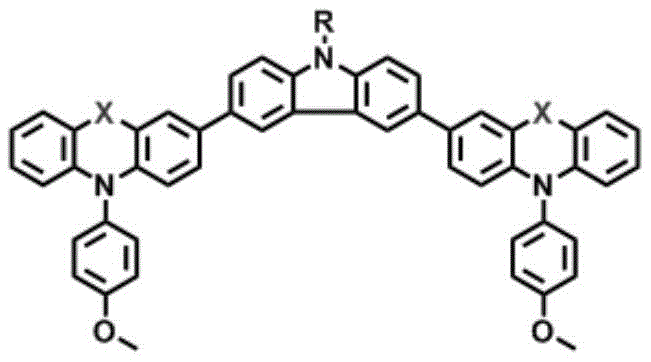
The Limitations of Conventional Methods vs. The Novel Approach
The Limitations of Conventional Methods
For years, the commercialization of perovskite solar cells has been bottlenecked by the reliance on Spiro-OMeTAD, a material plagued by complex multi-step synthesis and arduous purification requirements that drive its market price to approximately $500 per gram. Traditional synthetic routes for high-performance hole transporters often involve harsh reaction conditions, low overall yields, and the use of expensive precursors that are difficult to source in bulk quantities, creating significant supply chain vulnerabilities for manufacturers. Furthermore, the thermal stability and film-forming properties of legacy materials often require extensive doping with hygroscopic salts, which can compromise the long-term operational stability of the solar module under ambient conditions. These economic and technical barriers have prevented the widespread adoption of perovskite technology in utility-scale applications, necessitating a fundamental rethinking of molecular design strategies.
The Novel Approach
The patented methodology introduces a modular synthetic strategy that utilizes readily available carbazole, phenothiazine, and phenoxazine building blocks to construct the target molecules through efficient bond-forming reactions. By substituting the expensive spiro-core with a planar carbazole backbone and tuning the side chains with either n-hexyl or ethoxyethyl groups, the inventors have achieved a dramatic reduction in raw material costs without sacrificing electronic performance. The process eliminates the need for complex oxidative coupling steps often seen in spiro-compound synthesis, replacing them with reliable palladium-catalyzed protocols that are well-understood in industrial organic chemistry. This approach not only simplifies the purification workflow but also enhances the solubility and film-forming characteristics of the final material, leading to more uniform hole transport layers in device fabrication. 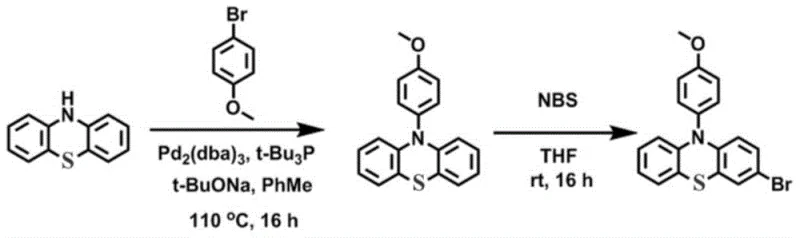
Mechanistic Insights into Suzuki-Miyaura Cross-Coupling for HTM Synthesis
The core of this synthetic innovation lies in the precise execution of the Suzuki-Miyaura cross-coupling reaction, which links the electron-rich carbazole core with the hole-transporting end groups. The mechanism initiates with the oxidative addition of the palladium(0) catalyst into the carbon-bromine bond of the phenothiazine or phenoxazine intermediate, forming a reactive organopalladium species. This is followed by transmetallation with the carbazole-derived bis-boronate ester, a step facilitated by the presence of a mild inorganic base such as cesium carbonate which activates the boron center. The final reductive elimination step releases the coupled product and regenerates the active palladium catalyst, allowing the cycle to continue with high turnover numbers. This catalytic cycle is particularly advantageous for scale-up because it tolerates various functional groups and proceeds under relatively mild thermal conditions, typically around 100°C in a toluene-water biphasic system. 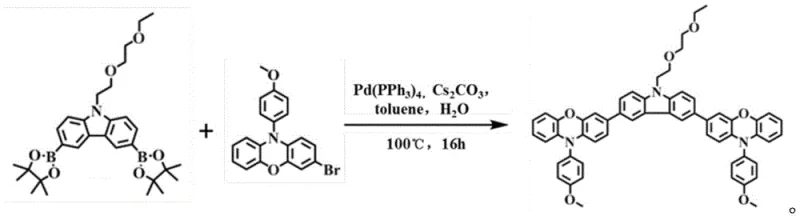
Impurity control is rigorously managed through the selection of specific ligands and reaction parameters that minimize homocoupling side reactions. The use of sterically bulky phosphine ligands on the palladium center helps to prevent the formation of undesired byproducts that could act as charge traps in the final solar cell device. Additionally, the purification protocol specified in the patent employs standard column chromatography with petroleum ether and ethyl acetate, a technique that effectively removes residual palladium species and unreacted starting materials to meet the stringent purity specifications required for electronic grade materials. The resulting compounds exhibit high thermal decomposition temperatures, with TM-6 stable up to 429°C, ensuring that the material integrity is maintained during the subsequent vacuum deposition or solution processing steps involved in device manufacturing.
How to Synthesize TM-6 Efficiently
The synthesis of the high-performing TM-6 variant involves a streamlined two-step sequence that begins with the functionalization of the carbazole core followed by the critical coupling event. The process is designed to maximize yield while minimizing the consumption of precious metal catalysts, making it highly suitable for kilogram-scale production runs. Detailed operational parameters regarding stoichiometry, solvent ratios, and workup procedures are critical for reproducing the high efficiency reported in the patent examples. For a comprehensive breakdown of the standardized operating procedures and safety protocols required for this synthesis, please refer to the technical guide below.
- Perform palladium-catalyzed boronation of 3,6-dibromo-9H-carbazole derivatives using bis(pinacolato)diboron and Pd(dppf)Cl2 in 1,4-dioxane at 90°C.
- Conduct Suzuki-Miyaura cross-coupling between the resulting carbazole bis-boronate ester and 3-bromo-10-(4-methoxyphenyl)-10H-phenothiazine or phenoxazine intermediates.
- Purify the final hole transport material via column chromatography using petroleum ether and ethyl acetate eluents to obtain high-purity electronic grade solids.
Commercial Advantages for Procurement and Supply Chain Teams
From a procurement perspective, the transition to these carbazole-based hole transport materials represents a strategic opportunity to drastically reduce the bill of materials for perovskite solar module production. The primary cost driver in traditional HTM procurement is the scarcity and complex synthesis of the spiro-core, whereas the carbazole and phenoxazine precursors utilized in this patent are commodity chemicals available from multiple global suppliers. This diversification of the supply base mitigates the risk of single-source dependency and allows procurement managers to negotiate more favorable pricing terms based on volume. Furthermore, the simplified synthetic route reduces the number of unit operations required in the manufacturing plant, directly translating to lower utility consumption and reduced labor costs per kilogram of finished product.
- Cost Reduction in Manufacturing: The patent explicitly highlights a massive disparity in production costs, noting that the TM-6 material can be produced at approximately $46.3/g compared to the $500/g benchmark of Spiro-OMeTAD. This order-of-magnitude cost advantage is achieved not by compromising quality, but by engineering a more efficient molecular architecture that relies on cheaper starting materials and higher-yielding reaction steps. Eliminating the need for expensive chiral resolution or complex oxidative dimerization further strips out cost from the manufacturing process, enabling a much healthier margin structure for downstream solar panel integrators.
- Enhanced Supply Chain Reliability: The reliance on robust, widely-used catalytic systems such as Pd(PPh3)4 and Pd(dppf)Cl2 ensures that the synthesis can be easily transferred to contract manufacturing organizations with existing infrastructure for fine chemical production. Unlike proprietary materials that require specialized equipment or hazardous reagents, this chemistry operates in common solvents like toluene and 1,4-dioxane, which are readily sourced and handled in standard pharmaceutical or electronic chemical facilities. This compatibility with existing industrial ecosystems significantly shortens the lead time for scaling up from laboratory grams to metric ton quantities, ensuring a continuous supply for high-volume manufacturing lines.
- Scalability and Environmental Compliance: The synthetic pathway generates fewer hazardous waste streams compared to traditional methods, as the byproducts are primarily inorganic salts that can be treated through standard wastewater protocols. The high thermal stability of the final products also reduces the risk of degradation during storage and transport, lowering the logistical costs associated with cold chain requirements. By adopting this greener and more efficient chemistry, companies can align their supply chains with increasingly strict environmental regulations while simultaneously improving their bottom line through operational efficiencies.
Frequently Asked Questions (FAQ)
The following questions address common technical and commercial inquiries regarding the implementation of these novel hole transport materials in perovskite solar cell production lines. The answers are derived directly from the experimental data and characterization results presented in the patent documentation to ensure accuracy and reliability for decision-makers.
Q: How does the cost of TM-6 compare to commercial Spiro-OMeTAD?
A: According to patent data, the production cost of TM-6 is approximately .3/g, which is significantly lower than the market price of Spiro-OMeTAD, reported at around 0/g, offering substantial economic advantages for large-scale manufacturing.
Q: What is the photoelectric conversion efficiency of devices using these new materials?
A: Devices utilizing the TM-6 hole transport material achieved a power conversion efficiency (PCE) of 21.03%, which surpasses the 20.74% efficiency observed in control devices using standard Spiro-OMeTAD.
Q: What catalytic system is used for the key coupling reaction?
A: The synthesis utilizes a palladium-catalyzed Suzuki-Miyaura cross-coupling protocol, specifically employing tetrakis(triphenylphosphine)palladium(0) [Pd(PPh3)4] as the catalyst and cesium carbonate as the base in a toluene-water solvent system.
Partnering with NINGBO INNO PHARMCHEM: Your Reliable TM-6 Supplier
As the global demand for renewable energy solutions accelerates, securing a dependable source of high-performance electronic chemicals is paramount for maintaining competitive advantage in the photovoltaic sector. NINGBO INNO PHARMCHEM stands ready to support your development and production needs with our extensive experience scaling diverse pathways from 100 kgs to 100 MT/annual commercial production. Our state-of-the-art facilities are equipped with rigorous QC labs capable of meeting the stringent purity specifications demanded by the semiconductor and solar industries, ensuring that every batch of hole transport material delivers consistent device performance. We understand the critical nature of supply continuity and are committed to providing a stable, high-quality supply of advanced materials like TM-6 to power your innovation.
We invite you to engage with our technical procurement team to discuss how we can tailor our manufacturing capabilities to your specific volume requirements and cost targets. By requesting a Customized Cost-Saving Analysis, you can gain deeper insights into how switching to our carbazole-based materials can optimize your overall production economics. Please contact us today to obtain specific COA data and route feasibility assessments that will demonstrate the tangible value of partnering with a leader in fine chemical synthesis.