
Scalable Synthesis of High-Efficiency D-A-D Cyanostyrene Hole Transport Materials for Next-Generation Photovoltaics
Introduction to Next-Generation Hole Transport Materials
The global transition towards renewable energy sources has intensified the research and development of high-performance photovoltaic technologies, with perovskite solar cells (PSCs) emerging as a frontrunner due to their exceptional power conversion efficiencies and low manufacturing costs. A critical component determining the overall performance and stability of these devices is the hole transport material (HTM), which facilitates the extraction and transport of positive charge carriers from the perovskite absorber layer. Traditional liquid electrolytes suffer from leakage and volatility issues, while commercially available solid-state HTMs like Spiro-OMeTAD often involve complex, multi-step syntheses and exorbitant costs. Addressing these challenges, the recent patent CN113200887B discloses a novel class of 'D-A-D' (Donor-Acceptor-Donor) type organic hole transport materials featuring a cyanostyrene parent nucleus. These materials, specifically designated as YJ01 and YJ02, offer a compelling balance of synthetic accessibility, structural tunability, and outstanding optoelectronic properties.
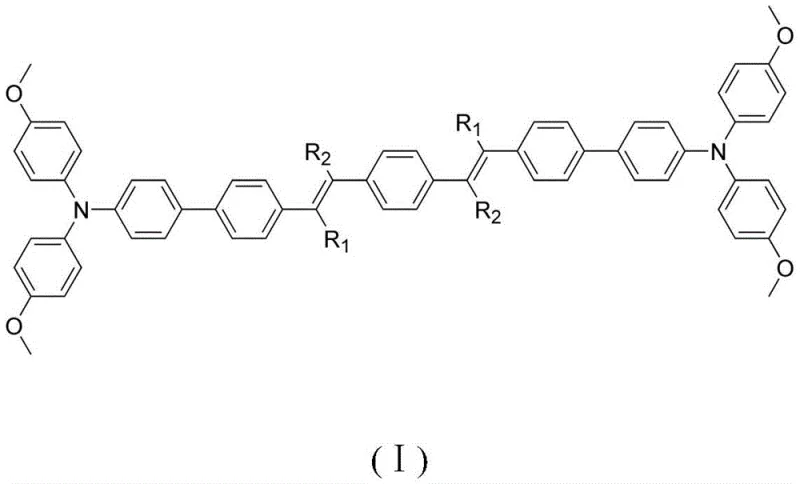
The core innovation lies in the strategic incorporation of the cyanostyrene group, which serves as a robust electron-accepting bridge connecting electron-rich triphenylamine donor units. This architectural design not only optimizes the energy level alignment with the perovskite layer but also enhances the thermal and morphological stability of the resulting thin films. In device testing, the inverted architecture utilizing YJ01 demonstrated a remarkable photoelectric conversion efficiency of 19.86%, significantly outperforming many conventional alternatives. For R&D directors and procurement specialists in the photovoltaic sector, this technology represents a viable pathway to reducing the levelized cost of energy (LCOE) by replacing expensive, scarce materials with efficiently synthesized organic semiconductors that do not compromise on device performance.
The Limitations of Conventional Methods vs. The Novel Approach
The Limitations of Conventional Methods
Historically, the commercialization of perovskite solar cells has been hindered by the limitations inherent in existing hole transport materials. The industry standard, Spiro-OMeTAD, requires a tedious synthetic route involving multiple purification steps, leading to high production costs and batch-to-batch variability that complicates quality control in mass manufacturing. Furthermore, to achieve high conductivity, Spiro-OMeTAD typically requires hygroscopic dopants like lithium bis(trifluoromethanesulfonyl)imide (Li-TFSI) and tert-butylpyridine (t-BP), which unfortunately accelerate the degradation of the perovskite layer upon exposure to moisture and heat. Liquid electrolyte-based systems, while initially offering good pore filling, pose severe reliability risks due to solvent evaporation and leakage, rendering them unsuitable for long-term outdoor deployment. These factors collectively create a bottleneck for the reliable electronic chemical supplier seeking to provide stable, high-volume solutions for the renewable energy market.
The Novel Approach
The methodology outlined in patent CN113200887B presents a transformative approach by utilizing a cyanostyrene-based D-A-D framework that circumvents the drawbacks of traditional HTMs. By modifying the position of the cyano (CN) groups on the styrene backbone, the inventors have created materials that exhibit high crystallinity and favorable molecular packing without the need for unstable dopants. The synthesis strategy relies on straightforward condensation and cross-coupling reactions that utilize abundant starting materials such as p-bromophenylacetonitrile and terephthalaldehyde. This simplifies the supply chain and drastically reduces the raw material costs compared to the complex spiro-backbones. Moreover, the resulting materials demonstrate excellent film-forming properties and intrinsic hole mobility, allowing for the fabrication of dopant-free or lightly doped devices that maintain high efficiency while offering superior environmental stability. This novel approach effectively bridges the gap between laboratory-scale high performance and industrial-scale manufacturability.
Mechanistic Insights into the D-A-D Molecular Architecture
The superior performance of YJ01 and YJ02 can be attributed to the precise engineering of their electronic structure through the D-A-D configuration. In this system, the terminal triphenylamine derivatives act as strong electron donors (D), while the central cyanostyrene unit functions as a potent electron acceptor (A). The presence of the electron-withdrawing cyano group on the vinyl bridge lowers the lowest unoccupied molecular orbital (LUMO) energy level and modulates the highest occupied molecular orbital (HOMO) level, ensuring efficient hole extraction from the perovskite valence band. This push-pull electronic effect promotes intramolecular charge transfer (ICT), which is crucial for enhancing the molar absorption coefficient and extending the spectral response. Additionally, the rigid planar structure induced by the cyanostyrene core facilitates π-π stacking interactions between adjacent molecules, creating continuous pathways for hole transport and minimizing charge recombination losses at the interface.
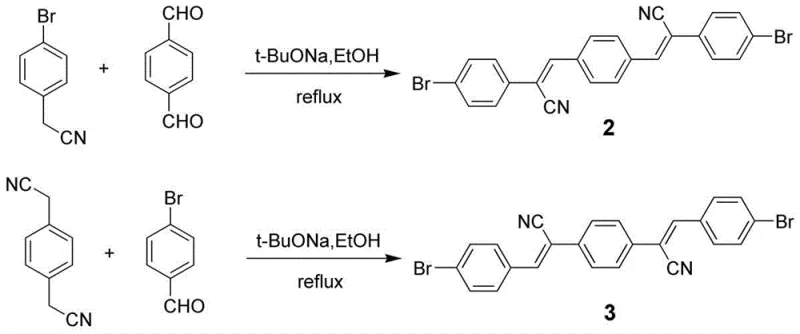
From a synthetic mechanistic perspective, the formation of the conjugated backbone is achieved through a base-catalyzed Knoevenagel condensation, as illustrated in the reaction scheme above. This reaction involves the nucleophilic attack of the carbanion generated from p-bromophenylacetonitrile (activated by sodium tert-butoxide) on the carbonyl carbon of terephthalaldehyde. The subsequent elimination of water yields the extended conjugated alkene linkage with high stereoselectivity, typically favoring the thermodynamically stable trans-isomer which is essential for linear charge transport. The use of ethanol as a solvent at reflux temperatures (78°C) ensures sufficient solubility of the reactants while driving the equilibrium towards product formation. This step is critical for establishing the rigid 'A' core, and the high yields reported (over 80%) indicate a robust process with minimal side reactions, ensuring a clean impurity profile that simplifies downstream purification and enhances the final device reproducibility.
How to Synthesize YJ01 Efficiently
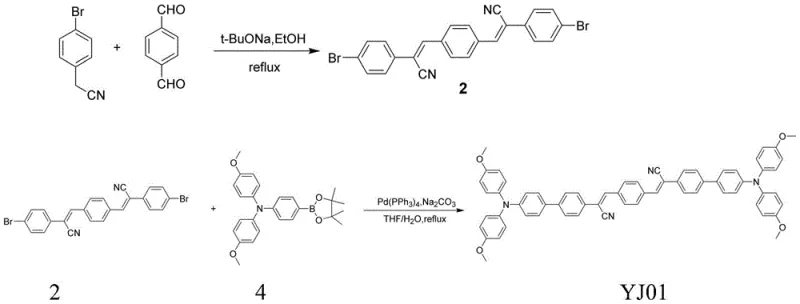
The practical realization of these advanced materials relies on a streamlined two-stage synthetic protocol that is amenable to both laboratory optimization and industrial scale-up. The process begins with the construction of the halogenated cyanostyrene intermediate, followed by a palladium-catalyzed cross-coupling with a boron-functionalized triphenylamine donor. This modular approach allows for the independent optimization of the core and the end-caps, providing flexibility to tune the material properties for specific device architectures. The reaction conditions are mild, utilizing standard laboratory equipment such as reflux condensers and Schlenk lines for inert atmosphere management, which lowers the barrier to entry for production facilities. Detailed operational parameters, including stoichiometry, temperature profiles, and workup procedures, are critical for maximizing yield and purity.
- Synthesize the cyanostyrene core intermediate (Intermediate 2) via Knoevenagel condensation of p-bromophenylacetonitrile and terephthalaldehyde using sodium tert-butoxide in ethanol at 78°C.
- Prepare the boronate ester donor unit (Intermediate 4) through palladium-catalyzed borylation of the corresponding bromo-triphenylamine precursor.
- Perform the final Suzuki-Miyaura coupling between Intermediate 2 and Intermediate 4 using Pd(PPh3)4 catalyst in a THF/Water system to yield the target D-A-D material YJ01.
Commercial Advantages for Procurement and Supply Chain Teams
For procurement managers and supply chain heads, the adoption of the cyanostyrene-based HTM technology offers significant strategic advantages over legacy materials. The primary benefit stems from the drastic simplification of the supply chain; the key precursors, such as bromobenzonitriles and benzaldehydes, are commodity chemicals produced on a multi-ton scale globally, ensuring a stable and resilient supply base that is not subject to the geopolitical or capacity constraints often associated with specialized fine chemicals. Furthermore, the synthetic route eliminates the need for cryogenic conditions or ultra-high vacuum processes, allowing for production in standard glass-lined or stainless steel reactors. This compatibility with existing infrastructure significantly reduces capital expenditure (CAPEX) for new production lines and accelerates the time-to-market for commercial products.
- Cost Reduction in Manufacturing: The economic viability of this technology is underpinned by the high atom economy of the Knoevenagel and Suzuki reactions employed. Unlike the multi-step synthesis of Spiro-OMeTAD which suffers from cumulative yield losses, this two-step process achieves high overall yields, directly translating to lower cost per gram of active material. The elimination of expensive dopants further reduces the bill of materials (BOM) for the final solar module. Additionally, the purification process relies on standard recrystallization and column chromatography techniques which are well-understood and easily scalable, avoiding the need for costly sublimation equipment often required for small molecule OLED materials. These factors combine to deliver substantial cost savings in electronic chemical manufacturing, making high-efficiency perovskite modules more competitive against silicon counterparts.
- Enhanced Supply Chain Reliability: The reliance on widely available petrochemical derivatives ensures that the production of YJ01 and YJ02 is not bottlenecked by rare earth elements or exotic reagents. The robustness of the chemical bonds formed (C-C and C=C) ensures that the intermediates and final products have excellent shelf-life stability, reducing waste due to material degradation during storage and transit. This stability allows for the maintenance of strategic inventory buffers without significant risk, thereby enhancing the reliability of the supply chain for downstream module manufacturers. The ability to source raw materials from multiple global vendors mitigates the risk of single-source dependency, providing procurement teams with greater negotiating power and supply security.
- Scalability and Environmental Compliance: The synthesis operates at atmospheric pressure and moderate temperatures, which inherently lowers the energy consumption of the manufacturing process compared to high-pressure hydrogenation or high-temperature pyrolysis routes. The use of ethanol and THF as solvents allows for efficient recovery and recycling through distillation, minimizing volatile organic compound (VOC) emissions and aligning with stringent environmental regulations. The high crystallinity of the product facilitates filtration and drying, reducing the solvent load in the waste stream. From a scale-up perspective, the exothermic nature of the condensation reaction is manageable with standard cooling jackets, and the heterogeneous catalysis in the coupling step allows for easy catalyst removal, ensuring the final product meets the rigorous purity specifications required for semiconductor applications without complex metal scavenging steps.
Frequently Asked Questions (FAQ)
The following questions address common technical and commercial inquiries regarding the implementation of cyanostyrene-based hole transport materials in photovoltaic applications. These insights are derived directly from the experimental data and claims presented in the patent literature, providing a factual basis for decision-making. Understanding these nuances is essential for R&D teams evaluating material integration and for business leaders assessing the commercial potential of this technology stack.
Q: What is the photoelectric conversion efficiency of devices using YJ01?
A: According to patent CN113200887B, inverted perovskite solar cell devices based on the ITO/YJ01/CH3NH3PbI3/PCBM61/Ag architecture achieved a power conversion efficiency of 19.86%, demonstrating superior performance compared to standard PEDOT controls.
Q: Why is the cyanostyrene core advantageous for hole transport materials?
A: The cyanostyrene moiety acts as a strong electron-accepting (A) unit in the D-A-D architecture. The cyano group enhances molecular planarity and intermolecular stacking, which facilitates efficient charge carrier mobility and improves the crystallinity of the hole transport layer.
Q: Is the synthesis of YJ01 suitable for large-scale production?
A: Yes, the synthesis utilizes robust and scalable reactions such as Knoevenagel condensation and Suzuki coupling. The process operates at moderate temperatures (78°C reflux) and uses readily available commodity chemicals, making it highly viable for commercial scale-up from kilograms to metric tons.
Partnering with NINGBO INNO PHARMCHEM: Your Reliable YJ01 Supplier
As the demand for high-efficiency perovskite solar cells continues to surge, securing a dependable supply of advanced hole transport materials is paramount for maintaining a competitive edge in the renewable energy sector. NINGBO INNO PHARMCHEM stands at the forefront of this evolution, leveraging our extensive experience scaling diverse pathways from 100 kgs to 100 MT/annual commercial production to bring innovations like the cyanostyrene-based YJ01 from the lab to the factory floor. Our state-of-the-art facilities are equipped with rigorous QC labs and stringent purity specifications, ensuring that every batch of material delivered meets the exacting standards required for high-performance optoelectronic devices. We understand that consistency is key in semiconductor manufacturing, and our robust quality management systems guarantee lot-to-lot reproducibility that minimizes device variability.
We invite forward-thinking enterprises to collaborate with us to unlock the full potential of next-generation photovoltaics. By partnering with our technical procurement team, you can access a Customized Cost-Saving Analysis tailored to your specific production volumes and integration requirements. We encourage you to reach out today to request specific COA data and route feasibility assessments, allowing us to demonstrate how our optimized synthesis of D-A-D hole transport materials can drive down your manufacturing costs while enhancing the efficiency and longevity of your solar energy solutions.