
Advanced Synthesis of Xanthene Ketone Intermediates for Global Agrochemical Compliance
The global agrochemical industry faces increasingly stringent regulatory pressures regarding impurity profiles in herbicide formulations, particularly for widely used products like mesotrione. Patent CN112939922A introduces a robust and economically viable synthesis method for 1-cyano-6-methylsulfonyl-7-nitro-9H-xanthene-9-one, a critical toxic impurity that must be strictly controlled to levels below 0.0002% (w/w) according to European standards. This technical breakthrough addresses the significant challenge of sourcing high-purity reference standards, which are essential for analytical validation and regulatory compliance. By utilizing 2-chloro-4-fluoro-5-nitrobenzoic acid as a cost-effective starting material, the disclosed route offers a practical alternative to inefficient extraction methods, ensuring that manufacturers can meet rigorous quality specifications without compromising supply continuity. For R&D directors and procurement specialists, understanding this synthetic pathway is vital for securing reliable sources of complex agrochemical intermediates.
The Limitations of Conventional Methods vs. The Novel Approach
The Limitations of Conventional Methods
Traditionally, obtaining specific trace impurities like 1-cyano-6-methylsulfonyl-7-nitro-9H-xanthene-9-one has been a logistical nightmare for quality control laboratories. In the standard production of mesotrione, this byproduct is generated in minute quantities, making isolation via extraction from the crude reaction mixture technically unfeasible and economically prohibitive. The low concentration means that vast amounts of parent drug would need to be processed to recover milligram quantities of the impurity, leading to excessive solvent waste and resource consumption. Furthermore, purification from such complex matrices often results in co-elution of structurally similar byproducts, failing to meet the high-purity standards required for analytical reference materials. This bottleneck frequently delays regulatory filings and complicates the validation of cleaning procedures in manufacturing facilities, creating significant supply chain vulnerabilities for agrochemical producers.
The Novel Approach
The methodology outlined in the patent data presents a streamlined, linear synthesis that bypasses the inefficiencies of extraction entirely. By constructing the xanthene core from simple, commercially available precursors, the process ensures a dedicated supply stream independent of the main herbicide production line. The route leverages classical organic transformations—nucleophilic substitution, esterification, copper-catalyzed coupling, oxidation, and cyclization—that are well-understood and easily scalable in industrial reactors. This approach not only guarantees the availability of the target molecule but also allows for precise control over isotopic labeling or structural modifications if needed for metabolic studies. For a reliable agrochemical intermediate supplier, adopting such a convergent synthesis strategy significantly enhances the ability to deliver high-purity materials with consistent batch-to-batch reproducibility.
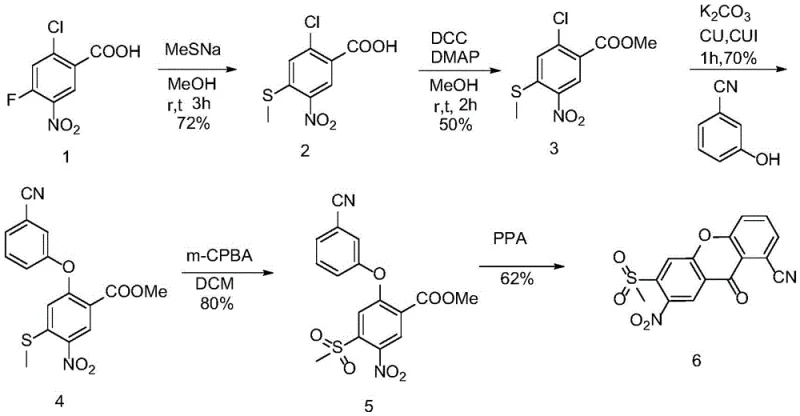
Mechanistic Insights into Copper-Catalyzed Etherification and Oxidative Cyclization
The heart of this synthetic strategy lies in the construction of the biaryl ether linkage and the subsequent formation of the tricyclic xanthene system. The third step involves a copper-catalyzed Ullmann-type coupling between the chloro-substituted benzoate and 3-hydroxybenzonitrile. In this mechanism, the copper catalyst facilitates the oxidative addition into the carbon-chlorine bond, followed by coordination with the phenoxide anion generated by the base. This creates a transient organocopper species that undergoes reductive elimination to forge the C-O bond, effectively stitching the two aromatic rings together. The use of a Cu/CuI dual catalyst system with potassium carbonate optimizes the electron transfer processes, minimizing homocoupling side reactions and ensuring high selectivity for the desired ether product. This step is crucial for establishing the correct substitution pattern required for the final cyclization.
Following the assembly of the linear precursor, the final transformation involves an intramolecular Friedel-Crafts acylation to close the central ring. Under strong acidic conditions provided by concentrated sulfuric acid or polyphosphoric acid (PPA), the ester carbonyl is activated towards electrophilic attack by the electron-rich aromatic ring ortho to the ether oxygen. This cyclization step is driven by the formation of the stable xanthene-9-one core, releasing methanol as a byproduct. The presence of the nitro and sulfone groups influences the electronics of the ring, requiring careful control of temperature and acid strength to prevent decomposition while driving the equilibrium towards the cyclic ketone. Understanding these mechanistic nuances allows process chemists to fine-tune reaction parameters, minimizing the formation of regioisomers and ensuring the final product meets the stringent purity specifications demanded by regulatory bodies.
How to Synthesize 1-cyano-6-methylsulfonyl-7-nitro-9H-xanthene-9-one Efficiently
Executing this synthesis requires precise control over reaction stoichiometry and purification techniques to maximize yield at each stage. The process begins with the nucleophilic displacement of fluorine by sodium methyl mercaptide, followed by esterification to protect the carboxylic acid functionality. Subsequent coupling and oxidation steps build the necessary complexity before the final ring closure. Each intermediate requires careful isolation, typically via column chromatography or crystallization, to prevent the carryover of impurities that could complicate downstream reactions. The detailed standardized synthesis steps see the guide below for specific operational parameters.
- Perform nucleophilic substitution on 2-chloro-4-fluoro-5-nitrobenzoic acid using sodium methyl mercaptide in methanol to obtain compound 2.
- Esterify compound 2 using DCC and DMAP in methanol to generate the methyl ester intermediate, compound 3.
- Execute a copper-catalyzed coupling reaction between compound 3 and 3-hydroxybenzonitrile using K2CO3 and Cu/CuI to form compound 4.
- Oxidize the methyl sulfide group in compound 4 to a sulfone using m-chloroperoxybenzoic acid (m-CPBA) in DCM to yield compound 5.
- Complete the synthesis by acid-catalyzed cyclization of compound 5 using concentrated sulfuric acid or PPA to form the final xanthene ketone structure.
Commercial Advantages for Procurement and Supply Chain Teams
For procurement managers and supply chain heads, the adoption of this synthetic route offers substantial strategic benefits beyond mere technical feasibility. The reliance on commodity chemicals such as 2-chloro-4-fluoro-5-nitrobenzoic acid and m-cyanophenol ensures that raw material costs remain stable and predictable, shielding the supply chain from the volatility associated with exotic reagents. By eliminating the need for complex extraction protocols, the manufacturing footprint is significantly reduced, lowering overhead costs related to solvent recovery and waste disposal. This efficiency translates directly into a more competitive pricing structure for the final reference standard, allowing agrochemical companies to allocate resources more effectively towards core R&D activities. Furthermore, the modular nature of the synthesis allows for flexible production scheduling, enabling suppliers to respond rapidly to fluctuating market demands without lengthy lead times.
- Cost Reduction in Manufacturing: The economic viability of this process is anchored in the use of inexpensive starting materials and the avoidance of precious metal catalysts often found in modern cross-coupling reactions. By utilizing copper powder and copper iodide, which are significantly cheaper than palladium or rhodium alternatives, the direct material cost is drastically simplified. Additionally, the high yields observed in the oxidation and substitution steps minimize the loss of valuable intermediates, reducing the overall cost per gram of the final product. This cost structure supports a sustainable business model where high-purity standards can be supplied at a fraction of the cost of custom-synthesized impurities derived from inefficient isolation methods.
- Enhanced Supply Chain Reliability: Supply continuity is critical for maintaining regulatory compliance, and this synthetic route mitigates risks associated with single-source dependencies. Since the starting materials are bulk chemicals produced by multiple global vendors, the risk of supply disruption due to vendor-specific issues is minimized. The robustness of the reaction conditions, which do not require ultra-low temperatures or inert atmospheres for every step, further enhances reliability by allowing production in a wider range of manufacturing facilities. This flexibility ensures that inventory levels can be maintained consistently, preventing bottlenecks in the quality control workflows of downstream herbicide manufacturers who rely on these standards for batch release testing.
- Scalability and Environmental Compliance: From an environmental and safety perspective, the process is designed with scalability in mind, utilizing solvents like methanol and dichloromethane that have established recovery and recycling protocols in modern chemical plants. The absence of highly toxic reagents or unstable intermediates reduces the hazard profile of the manufacturing process, simplifying permitting and safety audits. The waste streams generated are primarily organic salts and spent acids, which can be treated using standard neutralization and incineration procedures. This alignment with green chemistry principles not only reduces the environmental burden but also future-proofs the supply chain against tightening environmental regulations, ensuring long-term operational viability for the supplier.
Frequently Asked Questions (FAQ)
The following questions address common technical and commercial inquiries regarding the production and application of this specific xanthene derivative. These insights are derived directly from the patent specifications and are intended to clarify the capabilities of the manufacturing process for potential partners. Understanding these details is essential for integrating this intermediate into your quality assurance frameworks.
Q: Why is the synthesis of 1-cyano-6-methylsulfonyl-7-nitro-9H-xanthene-9-one critical for mesotrione production?
A: This compound is a toxic impurity generated during mesotrione manufacturing. European standards strictly limit its content to less than 0.0002% (w/w), necessitating reliable reference standards for quality control and regulatory registration.
Q: What are the key advantages of the patented synthesis route over extraction methods?
A: Since the impurity occurs in trace amounts during mesotrione production, extraction is not feasible. This patented method provides a scalable, economical synthetic route using cheap starting materials like 2-chloro-4-fluoro-5-nitrobenzoic acid, ensuring a consistent supply of high-purity reference material.
Q: How does the copper-catalyzed step impact the overall process efficiency?
A: The use of a Cu/CuI catalytic system with K2CO3 allows for efficient aryl ether formation under relatively mild thermal conditions (120-130°C). This avoids the need for more hazardous or expensive coupling reagents, simplifying the purification process and improving overall yield.
Partnering with NINGBO INNO PHARMCHEM: Your Reliable 1-cyano-6-methylsulfonyl-7-nitro-9H-xanthene-9-one Supplier
At NINGBO INNO PHARMCHEM, we recognize that the integrity of your agrochemical products depends on the quality of your reference standards. Our team possesses extensive experience scaling diverse pathways from 100 kgs to 100 MT/annual commercial production, ensuring that we can meet your volume requirements whether for initial method validation or routine QC testing. We operate stringent purity specifications and maintain rigorous QC labs equipped with advanced analytical instrumentation to verify the identity and purity of every batch. Our commitment to technical excellence ensures that the 1-cyano-6-methylsulfonyl-7-nitro-9H-xanthene-9-one we supply meets the exacting standards required for global regulatory submissions.
We invite you to collaborate with us to optimize your supply chain for mesotrione impurity standards. Contact our technical procurement team today to request a Customized Cost-Saving Analysis tailored to your specific volume needs. We are ready to provide specific COA data and route feasibility assessments to demonstrate how our manufacturing capabilities can support your long-term compliance and quality goals efficiently.