
Optimizing OXD-7 Production: A High-Yield Route for Advanced OLED Materials
The rapid evolution of the organic light-emitting diode (OLED) industry has placed immense pressure on the supply chain for high-performance electron transport materials. Among these, 2,2'-(1,3-phenylene)bis{5-[4-(1,1-dimethyl ethyl)phenyl]}-1,3,4-oxadiazole, commonly known as OXD-7, stands out as a critical component for blue-region emission due to its exceptional thermal stability and film-forming properties. Patent CN102285935A introduces a transformative synthetic methodology that addresses the historical bottlenecks of low yield and prolonged reaction times associated with traditional production routes. By optimizing the cyclodehydration step and refining the precursor preparation, this technology offers a robust pathway for generating high-purity electronic chemicals. For R&D directors and procurement strategists, understanding this shift is vital, as it directly impacts the cost structure and availability of reliable OLED material suppliers in the global market.
The Limitations of Conventional Methods vs. The Novel Approach
The Limitations of Conventional Methods
Prior to this innovation, the synthesis of OXD-7 relied heavily on inefficient multi-step processes that struggled to meet the demands of modern electronic chemical manufacturing. The conventional route, often cited in earlier literature, typically involved reacting p-tert-butyl benzoic acid directly with dibenzoyl hydrazine, resulting in a cumbersome three-step sequence that required approximately 22.5 hours to complete. More critically, the overall yield of this legacy method was abysmally low, hovering around merely 12.5%. Such poor efficiency not only inflated the cost of goods sold but also generated significant chemical waste, creating environmental compliance challenges and supply chain volatility. For procurement managers, relying on such outdated methodologies meant facing unpredictable lead times and inconsistent batch quality, which are unacceptable risks in the high-stakes display industry.
The Novel Approach
The patented methodology fundamentally reengineers the synthetic pathway to maximize atom economy and operational efficiency. By introducing a distinct acylation step using thionyl chloride to generate p-tert-butylbenzoyl chloride first, the reaction kinetics are significantly enhanced. This is followed by a controlled condensation with isophthalic dihydrazide and a final, highly effective cyclodehydration using a phosphorus oxychloride and phosphorus pentachloride system. The result is a dramatic reduction in total processing time to just 15 hours and a staggering increase in overall yield to 64.5%. This leap in performance transforms the economic viability of OXD-7 production, making cost reduction in electronic chemical manufacturing a tangible reality rather than a theoretical goal. The streamlined process ensures that high-purity OXD-7 can be produced with greater consistency and lower resource consumption.
Mechanistic Insights into Phosphorus-Mediated Cyclodehydration
The core of this technological breakthrough lies in the final cyclodehydration step, where the bis-hydrazide intermediate is converted into the stable 1,3,4-oxadiazole ring system. In this critical phase, phosphorus oxychloride (POCl3) acts as both the solvent and the dehydrating agent, while phosphorus pentachloride (PCl5) serves as a potent chlorinating catalyst to activate the carbonyl groups. The mechanism involves the initial formation of an imidoyl chloride intermediate, which subsequently undergoes intramolecular nucleophilic attack by the adjacent nitrogen atom. This cyclization is driven forward by the removal of water molecules, which are scavenged by the phosphorus species. Maintaining the reaction at reflux temperatures for 4 to 6 hours ensures complete conversion, minimizing the presence of unreacted hydrazide impurities that could otherwise quench excitons in the final OLED device.
Furthermore, the choice of reagents and conditions plays a pivotal role in controlling the impurity profile of the final product. The use of pyridine in the preceding acylation step effectively neutralizes hydrochloric acid byproducts, preventing the degradation of the sensitive hydrazide linkage. Subsequent washing of the dichloromethane solution with saturated sodium bicarbonate ensures the removal of residual acidic phosphorus species, which is crucial for achieving the reported purity levels of over 99.7%. For R&D teams focused on impurity谱 analysis, this rigorous workup protocol demonstrates a clear understanding of how trace metal or acid contaminants can degrade device lifetime. The structural integrity of the final molecule is confirmed through detailed NMR and elemental analysis, validating the efficacy of this catalytic system.
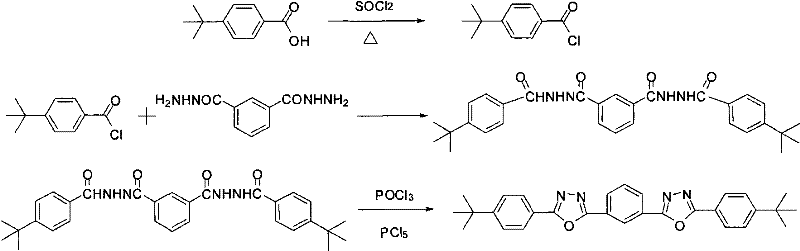
How to Synthesize 2,2'-(1,3-phenylene)bis{5-[4-(1,1-dimethyl ethyl)phenyl]}-1,3,4-oxadiazole Efficiently
Implementing this synthesis requires precise control over stoichiometry and temperature to replicate the high yields described in the patent data. The process begins with the activation of the carboxylic acid, followed by a低温 or reflux condensation depending on the desired reaction rate, and concludes with the rigorous dehydration cycle. Operators must pay close attention to the molar ratios, particularly the excess of thionyl chloride and phosphorus oxychloride, to drive the equilibrium towards the product. The following guide outlines the standardized operational parameters derived from the patent examples to ensure reproducibility and safety during scale-up.
- Preparation of p-tert-butylbenzoyl chloride via refluxing p-tert-butylbenzoic acid with thionyl chloride.
- Condensation of the acid chloride with isophthalic dihydrazide in pyridine to form the bis-hydrazide intermediate.
- Cyclodehydration of the intermediate using phosphorus oxychloride and phosphorus pentachloride under reflux to yield the final oxadiazole product.
Commercial Advantages for Procurement and Supply Chain Teams
For supply chain leaders, the transition to this optimized synthetic route represents a strategic opportunity to stabilize the sourcing of critical OLED intermediates. The drastic improvement in yield from 12.5% to 64.5% implies that significantly less raw material is required to produce the same amount of finished product, leading to substantial cost savings in procurement budgets. Moreover, the reduction in reaction time from nearly a full day to just 15 hours enhances the throughput capacity of existing manufacturing facilities without the need for capital-intensive equipment upgrades. This efficiency gain directly translates to improved supply continuity, reducing the risk of stockouts that can halt downstream panel production lines.
- Cost Reduction in Manufacturing: The elimination of inefficient reaction steps and the maximization of yield inherently lower the cost per kilogram of the final API intermediate. By avoiding the losses associated with the older 12.5% yield process, manufacturers can realize significant margin improvements. Additionally, the use of common industrial reagents like thionyl chloride and phosphorus oxychloride ensures that raw material costs remain stable and predictable, avoiding the price volatility often seen with exotic catalysts.
- Enhanced Supply Chain Reliability: The robustness of this three-step sequence allows for more accurate production planning and forecasting. Since the reaction conditions are well-defined and the reagents are readily available globally, the risk of supply disruption due to specialized chemical shortages is minimized. This reliability is essential for maintaining the just-in-time delivery schedules required by major display manufacturers, ensuring that the flow of high-purity oxadiazoles remains uninterrupted.
- Scalability and Environmental Compliance: The process is designed with scalability in mind, utilizing standard unit operations such as reflux, distillation, and recrystallization that are easily adapted from laboratory to pilot and commercial scales. Furthermore, the higher yield means less chemical waste is generated per unit of product, simplifying effluent treatment and helping facilities meet increasingly stringent environmental regulations. This alignment with green chemistry principles enhances the long-term sustainability of the supply chain.
Frequently Asked Questions (FAQ)
The following questions address common technical and commercial inquiries regarding the production and application of OXD-7 based on the patented methodology. These insights are derived directly from the experimental data and process descriptions found in the intellectual property documentation. Understanding these details helps stakeholders make informed decisions regarding vendor qualification and material specification.
Q: What is the primary advantage of the new synthesis method for OXD-7 compared to prior art?
A: The patented method significantly improves the overall reaction yield from 12.5% to 64.5% and reduces the total reaction time from 22.5 hours to 15 hours, offering substantial efficiency gains for industrial production.
Q: What purity levels can be achieved with this synthesis route?
A: Through optimized recrystallization steps, the process consistently achieves product purity exceeding 99.7%, which is critical for high-performance organic electroluminescent devices.
Q: Is this process suitable for large-scale commercial manufacturing?
A: Yes, the process utilizes standard industrial reagents like thionyl chloride and phosphorus oxychloride, and the simplified workflow enhances scalability for producing complex oxadiazole derivatives.
Partnering with NINGBO INNO PHARMCHEM: Your Reliable OXD-7 Supplier
As the demand for high-efficiency OLED materials continues to surge, partnering with a manufacturer who masters advanced synthetic pathways is essential for maintaining a competitive edge. NINGBO INNO PHARMCHEM leverages extensive experience scaling diverse pathways from 100 kgs to 100 MT/annual commercial production to deliver OXD-7 with unmatched consistency. Our facility is equipped with rigorous QC labs and adheres to stringent purity specifications, ensuring that every batch meets the exacting standards required for next-generation display technologies. We understand that in the electronic materials sector, purity is not just a metric but a prerequisite for device performance.
We invite procurement directors and technical leads to engage with our team for a Customized Cost-Saving Analysis tailored to your specific volume requirements. By collaborating with our technical procurement team, you can access specific COA data and route feasibility assessments that demonstrate how our optimized processes can enhance your supply chain resilience. Contact us today to discuss how we can support your roadmap for advanced organic electroluminescent materials.