
Advanced Ionic Liquid Catalysis for Scalable Production of Disubstituted 1,6-Dihydropyrrolo[2,3-g]indazole Derivatives
The pharmaceutical industry is constantly seeking more efficient and sustainable pathways for synthesizing complex heterocyclic scaffolds, particularly those serving as critical intermediates for kinase inhibitors and other targeted therapies. Patent CN116332943A presents a significant technological breakthrough in this domain by disclosing a novel preparation method for disubstituted 1,6-dihydropyrrolo[2,3-g]indazole derivatives. This specific class of nitrogen-containing fused heterocycles has garnered immense attention due to its potent biological activities, including applications in PIM kinase inhibitors and soluble guanylate cyclase blockers. The core innovation lies in the replacement of conventional corrosive organic acids with a specialized Brønsted acidic ionic liquid catalyst. This shift not only addresses the longstanding issues of equipment corrosion and environmental pollution associated with traditional acetic acid-catalyzed methods but also dramatically enhances the reaction kinetics and product isolation efficiency. By utilizing a dual-sulfonated imidazolium-based ionic liquid in an ethanol solvent system, the process achieves high yields and exceptional purity under mild reflux conditions, marking a substantial step forward in green chemistry for pharmaceutical intermediates.
![General reaction scheme for the synthesis of disubstituted 1,6-dihydropyrrolo[2,3-g]indazole derivatives using ionic liquid catalysis](/insights/img/disubstituted-pyrroloindazole-synthesis-pharma-supplier-20260306220226-01.webp)
The transition from legacy synthetic routes to this novel ionic liquid-mediated protocol represents a paradigm shift in process chemistry for heterocyclic compounds. Conventional methods, such as the one reported by Chen Dongsheng et al. in 2023, typically rely on acetic acid as a catalyst in refluxing ethanol. While operationally simple, these traditional approaches suffer from significant drawbacks that hinder their scalability and economic viability for industrial applications. The primary limitation is the corrosive nature of acetic acid, which necessitates the use of expensive corrosion-resistant reactor materials and leads to frequent maintenance downtime. Furthermore, the separation of the catalyst from the product is often energy-intensive, and the catalyst itself cannot be effectively recycled, leading to substantial chemical waste and increased raw material costs. In contrast, the novel approach detailed in the patent utilizes a task-specific ionic liquid that acts as both a solvent modifier and a highly active acid catalyst. This system allows for the direct crystallization of the product upon cooling, simplifying the work-up procedure to a mere filtration and washing step. The non-volatile nature of the ionic liquid ensures that it remains in the mother liquor, facilitating straightforward recovery and reuse, thereby aligning perfectly with the principles of atom economy and waste reduction required for modern cost reduction in pharmaceutical manufacturing.
Mechanistic Insights into Brønsted Acidic Ionic Liquid Catalysis
The superior performance of this synthetic route can be attributed to the unique structural features and dual-activation capability of the chosen Brønsted acidic ionic liquid. The catalyst features a parent structure where two imidazolyl rings are connected by a long alkyl chain, with each ring functionalized with a sulfonic acid group. This bifunctional design creates a robust hydrogen-bonding network that effectively activates the carbonyl groups of both the 4-hydroxy-2H-chromen-2-one and the arylglyoxal monohydrate simultaneously. The proton donation from the sulfonic acid groups increases the electrophilicity of the carbonyl carbons, facilitating the nucleophilic attack by the amine group of the 1H-indazol-6-amine. This cooperative activation lowers the activation energy of the rate-determining steps, allowing the reaction to proceed rapidly at reflux temperatures (typically completing within 36 to 59 minutes). Moreover, the ionic environment provided by the liquid salt stabilizes the polar transition states and intermediates, further driving the equilibrium towards the desired product.
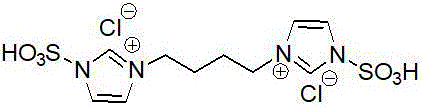
From an impurity control perspective, the high selectivity of this catalytic system is paramount for producing high-purity pharmaceutical intermediates suitable for downstream drug synthesis. Traditional acid catalysts often promote uncontrolled polymerization or side reactions due to their harsh acidity and lack of specific interaction with the substrates. However, the structured nature of the ionic liquid imposes a degree of steric and electronic control over the reaction pathway. The specific arrangement of the sulfonate groups and the imidazolium cations creates a microenvironment that favors the formation of the fused pyrroloindazole ring system while suppressing competing condensation reactions. This results in crude products with HPLC purities consistently exceeding 99%, as evidenced by the experimental data where products like 4-hydroxy-3-(7-phenyl-1,6-dihydropyrrolo[2,3-g]indazol-8-yl)-2H-chromen-2-one were obtained with 99.4% purity directly after filtration. Such high initial purity significantly reduces the burden on quality control laboratories and eliminates the need for resource-intensive purification techniques like column chromatography, which are often bottlenecks in process development.
How to Synthesize Disubstituted 1,6-Dihydropyrrolo[2,3-g]indazole Derivatives Efficiently
The operational simplicity of this method makes it highly attractive for both laboratory scale-up and industrial production. The process involves a straightforward one-pot three-component reaction where the stoichiometric ratios of the reactants are carefully balanced to maximize conversion. Typically, a molar ratio of 1:1:1 for the chromenone, indazole amine, and arylglyoxal is employed, with the ionic liquid catalyst loaded at 2-5% relative to the total moles of reactants. The reaction is conducted in ethanol, a green and inexpensive solvent, which also aids in the crystallization of the product upon cooling. The detailed standardized synthesis steps, including precise temperature controls and work-up procedures, are outlined below to ensure reproducibility and safety.
- Combine 4-hydroxy-2H-chromen-2-one, 1H-indazol-6-amine, and arylglyoxal monohydrate in ethanol with 2-5% molar equivalent of the specific bis-sulfonated imidazolium ionic liquid catalyst.
- Heat the reaction mixture to reflux using an oil bath for 36 to 59 minutes until TLC indicates complete consumption of starting materials.
- Cool the mixture to room temperature to induce crystallization, filter the solid product, wash with ethanol, and dry under vacuum at 85°C.
Commercial Advantages for Procurement and Supply Chain Teams
For procurement managers and supply chain directors, the adoption of this ionic liquid technology offers tangible strategic benefits beyond mere chemical yield. The primary advantage lies in the drastic simplification of the supply chain for catalysts and the reduction of hazardous waste disposal costs. Traditional processes relying on mineral acids or volatile organic acids require complex neutralization and wastewater treatment protocols, which add significant overhead to the cost of goods sold. By implementing a recyclable ionic liquid system, the volume of chemical waste generated per kilogram of product is substantially reduced. Furthermore, the ability to regenerate the catalyst system means that the effective cost of the catalyst per batch decreases exponentially over time, providing a clear pathway for cost reduction in API manufacturing. The mild reaction conditions also imply lower energy consumption for heating and cooling, contributing to a smaller carbon footprint and aligning with corporate sustainability goals.
- Cost Reduction in Manufacturing: The elimination of expensive corrosion-resistant equipment and the reduction in waste treatment fees directly impact the bottom line. Since the catalyst can be reused multiple times without significant loss of activity, the recurring cost of catalytic materials is minimized. Additionally, the high purity of the crude product reduces the need for secondary purification solvents and silica gel, further lowering material costs.
- Enhanced Supply Chain Reliability: The robustness of the catalytic system ensures consistent batch-to-batch quality, which is critical for maintaining regulatory compliance in pharmaceutical production. The use of commercially available and stable starting materials, combined with a catalyst that does not degrade rapidly, mitigates the risk of production delays caused by reagent instability or supply shortages. This reliability is essential for reducing lead time for high-purity pharmaceutical intermediates.
- Scalability and Environmental Compliance: The process is inherently scalable due to the homogeneous nature of the catalytic system and the use of ethanol as a solvent, which is well-understood in large-scale operations. The non-volatile nature of the ionic liquid reduces emissions of volatile organic compounds (VOCs), making it easier to meet stringent environmental regulations. This facilitates the commercial scale-up of complex heterocyclic intermediates without requiring major modifications to existing infrastructure.
Frequently Asked Questions (FAQ)
To assist technical teams in evaluating the feasibility of this technology for their specific projects, we have compiled answers to common questions regarding the catalyst's performance, regeneration, and substrate scope. These insights are derived directly from the experimental data provided in the patent documentation, ensuring accuracy and relevance for process chemists.
Q: What are the advantages of using Brønsted acidic ionic liquids over traditional acetic acid catalysts?
A: Unlike traditional acetic acid which causes severe equipment corrosion and cannot be easily recycled, the Brønsted acidic ionic liquid described in CN116332943A offers high catalytic activity, minimal equipment corrosion, and can be recycled and regenerated multiple times without significant loss in yield or purity.
Q: How does this method improve the purity of the final pharmaceutical intermediate?
A: The high selectivity of the ionic liquid catalytic system minimizes side reactions and by-product formation. This results in crude products with HPLC purity often exceeding 99%, eliminating the need for complex purification steps like column chromatography.
Q: Can the catalytic system be reused for large-scale manufacturing?
A: Yes, the filtrate containing the catalyst and solvent can be directly reused for up to 5-6 cycles. Once performance declines, the system can be regenerated through a simple extraction and distillation process, ensuring long-term supply chain stability.
Partnering with NINGBO INNO PHARMCHEM: Your Reliable Disubstituted 1,6-Dihydropyrrolo[2,3-g]indazole Derivative Supplier
The technological advancements described in CN116332943A highlight the immense potential of ionic liquid catalysis in modernizing the synthesis of bioactive heterocycles. At NINGBO INNO PHARMCHEM, we recognize the value of such innovative processes and have integrated similar green chemistry principles into our own manufacturing platforms. As a leading CDMO partner, we possess extensive experience scaling diverse pathways from 100 kgs to 100 MT/annual commercial production, ensuring that our clients receive a consistent and reliable supply of critical intermediates. Our facilities are equipped with rigorous QC labs and adhere to stringent purity specifications, guaranteeing that every batch meets the highest standards required for pharmaceutical applications. We are committed to delivering not just chemicals, but comprehensive solutions that enhance your R&D efficiency and supply chain resilience.
We invite you to explore how our expertise in advanced catalytic methods can accelerate your drug development programs. For a Customized Cost-Saving Analysis tailored to your specific project needs, please contact our technical procurement team. We are ready to provide specific COA data and route feasibility assessments to demonstrate how our optimized processes can drive value for your organization. Let us collaborate to bring your next generation of therapeutics to market faster and more efficiently.