
Advanced Friedel-Crafts Synthesis of 2-Amino-3-Methyl-4-Methoxy Acetophenone for Commercial Scale
Introduction to Next-Generation Intermediate Synthesis
The pharmaceutical industry constantly seeks robust synthetic routes that balance high purity with economic viability, particularly for critical intermediates like 2-amino-3-methyl-4-methoxy acetophenone. Patent CN101987825B introduces a transformative methodology that addresses longstanding inefficiencies in producing this key building block, which is essential for synthesizing anti-hepatitis B, anti-AIDS, and antitumor agents. By shifting away from traditional high-energy pyroreactions toward a catalyzed Friedel-Crafts acylation, this technology offers a streamlined pathway that significantly enhances operational efficiency. The core innovation lies in the strategic use of boron trichloride combined with other Lewis acids to activate the aromatic ring under mild conditions, effectively bypassing the need for subsequent hydrolysis steps that have historically plagued production lines. This technical advancement not only simplifies the workflow but also establishes a new benchmark for yield and purity in the manufacturing of complex aniline derivatives.
The Limitations of Conventional Methods vs. The Novel Approach
The Limitations of Conventional Methods
Historically, the synthesis of 2-amino-3-methyl-4-methoxy acetophenone relied heavily on the reaction of the corresponding aniline derivative with acetonitrile under prolonged high-temperature conditions. This conventional route, often referenced in prior art such as WO2007014926, suffers from inherent thermodynamic and kinetic limitations that result in suboptimal conversion rates, typically hovering around a mere 46%. Furthermore, the process necessitates a cumbersome hydrolysis step to convert the intermediate nitrile into the desired ketone, introducing additional unit operations that consume significant time and energy. Post-reaction purification in these legacy methods frequently demands silica gel column chromatography or extensive washing with large volumes of alkaline solutions, creating substantial waste streams and driving up the overall cost of goods sold. These factors collectively render the traditional approach unsuitable for modern, large-scale industrial applications where throughput and environmental compliance are paramount concerns for supply chain managers.
The Novel Approach
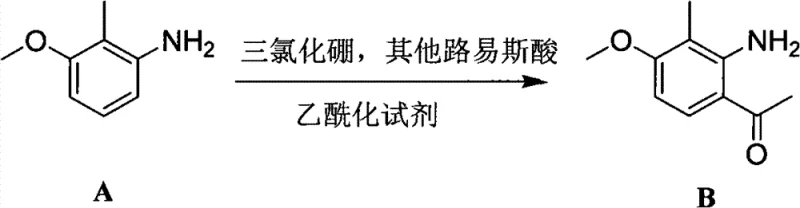
In stark contrast, the novel methodology detailed in the patent utilizes a direct Friedel-Crafts acylation strategy that fundamentally restructures the synthetic logic. By employing boron trichloride alongside secondary Lewis acids such as aluminum chloride, the reaction proceeds efficiently in organic solvents like methylene dichloride at controlled low temperatures ranging from -60°C to 40°C. This catalytic system activates the acetylation reagent, whether it be acetyl chloride or acetic anhydride, allowing for direct substitution on the aromatic ring without the need for a separate hydrolysis phase. The elimination of the hydrolysis step not only shortens the total processing time but also drastically reduces the consumption of solvents and reagents associated with workup procedures. As illustrated in the reaction scheme below, the transformation from Compound A to Compound B is achieved in a single pot with remarkable efficiency, paving the way for a more sustainable and cost-effective manufacturing process.
Mechanistic Insights into Boron Trichloride-Catalyzed Acylation
The success of this synthetic route hinges on the unique coordination chemistry facilitated by boron trichloride, which acts as a potent Lewis acid capable of forming stable complexes with the amino group of the starting material. This initial complexation serves a dual purpose: it protects the sensitive amino functionality from unwanted oxidation or side reactions during the acylation process, and it modulates the electron density of the aromatic ring to favor ortho-substitution. When the acetylation reagent is introduced in the presence of a co-catalyst like aluminum chloride, a highly reactive acylium ion species is generated in situ, which attacks the activated aromatic ring with high regioselectivity. The synergy between boron trichloride and the secondary Lewis acid ensures that the reaction kinetics are favorable even at reduced temperatures, preventing the thermal degradation of the product that often occurs in high-heat processes. This precise control over the reaction environment is critical for maintaining the structural integrity of the molecule and ensuring that the final product meets the stringent quality specifications required for pharmaceutical applications.
From an impurity control perspective, the mechanism inherently minimizes the formation of by-products that are difficult to separate. Traditional methods often generate tarry residues or polymeric side products due to the harsh conditions, necessitating aggressive purification techniques. However, the mild acidic conditions of this novel protocol promote a cleaner reaction profile, where the primary impurities are easily removed through simple aqueous workup and recrystallization. The ability to tune the molar ratios of the catalysts, specifically maintaining a boron trichloride to substrate ratio between 1.2:1 and 1.5:1, allows process chemists to optimize the balance between reaction rate and selectivity. This level of mechanistic understanding empowers R&D teams to troubleshoot potential scale-up issues proactively, ensuring that the transition from benchtop to pilot plant maintains the high fidelity observed in laboratory experiments.
How to Synthesize 2-Amino-3-Methyl-4-Methoxy Acetophenone Efficiently
Implementing this synthesis in a production environment requires strict adherence to the optimized parameters regarding temperature gradients and reagent addition rates to maximize yield and safety. The process begins with the formation of the boron trichloride complex under inert atmosphere, followed by the controlled addition of the acylating agent at cryogenic temperatures to manage the exotherm. Detailed standard operating procedures for this specific transformation, including precise quenching and isolation steps, are essential for reproducibility and operator safety. For a comprehensive breakdown of the standardized synthesis steps, please refer to the technical guide below.
- Under inert gas protection, dissolve Compound A in an organic solvent such as methylene dichloride and cool to -10°C. Add boron trichloride solution to form a complex compound.
- Cool the mixture further to -50°C and add the acetylation reagent (e.g., acetyl chloride) along with a secondary Lewis acid catalyst like aluminum chloride.
- Stir the reaction while gradually warming to room temperature and then refluxing. Quench with ice water, adjust pH, extract, and purify the final product via recrystallization.
Commercial Advantages for Procurement and Supply Chain Teams
For procurement managers and supply chain directors, the adoption of this patented methodology represents a significant opportunity to optimize the cost structure and reliability of the supply chain for critical pharmaceutical intermediates. By eliminating the need for column chromatography and reducing the reliance on large volumes of alkali for cleaning, the process inherently lowers the consumption of consumables and waste disposal costs. The simplified workflow translates directly into reduced manufacturing lead times, allowing for faster turnover of batches and improved responsiveness to market demand fluctuations. Furthermore, the use of commercially available and inexpensive reagents such as acetyl chloride and aluminum chloride mitigates the risk of raw material shortages that can plague supply chains dependent on specialized or exotic catalysts.
- Cost Reduction in Manufacturing: The most immediate financial benefit arises from the drastic simplification of the purification process. Traditional routes require expensive silica gel columns or extensive solvent washes, both of which contribute heavily to the variable cost per kilogram. By replacing these with a straightforward recrystallization using petroleum ether and ethyl acetate, the new method achieves substantial cost savings without compromising on quality. Additionally, the higher yields observed in optimized embodiments, reaching up to 94.4%, mean that less starting material is wasted, further driving down the effective cost of the active pharmaceutical ingredient precursor.
- Enhanced Supply Chain Reliability: Supply continuity is often threatened by complex processes that are prone to failure or batch-to-batch variability. This robust Friedel-Crafts protocol operates under mild conditions that are easier to control in large reactors, reducing the likelihood of batch failures due to thermal runaway or incomplete reactions. The reliance on commodity chemicals for catalysis ensures that the supply of reagents remains stable even during global market disruptions, providing a secure foundation for long-term production planning and inventory management strategies.
- Scalability and Environmental Compliance: As regulatory pressures regarding industrial waste increase, the ability to minimize solvent usage and hazardous by-products becomes a competitive advantage. This process generates significantly less waste compared to the hydrolysis-based alternatives, aligning with green chemistry principles and reducing the burden on wastewater treatment facilities. The scalability is further supported by the fact that the reaction does not require extreme pressures or temperatures, making it compatible with standard glass-lined or stainless steel reactors found in most multipurpose chemical manufacturing plants.
Frequently Asked Questions (FAQ)
Understanding the technical nuances of this synthesis is vital for stakeholders evaluating its integration into existing production portfolios. The following questions address common concerns regarding process safety, purity profiles, and scalability, drawing directly from the experimental data and technical specifications outlined in the patent documentation. These insights are intended to provide clarity on how this method compares to legacy technologies and what expectations partners should have regarding performance metrics.
Q: How does this new method improve upon the traditional acetonitrile pyroreaction route?
A: The traditional method requires long-time pyroreaction followed by a hydrolysis step, resulting in low conversion rates around 46% and complex post-treatment. The novel Friedel-Crafts approach utilizes direct acylation with boron trichloride catalysis, achieving yields up to 94.4% without the need for hydrolysis or column chromatography.
Q: What are the critical reaction conditions for maintaining high purity?
A: Maintaining strict temperature control is essential, starting at -10°C for complex formation and dropping to -50°C during reagent addition. The use of inert gas protection and specific molar ratios of boron trichloride to Compound A (preferably 1.2:1 to 1.5:1) ensures minimal side reactions and high product purity exceeding 90%.
Q: Is this process suitable for large-scale industrial manufacturing?
A: Yes, the process is designed for industrial suitability by replacing expensive and time-consuming purification steps like silica gel column separation with simple recrystallization using petroleum ether and ethyl acetate. The mild reaction conditions and readily available reagents facilitate easy scale-up from laboratory to commercial production.
Partnering with NINGBO INNO PHARMCHEM: Your Reliable 2-Amino-3-Methyl-4-Methoxy Acetophenone Supplier
At NINGBO INNO PHARMCHEM, we recognize that the transition to a superior synthetic route is only valuable if it can be executed with precision and consistency at scale. Our team possesses extensive experience scaling diverse pathways from 100 kgs to 100 MT/annual commercial production, ensuring that the theoretical benefits of this patent are fully realized in your supply chain. We maintain stringent purity specifications through our rigorous QC labs, guaranteeing that every batch of 2-amino-3-methyl-4-methoxy acetophenone meets the exacting standards required for downstream drug synthesis. Our commitment to technical excellence means we can adapt this Friedel-Crafts methodology to fit your specific capacity requirements while maintaining full regulatory compliance.
We invite you to engage with our technical procurement team to discuss how this advanced manufacturing process can drive value for your organization. By requesting a Customized Cost-Saving Analysis, you can quantify the potential economic impact of switching to this high-yield route. We encourage you to contact us today to obtain specific COA data and route feasibility assessments tailored to your project timelines, ensuring a seamless partnership that accelerates your development goals.