
Advanced Fragment Coupling Strategy for High-Purity Chlorotoxin Manufacturing
The pharmaceutical industry's relentless pursuit of effective oncology therapeutics has placed significant spotlight on Chlorotoxin, a potent 36-amino acid peptide derived from the venom of the scorpion Leiurus quinquestriatus. Known for its unique ability to specifically bind to tumor cells, particularly glioblastomas and metastatic tumors, Chlorotoxin serves as a critical targeting agent for delivering cytotoxic drugs and imaging isotopes. However, the commercial realization of Chlorotoxin-based therapies has historically been hindered by the limitations of biological fermentation methods, which often struggle with low yields and complex downstream purification. Addressing these critical bottlenecks, the recent patent CN114230653B, published in early 2023, introduces a groundbreaking preparation method that combines solid-phase fragment synthesis with liquid-phase cyclization. This technical breakthrough not only streamlines the synthetic route but also achieves a total yield exceeding 25 percent and a purity greater than 99 percent, setting a new benchmark for the reliable supply of high-purity peptide intermediates in the global market.
The Limitations of Conventional Methods vs. The Novel Approach
The Limitations of Conventional Methods
Traditionally, the synthesis of long-chain polypeptides like Chlorotoxin has relied heavily on stepwise solid-phase peptide synthesis (SPPS), where amino acids are added one by one to a growing chain anchored on a resin. While conceptually straightforward, this approach faces severe diminishing returns as the chain length increases. In the context of a 36-residue peptide, the cumulative effect of incomplete couplings at each step leads to a proliferation of deletion sequences and truncated byproducts. As highlighted in the background art of the patent, conventional stepwise methods often result in dismal overall yields, typically hovering around 8 percent, necessitating extensive and costly purification efforts to isolate the active pharmaceutical ingredient. Furthermore, the steric hindrance encountered during the coupling of bulky residues in the middle of a long chain can lead to racemization and aggregation, complicating the impurity profile and jeopardizing the safety standards required for clinical applications.
The Novel Approach
The methodology disclosed in patent CN114230653B fundamentally reengineers the synthesis logic by adopting a convergent fragment condensation strategy. Instead of a linear addition of 36 amino acids, the Chlorotoxin sequence is strategically divided into four distinct segments: residues 1-5, 6-9, 10-13, and 14-36. This segmentation allows for the independent optimization of each fragment, ensuring high purity before the final assembly. The process initiates with the solid-phase synthesis of the largest fragment (residues 14-36) directly on the resin, followed by the sequential coupling of the smaller, pre-synthesized fragments. This hybrid solid-liquid approach drastically reduces the number of on-resin cycles, thereby minimizing the accumulation of side reactions. The result is a robust manufacturing process that significantly shortens the synthesis period while delivering a product with superior homogeneity, effectively solving the yield and purity issues that have long plagued the cost reduction in pharmaceutical intermediate manufacturing.
Mechanistic Insights into Fragment Condensation and Oxidative Cyclization
The core innovation of this synthesis lies in the precise management of protecting groups and the strategic order of fragment assembly. The process utilizes standard Fmoc chemistry, where the C-terminal fragment (14-36) is built on an AM Resin with a substitution degree of roughly 0.316 mmol/g. Critical to the success of this route is the selection of orthogonal protecting groups for the reactive side chains; for instance, Arginine residues are protected with Pbf groups, Lysine with Boc, and the eight Cysteine residues crucial for structural integrity are protected with Trt (trityl) groups. The smaller fragments (B, C, and D) are synthesized separately using similar Fmoc protocols and activated for coupling using reagents such as HOBt and DIC in DMF solvent. This modular assembly ensures that the difficult couplings, which often occur in the hydrophobic regions of the peptide, are performed in solution or on shorter chains where steric hindrance is manageable, thus preserving the stereochemical integrity of the amino acids.
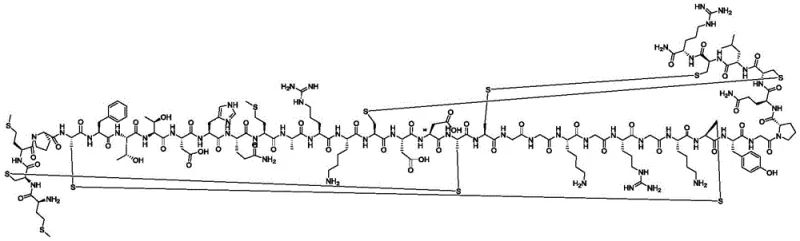
Following the assembly of the full linear peptide chain on the resin, the molecule undergoes global deprotection and cleavage using a cocktail of TFA, EDT, TIS, and water. The resulting linear crude product must then navigate the most complex stage of the synthesis: the formation of the four native disulfide bridges (Cys2-Cys19, Cys5-Cys28, Cys16-Cys33, and Cys20-Cys35). The patent specifies a liquid-phase oxidative cyclization performed in a buffered aqueous system containing reduced and oxidized glutathione at a pH of 7.5 to 8.0. This redox environment facilitates the thermodynamic shuffling of disulfide bonds, guiding the peptide towards its native, biologically active conformation. The structural complexity of Chlorotoxin, with its intricate network of sulfur bridges, is visualized below, underscoring why a controlled cyclization environment is paramount for achieving the requisite bioactivity.
The final purification is achieved via Prep-HPLC using a reversed-phase C18 column with a gradient elution of acetic acid and acetonitrile. This rigorous downstream processing ensures that the final Chlorotoxin product meets the stringent purity specifications of >99 percent, making it suitable for conjugation with radioisotopes or cytotoxic agents. By decoupling the synthesis into fragments and optimizing the oxidation conditions, this method effectively mitigates the risk of misfolded isoforms, providing a scalable pathway for the commercial scale-up of complex peptide intermediates.
How to Synthesize Chlorotoxin Efficiently
Implementing this advanced fragment coupling protocol requires strict adherence to reaction parameters to maximize yield and minimize epimerization. The process begins with the swelling of the resin and the stepwise construction of the C-terminal anchor fragment, followed by the activation and coupling of the N-terminal segments. Each coupling step is monitored via ninhydrin testing to ensure completion before proceeding, preventing the propagation of deletion impurities. For a detailed breakdown of the specific reagent quantities, reaction times, and temperature controls required to replicate this high-yield process, please refer to the standardized technical guide below.
- Synthesize the C-terminal fragment (residues 14-36) on AM Resin using standard Fmoc-SPPS protocols with appropriate side-chain protection.
- Prepare N-terminal fragments (residues 1-5, 6-9, and 10-13) separately via solid-phase synthesis and cleave them from their respective resins.
- Sequentially couple fragments B, C, and D onto the resin-bound fragment A, followed by global deprotection, cleavage, and liquid-phase oxidative cyclization to form the four disulfide bridges.
Commercial Advantages for Procurement and Supply Chain Teams
For procurement managers and supply chain directors, the shift from stepwise to fragment-based synthesis represents a substantial opportunity for cost optimization and risk mitigation. The traditional reliance on long, linear synthesis runs ties up reactor capacity for extended periods and consumes vast quantities of expensive activated amino acids and solvents, much of which is wasted due to low overall conversion. By adopting the fragment condensation strategy outlined in CN114230653B, manufacturers can achieve a dramatic improvement in material efficiency. The increase in total yield from single-digit percentages to over 25 percent implies that significantly less raw material is required to produce the same amount of final API, directly translating to a lower cost of goods sold (COGS) without compromising on quality standards.
- Cost Reduction in Manufacturing: The elimination of inefficient stepwise coupling cycles reduces the consumption of high-cost coupling reagents and solvents. Furthermore, the higher crude purity obtained from fragment coupling simplifies the downstream purification process, reducing the load on preparative HPLC columns and extending their operational lifespan. This streamlined workflow removes the need for excessive recycling of failed batches, leading to substantial cost savings in the overall manufacturing budget.
- Enhanced Supply Chain Reliability: One of the key advantages of this method is its reliance on commercially available Fmoc-protected amino acids and standard resins, which are readily sourced from multiple global suppliers. This diversification of raw material sources mitigates the risk of supply disruptions that can occur with proprietary or exotic reagents. Additionally, the modular nature of fragment synthesis allows for parallel processing; different fragments can be manufactured simultaneously in separate reactors, significantly reducing the total lead time for high-purity peptide intermediates and ensuring consistent delivery schedules for downstream drug developers.
- Scalability and Environmental Compliance: The transition to liquid-phase oxidative cyclization for the final folding step is inherently more scalable than attempting complex on-resin folding for long chains. This approach facilitates easier heat and mass transfer control during the critical disulfide bond formation. Moreover, by improving the overall yield and reducing the number of synthesis cycles, the process generates less chemical waste per kilogram of product. This aligns with modern green chemistry principles, helping manufacturers meet increasingly stringent environmental regulations while maintaining high production volumes.
Frequently Asked Questions (FAQ)
The following questions address common technical and commercial inquiries regarding the production of Chlorotoxin using this novel fragment coupling methodology. These insights are derived directly from the experimental data and process descriptions found in the patent literature, aiming to clarify the feasibility and advantages of this synthetic route for potential partners and stakeholders evaluating the technology for commercial adoption.
Q: Why is fragment coupling preferred over stepwise synthesis for Chlorotoxin?
A: Stepwise synthesis of long peptides often suffers from cumulative coupling inefficiencies and deletion sequences. Fragment coupling divides the 36-amino acid chain into manageable segments (1-5, 6-9, 10-13, 14-36), significantly improving overall yield from approximately 8% to over 25% and enhancing purity to >99%.
Q: What are the critical challenges in Chlorotoxin production?
A: The primary challenge lies in the correct formation of four specific disulfide bridges (Cys2-Cys19, Cys5-Cys28, Cys16-Cys33, Cys20-Cys35). Incorrect pairing leads to inactive isoforms. The patented method utilizes a controlled liquid-phase oxidative cyclization environment to ensure correct folding.
Q: Is this method suitable for large-scale commercial production?
A: Yes. By utilizing standard Fmoc-amino acids and common coupling reagents like HOBt/DIC, the process avoids exotic catalysts. The separation of synthesis into fragments allows for parallel processing, which drastically reduces cycle time and facilitates scale-up from grams to kilograms.
Partnering with NINGBO INNO PHARMCHEM: Your Reliable Chlorotoxin Supplier
As the demand for targeted cancer therapies continues to surge, the need for a dependable source of high-quality Chlorotoxin has never been more critical. NINGBO INNO PHARMCHEM stands at the forefront of peptide manufacturing, leveraging deep expertise in complex synthetic pathways to deliver solutions that meet the rigorous demands of the pharmaceutical industry. Our facilities are equipped to handle the intricate requirements of fragment condensation and oxidative folding, ensuring that every batch of Chlorotoxin we produce adheres to the highest standards of quality and consistency. With extensive experience scaling diverse pathways from 100 kgs to 100 MT/annual commercial production, we possess the infrastructure and technical know-how to support your project from early-stage development through to full-scale commercialization, backed by our stringent purity specifications and rigorous QC labs.
We invite you to collaborate with us to unlock the full potential of this innovative synthesis route. Our technical team is ready to provide a Customized Cost-Saving Analysis tailored to your specific volume requirements, demonstrating how our optimized processes can enhance your bottom line. We encourage you to contact our technical procurement team today to request specific COA data and route feasibility assessments, ensuring that your supply chain is built on a foundation of scientific excellence and commercial reliability.