
Advanced Liquid Phase Synthesis of Snake Venom Tripeptide for High-Purity Cosmetic Manufacturing
The escalating global demand for effective anti-aging cosmetic ingredients has placed significant pressure on supply chains to deliver high-purity bioactive peptides at commercially viable costs. Patent CN114213503A introduces a groundbreaking liquid phase synthesis methodology for the production of snake venom-like tripeptide, chemically defined as Beta-Ala-Pro-Dab-NHBzl, which serves as a potent mimic of Waglerin I toxin activity. This specific peptide sequence has garnered immense attention in the dermatological sector for its ability to inhibit muscle contraction, thereby reducing wrinkle formation and enhancing skin elasticity without the risks associated with actual venom. The patent outlines a sophisticated yet practical approach that transitions away from traditional solid-phase peptide synthesis (SPPS) and cumbersome Boc/Cbz liquid-phase strategies, opting instead for a robust phthaloyl protection scheme that streamlines the entire manufacturing workflow. By leveraging 3-phthalimidopropionic acid as a foundational building block, the inventors have constructed a pathway that minimizes the reliance on expensive coupling reagents in early stages and completely eradicates the need for heavy metal catalysts in the final deprotection steps. 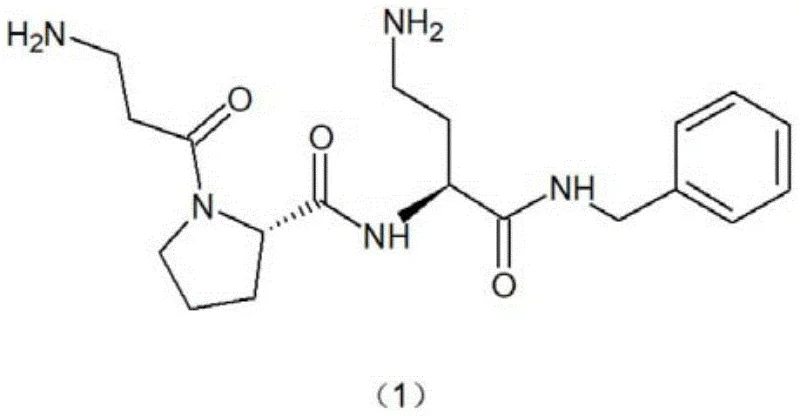
The Limitations of Conventional Methods vs. The Novel Approach
The Limitations of Conventional Methods
Historically, the production of small molecular weight peptides like the snake venom tripeptide has been plagued by inefficiencies inherent to solid-phase synthesis and traditional liquid-phase protecting group strategies. In solid-phase synthesis, the substantial consumption of resin relative to the small peptide size results in disproportionately high raw material costs and generates significant solid waste, rendering it economically unfeasible for large-scale commercial manufacturing. Furthermore, liquid-phase methods relying on Boc (tert-butyloxycarbonyl) or Cbz (carboxybenzyl) protection groups introduce their own set of critical bottlenecks; specifically, the selective protection of the diamino acid Dab (2,4-diaminobutyric acid) is synthetically challenging and expensive, often requiring multi-step sequences to differentiate the alpha and gamma amines. Additionally, the removal of Cbz groups typically necessitates hydrogenation over palladium on carbon (Pd/C), which introduces severe safety hazards due to pyrophoric catalysts and leaves behind trace heavy metal residues that are strictly regulated in cosmetic applications, necessitating costly purification protocols to meet safety standards.
The Novel Approach
The methodology disclosed in patent CN114213503A represents a paradigm shift by employing a unified phthaloyl protection strategy that addresses these economic and safety concerns simultaneously. Instead of disparate protecting groups requiring orthogonal removal conditions, this novel route utilizes the phthaloyl group to protect both the N-terminal beta-alanine precursor and the side chain of the diaminobutyric acid residue, allowing for a synchronized deprotection event at the end of the synthesis. This approach begins with the conversion of 3-phthalimidopropionic acid into its corresponding acyl chloride, which then reacts directly with proline without the need for additional coupling agents, significantly reducing reagent costs. The synthesis of the C-terminal fragment involves protecting Boc-L-2,4-diaminobutyric acid with a phthaloyl group and coupling it with benzylamine via a mixed anhydride method, again bypassing the need for expensive peptide coupling reagents in this critical step. 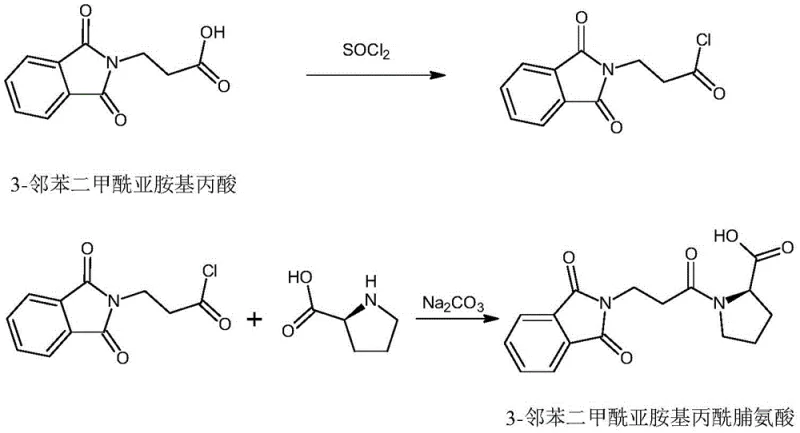
Mechanistic Insights into Phthaloyl-Mediated Peptide Assembly
The core innovation of this synthesis lies in the strategic deployment of the phthaloyl moiety as a dual-purpose protecting group that offers exceptional stability during coupling reactions while remaining susceptible to mild hydrazinolysis. In the initial stage, 3-phthalimidopropionic acid is treated with thionyl chloride to generate a reactive acyl chloride intermediate, which possesses high electrophilicity allowing it to acylate the secondary amine of proline efficiently under basic aqueous conditions. This direct acylation mechanism circumvents the atom economy losses associated with carbodiimide or uranium-based coupling agents, as the activation energy is provided by the acid chloride formation rather than in situ activation. Subsequently, the diaminobutyric acid fragment is prepared by reacting Boc-L-2,4-diaminobutyric acid with N-carbethoxyphthalimide, effectively installing the phthaloyl group on the side chain amine while retaining the Boc group on the alpha amine for temporary masking. 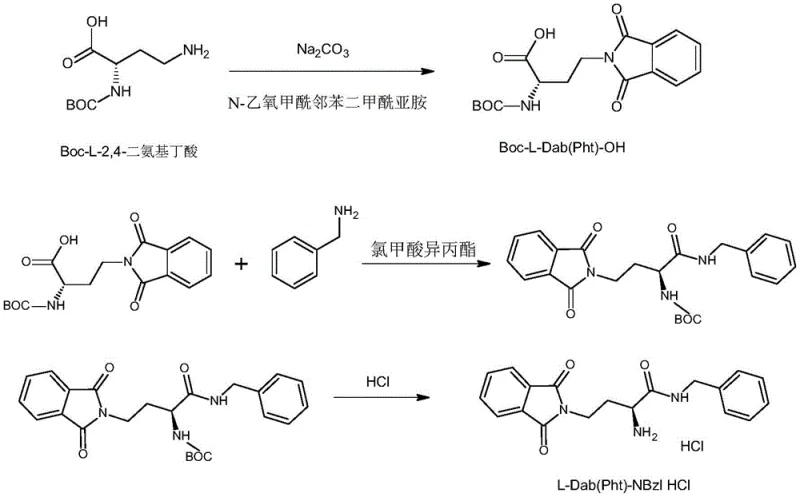
The final assembly and deprotection sequence demonstrates the elegance of this chemical design, where the two protected fragments are condensed using standard coupling agents like EDCl or HBTU to form the full tripeptide backbone with all protecting groups intact. The crucial final step involves treating the fully protected tripeptide with hydrazine hydrate in an alcoholic solvent under reflux conditions, which triggers a nucleophilic attack on the phthalimide carbonyls. This reaction cleaves both the N-terminal phthaloyl group derived from the beta-alanine precursor and the side-chain phthaloyl group on the diaminobutyric acid residue simultaneously, releasing the free amine functionalities required for biological activity. This synchronous deprotection mechanism not only simplifies the process flow by combining two deprotection steps into one but also ensures that the final product is free from the heterogeneous mixtures of partially deprotected species that often complicate purification in orthogonal protection strategies. 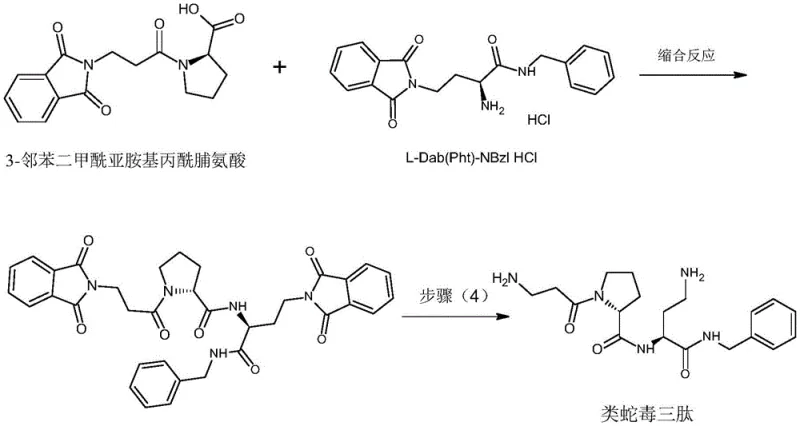
How to Synthesize Snake Venom Tripeptide Efficiently
The operational protocol for this synthesis is designed to maximize yield and purity through controlled crystallization and extraction techniques rather than relying solely on chromatographic purification. The process initiates with the rigorous preparation of the acid chloride intermediate, followed by careful pH control during the proline coupling to prevent racemization and ensure complete conversion. Detailed standardized synthetic steps for the preparation of intermediates and the final tripeptide are provided in the technical guide below, outlining specific solvent systems, temperature ranges, and stoichiometric ratios optimized for industrial reproducibility.
- Acyl chlorination of 3-phthalimidopropionic acid followed by condensation with proline to form the N-terminal segment without coupling agents.
- Protection of Boc-L-2,4-diaminobutyric acid with phthalic anhydride derivatives and subsequent coupling with benzylamine via mixed anhydride method.
- Final condensation of the two segments followed by simultaneous hydrazinolysis to remove phthaloyl protecting groups and yield the free tripeptide.
Commercial Advantages for Procurement and Supply Chain Teams
For procurement managers and supply chain directors, the transition to this phthaloyl-based liquid phase synthesis offers profound advantages in terms of cost structure and supply reliability. The elimination of solid-phase resin removes a major variable cost driver, while the avoidance of palladium catalysts mitigates the risk of supply disruptions associated with precious metal markets and reduces the regulatory burden of heavy metal testing. Furthermore, the use of readily available starting materials such as 3-phthalimidopropionic acid and standard amino acid derivatives ensures a stable supply chain that is less susceptible to the volatility seen with specialized protected amino acids.
- Cost Reduction in Manufacturing: The process achieves significant cost savings by eliminating the use of expensive coupling reagents in the first two synthetic steps, relying instead on acyl chloride activation and mixed anhydride methods which utilize cheaper reagents like thionyl chloride and isopropyl chloroformate. Additionally, the removal of the Pd/C hydrogenation step not only saves on catalyst costs but also reduces the capital expenditure required for high-pressure hydrogenation equipment and the operational costs associated with stringent heavy metal clearance protocols. The ability to purify intermediates via crystallization rather than preparative HPLC further drives down the cost of goods sold by minimizing solvent consumption and processing time.
- Enhanced Supply Chain Reliability: By utilizing commodity chemicals and widely available amino acid derivatives, this synthesis route reduces dependency on niche suppliers of complex protected building blocks like Dab(Boc)-OMe, which are often subject to long lead times and price fluctuations. The robustness of the phthaloyl protection group allows for flexible batch scheduling and storage of stable intermediates, enabling manufacturers to build strategic inventory buffers without the risk of degradation that plagues more labile protecting groups. This stability translates directly into improved on-time delivery performance for downstream cosmetic formulators who require consistent quality and volume.
- Scalability and Environmental Compliance: The liquid phase nature of this synthesis facilitates straightforward scale-up from laboratory to multi-ton production without the engineering challenges associated with swelling resins or filtration of fine catalyst powders. The process generates less hazardous waste compared to solid-phase synthesis, as it avoids the disposal of spent polystyrene resins and reduces the volume of organic solvents required for washing cycles. Moreover, the absence of heavy metals aligns perfectly with the increasingly stringent environmental and safety regulations governing the cosmetic industry, ensuring long-term compliance and reducing the risk of product recalls due to contamination.
Frequently Asked Questions (FAQ)
The following questions address common technical and commercial inquiries regarding the implementation of this synthesis technology, focusing on purity profiles, regulatory compliance, and process scalability. These insights are derived directly from the experimental data and comparative analysis presented in the patent documentation to assist decision-makers in evaluating the feasibility of adoption.
Q: Why is the phthaloyl protection strategy superior to Boc/Cbz methods for this tripeptide?
A: The phthaloyl strategy eliminates the need for expensive palladium catalysts required for Cbz removal and avoids the costly synthesis of selectively protected Dab derivatives associated with Boc chemistry, while allowing simultaneous deprotection of multiple sites.
Q: How does this method improve impurity control compared to solid phase synthesis?
A: By utilizing liquid phase synthesis with crystallization steps for intermediates, this method achieves higher purity profiles than solid phase synthesis, which often suffers from resin-related impurities and requires extensive preparative HPLC purification.
Q: Is this process suitable for large-scale industrial production?
A: Yes, the process uses readily available starting materials like 3-phthalimidopropionic acid and avoids hazardous heavy metal catalysts, making it safer and more economically viable for scaling up to multi-kilogram or ton-level production.
Partnering with NINGBO INNO PHARMCHEM: Your Reliable Snake Venom Tripeptide Supplier
At NINGBO INNO PHARMCHEM, we recognize the critical importance of adopting advanced synthesis technologies to maintain competitiveness in the fast-evolving cosmetic peptide market. As a leading CDMO partner, we possess extensive experience scaling diverse pathways from 100 kgs to 100 MT/annual commercial production, ensuring that the innovative phthaloyl-based route described in patent CN114213503A can be seamlessly transferred to our state-of-the-art manufacturing facilities. Our commitment to quality is underpinned by stringent purity specifications and rigorous QC labs equipped with advanced analytical instrumentation, guaranteeing that every batch of snake venom tripeptide meets the highest international standards for safety and efficacy.
We invite potential partners to engage with our technical procurement team to discuss how this optimized synthesis route can drive value for your specific product portfolio. By requesting a Customized Cost-Saving Analysis, you can gain a detailed understanding of the economic benefits specific to your volume requirements. We encourage you to contact us today to obtain specific COA data and route feasibility assessments, allowing you to make informed decisions about securing a sustainable and high-quality supply of this premium anti-aging ingredient.