
Scalable Synthesis of 1,3,5,7-Tetrakis(4-pyridylformyloxy)adamantane for Advanced Coordination Chemistry
The chemical industry is constantly seeking robust, rigid scaffolds that can serve as versatile building blocks for advanced functional materials and pharmaceutical intermediates. Patent CN102153510A introduces a significant breakthrough in this domain by detailing the efficient synthesis of 1,3,5,7-tetrakis(4-pyridylformyloxy)adamantane. This compound represents a highly symmetrical, rigid ligand featuring a central adamantane cage substituted with four pyridyl ester groups. The strategic placement of these nitrogen-containing aromatic rings provides exceptional coordination capacity, allowing the molecule to act as a node in the construction of complex metal-organic frameworks (MOFs) or as a specialized intermediate in drug design. The patent outlines a streamlined three-step pathway starting from readily available adamantane, utilizing substitution, hydrolysis, and esterification reactions. This methodology addresses the historical challenges of functionalizing the inert adamantane cage, offering a reproducible route that balances yield with operational simplicity. For R&D teams and procurement specialists alike, understanding this synthetic architecture is crucial for securing a reliable supply chain of high-performance coordination ligands.
The Limitations of Conventional Methods vs. The Novel Approach
The Limitations of Conventional Methods
Traditionally, the functionalization of the adamantane skeleton has been plagued by issues related to regioselectivity and harsh reaction conditions. Conventional methods often struggle to achieve tetra-substitution at the 1,3,5,7 positions without generating a complex mixture of mono-, di-, and tri-substituted byproducts, which are notoriously difficult to separate due to similar physical properties. Furthermore, older protocols frequently relied on extreme temperatures or hazardous oxidizing agents that compromised the integrity of the cage structure or introduced toxic impurities difficult to remove to pharmaceutical grades. The lack of a controlled catalytic system in early attempts often resulted in poor atom economy and excessive waste generation, driving up the cost of goods sold (COGS) for downstream applications. Additionally, the introduction of oxygenated functional groups typically required multi-step protection and deprotection strategies, elongating the production timeline and increasing the risk of yield loss at each stage. These inefficiencies created a bottleneck for industries requiring bulk quantities of symmetric adamantane derivatives for material science applications.
The Novel Approach
The methodology disclosed in CN102153510A overcomes these hurdles through a cleverly designed sequence that leverages the inherent symmetry of the adamantane molecule. By initiating the synthesis with a controlled Lewis acid-catalyzed bromination, the process ensures high selectivity for the tertiary carbon positions, directly yielding the 1,3,5,7-tetrabromo precursor with minimal isomeric contamination. The subsequent hydrolysis step utilizes a silver-assisted mechanism which effectively drives the substitution of bromine atoms with hydroxyl groups under relatively mild thermal conditions, avoiding the degradation often seen in strong acid environments. Finally, the esterification with isonicotinic acid chloride is conducted in a pyridine medium that serves both as a solvent and an acid scavenger, streamlining the workup procedure. This novel approach eliminates the need for complex protecting groups and reduces the total number of unit operations, thereby significantly simplifying the manufacturing workflow. The result is a process that is not only chemically elegant but also commercially viable, offering a clear path toward cost reduction in fine chemical manufacturing for high-value ligands.
Mechanistic Insights into Lewis Acid-Catalyzed Functionalization
The core of this synthesis lies in the precise manipulation of electrophilic substitution and nucleophilic acyl substitution mechanisms. In the first step, anhydrous aluminum trichloride or aluminum tribromide acts as a potent Lewis acid, activating molecular bromine to generate an electrophilic bromonium species. This species attacks the electron-rich tertiary C-H bonds of the adamantane cage. The rigidity of the cage structure dictates that once one position is substituted, the steric and electronic environment favors further substitution at the remaining bridgehead positions, ultimately leading to the thermodynamically stable 1,3,5,7-tetrabromoadamantane. The second step involves a hydrolysis mechanism where silver sulfate plays a dual role: it acts as a catalyst and a precipitating agent. As the bromine atoms are displaced by hydroxyl groups derived from the sulfuric acid medium, silver ions sequester the released bromide ions as insoluble silver bromide. This precipitation effectively removes the byproduct from the equilibrium, driving the reaction to completion according to Le Chatelier's principle, which is critical for achieving high conversion rates in this sterically crowded system.
The final esterification step is a classic nucleophilic acyl substitution where the hydroxyl groups of the 1,3,5,7-tetrahydroxyadamantane attack the carbonyl carbon of the isonicotinic acid chloride. The pyridine solvent neutralizes the generated hydrogen chloride, preventing the protonation of the pyridine rings on the incoming acyl chloride, which would otherwise deactivate the electrophile. This careful control of the reaction medium ensures that all four hydroxyl groups are successfully esterified, resulting in the target molecule with high structural fidelity. The resulting compound possesses a distinct tetrahedral geometry with extended conjugation through the ester linkages, enhancing its stability and coordination potential. Understanding these mechanistic nuances allows process chemists to optimize parameters such as temperature ramps and stoichiometric ratios to maximize purity and minimize the formation of partially esterified impurities.
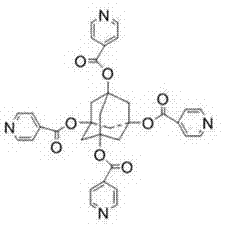
How to Synthesize 1,3,5,7-Tetrakis(4-pyridylformyloxy)adamantane Efficiently
Executing this synthesis requires strict adherence to the specified thermal profiles and stoichiometric ratios to ensure safety and reproducibility. The process begins with the careful addition of adamantane to a cooled mixture of liquid bromine and catalyst to manage the exothermic nature of the bromination. Following isolation of the tetrabromo-intermediate, the hydrolysis step demands precise pH control during the neutralization phase to prevent the formation of emulsions that could trap the product. The final esterification requires anhydrous conditions to prevent the hydrolysis of the acid chloride before it reacts with the alcohol. Detailed standard operating procedures regarding mixing speeds, addition rates, and crystallization cooling curves are essential for transferring this laboratory protocol to a pilot or production scale. For a comprehensive breakdown of the specific operational parameters, please refer to the standardized guide below.
- Perform Lewis acid-catalyzed bromination of adamantane using liquid bromine and AlCl3 at 70-100°C to yield 1,3,5,7-tetrabromoadamantane.
- Execute silver-assisted hydrolysis of the tetrabromo-intermediate using concentrated sulfuric acid and silver sulfate at 40-100°C to form 1,3,5,7-tetrahydroxyadamantane.
- Conduct esterification with isonicotinic acid chloride in pyridine solvent at 60-100°C, followed by acid precipitation and recrystallization to isolate the final ligand.
Commercial Advantages for Procurement and Supply Chain Teams
From a supply chain perspective, the adoption of this synthetic route offers substantial strategic benefits regarding raw material security and operational expenditure. The primary starting materials, including adamantane, liquid bromine, and isonicotinic acid chloride, are commodity chemicals produced by multiple global suppliers, mitigating the risk of single-source dependency. This abundance ensures that procurement managers can negotiate favorable terms and maintain consistent inventory levels without fear of market volatility affecting niche precursors. Furthermore, the process avoids the use of expensive transition metal catalysts like palladium or platinum, which are subject to significant price fluctuations and require complex recovery systems to meet environmental regulations. By utilizing aluminum and silver salts which are more easily managed and recovered, the overall cost structure of the manufacturing process is significantly optimized. This translates to a more competitive pricing model for the final ligand, making it accessible for broader applications in material science and pharmaceutical research.
- Cost Reduction in Manufacturing: The elimination of precious metal catalysts and the use of standard solvents like pyridine and chloroform drastically lowers the direct material costs associated with production. Additionally, the high selectivity of the bromination step reduces the burden on downstream purification processes, such as chromatography, which are often the most expensive part of fine chemical manufacturing. The ability to use simple recrystallization techniques for purification further decreases energy consumption and solvent waste disposal costs. Consequently, the overall manufacturing overhead is reduced, allowing for better margin management even when scaling to larger batch sizes. This economic efficiency makes the compound a viable candidate for large-scale industrial applications where cost-per-kilogram is a critical decision factor.
- Enhanced Supply Chain Reliability: The robustness of the reaction conditions contributes to high batch-to-batch consistency, which is vital for maintaining supply continuity. The tolerance of the process to slight variations in temperature and reaction time means that production schedules are less likely to be disrupted by minor operational deviations. Moreover, the intermediates formed, such as 1,3,5,7-tetrabromoadamantane, are stable solids that can be stored or transported if necessary, providing flexibility in the production workflow. This stability reduces the pressure on just-in-time manufacturing constraints and allows for the buildup of safety stock. For supply chain heads, this reliability ensures that downstream customers receive their orders on time, fostering long-term partnerships and trust in the supplier's capability to deliver critical intermediates without interruption.
- Scalability and Environmental Compliance: The synthetic route is inherently scalable because it relies on unit operations that are well-understood in the chemical industry, such as filtration, distillation, and crystallization. There are no high-pressure hydrogenations or cryogenic reactions that would require specialized, capital-intensive equipment. From an environmental standpoint, the process generates manageable waste streams; the silver byproducts can be recovered and recycled, and the acidic waste can be neutralized according to standard protocols. This alignment with green chemistry principles simplifies the permitting process for new production lines and ensures compliance with increasingly stringent environmental regulations. The ability to scale from kilogram to tonnage quantities without fundamental changes to the chemistry provides a clear pathway for meeting growing market demand.
Frequently Asked Questions (FAQ)
The following questions address common technical and commercial inquiries regarding the production and application of this adamantane derivative. These insights are derived directly from the experimental data and beneficial effects described in the patent literature, providing clarity for potential partners and technical evaluators. Understanding these details helps in assessing the feasibility of integrating this material into your specific R&D pipeline or manufacturing process. We encourage reviewing these points to gain a deeper appreciation of the compound's value proposition.
Q: What are the critical purity specifications for the adamantane ligand?
A: High purity is essential for coordination chemistry. The process utilizes rigorous recrystallization steps (e.g., chloroform/methanol systems) to remove unreacted acid chlorides and brominated byproducts, ensuring suitability for sensitive metal-organic framework (MOF) synthesis.
Q: How does the silver sulfate catalyst impact the hydrolysis step?
A: Silver sulfate acts as a halide scavenger during the hydrolysis of 1,3,5,7-tetrabromoadamantane. By precipitating silver bromide, it drives the equilibrium towards the formation of the tetrahydroxy intermediate, significantly improving conversion rates compared to standard acid hydrolysis.
Q: Is this synthesis route suitable for large-scale industrial production?
A: Yes, the route relies on commodity chemicals like liquid bromine, sulfuric acid, and pyridine. The reaction conditions (70-100°C) are moderate and compatible with standard glass-lined or stainless steel reactors, facilitating commercial scale-up without requiring exotic high-pressure equipment.
Partnering with NINGBO INNO PHARMCHEM: Your Reliable 1,3,5,7-Tetrakis(4-pyridylformyloxy)adamantane Supplier
At NINGBO INNO PHARMCHEM, we recognize the critical role that high-quality ligands play in the development of next-generation functional materials and pharmaceuticals. Our team possesses extensive experience scaling diverse pathways from 100 kgs to 100 MT/annual commercial production, ensuring that we can meet your volume requirements whether you are in the clinical trial phase or full-scale manufacturing. We adhere to stringent purity specifications and operate rigorous QC labs equipped with advanced analytical instrumentation to guarantee that every batch of 1,3,5,7-tetrakis(4-pyridylformyloxy)adamantane meets the highest standards of quality and consistency. Our commitment to technical excellence means we can handle the complexities of adamantane chemistry with precision, delivering products that perform reliably in your downstream applications.
We invite you to collaborate with us to optimize your supply chain and accelerate your project timelines. Contact our technical procurement team today to request a Customized Cost-Saving Analysis tailored to your specific volume needs. We are ready to provide specific COA data and route feasibility assessments to demonstrate how our manufacturing capabilities can support your strategic goals. Let us be your partner in turning complex chemical challenges into commercial successes.