
Advanced Biocatalytic Deracemization for Commercial L-Glufosinate-Ammonium Production
The agrochemical industry is currently witnessing a paradigm shift towards sustainable and highly efficient manufacturing processes, particularly for chiral herbicides like glufosinate. A pivotal development in this sector is documented in patent CN109609582B, which discloses a groundbreaking method for preparing L-glufosinate-ammonium through microbial catalytic racemization removal. This technology leverages the unique enzymatic capabilities of Lysinibacillus xylolyticus XX-2 to achieve a complete deracemization of DL-glufosinate-ammonium. Unlike traditional methods that discard half of the raw material, this approach utilizes a sophisticated dual-enzyme system to convert the inactive D-enantiomer into the biologically active L-form. For R&D directors and procurement specialists, this represents a significant opportunity to enhance process economics while meeting stringent environmental regulations. The ability to produce high-purity agrochemical intermediates without harsh chemical reagents aligns perfectly with the global demand for green chemistry solutions in large-scale herbicide manufacturing.
The Limitations of Conventional Methods vs. The Novel Approach
The Limitations of Conventional Methods
Historically, the production of L-glufosinate-ammonium has been plagued by inherent inefficiencies associated with chemical resolution and early-generation biological methods. Traditional chemical resolution techniques are fundamentally limited by a maximum theoretical yield of 50%, as they require the separation and disposal of the unwanted D-enantiomer. This not only doubles the raw material cost but also generates significant chemical waste, creating a heavy burden on waste treatment facilities. Furthermore, existing biological asymmetric synthesis methods often suffer from low yields or require expensive cofactors like NADP+ that need complex regeneration systems. Transaminase-based approaches, while effective, are reversible reactions that create an equilibrium between amino acids and alpha-keto acids, making it difficult to drive the reaction to completion without intricate separation processes. These technical bottlenecks result in higher production costs and inconsistent supply reliability for reliable agrochemical intermediate supplier networks globally.
The Novel Approach
The novel approach described in the patent data overcomes these historical barriers by employing a 'one-pot' microbial catalytic system that integrates oxidative deamination and reductive amination. By utilizing whole cells of Lysinibacillus xylolyticus XX-2, the process eliminates the need for enzyme purification and cofactor addition, as the microbial cells naturally regenerate the necessary components. The D-amino acid oxidase selectively targets the D-glufosinate-ammonium, oxidizing it into a keto acid intermediate, which is then immediately reduced back to the L-form by the co-expressed amino acid dehydrogenase. This seamless cycle ensures that the starting DL-racemate is fully converted into the desired L-product with no by-products. For procurement managers, this translates to cost reduction in agrochemical intermediate manufacturing by maximizing raw material utilization and simplifying the downstream purification workflow to basic concentration and crystallization steps.
Mechanistic Insights into Microbial Catalytic Deracemization
The core of this technological breakthrough lies in the synergistic action of two specific enzymes expressed within the Lysinibacillus xylolyticus XX-2 strain. The process initiates with the enantioselective oxidation of the D-enantiomer of glufosinate-ammonium by D-amino acid oxidase. This enzyme catalyzes the removal of the amino group from the D-isomer, converting it into 2-carbonyl-4-(hydroxymethyl phosphonyl) butyric acid. This step is crucial as it effectively removes the unwanted stereoisomer from the mixture without destroying the carbon skeleton. Subsequently, the L-amino acid dehydrogenase present in the same cellular system catalyzes the reductive amination of this keto acid intermediate. Using ammonia as the nitrogen source, the dehydrogenase reduces the carbonyl group back into an amino group, but strictly with L-stereoselectivity. This creates a dynamic kinetic resolution where the D-form is continuously recycled into the L-form until the entire batch consists of the high-purity L-isomer.
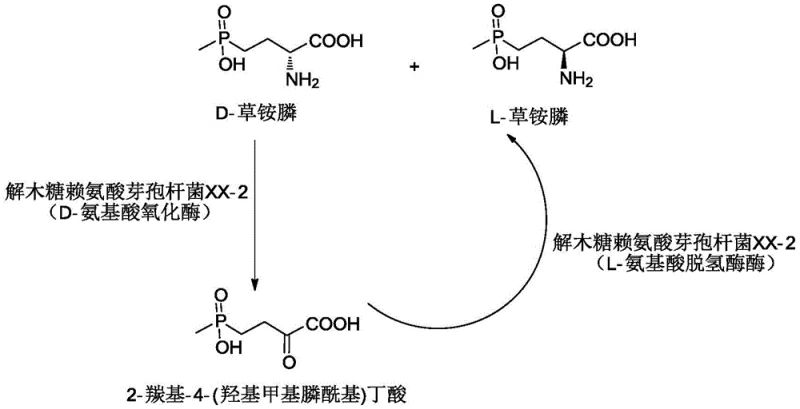
Controlling impurity profiles in chiral synthesis is often a major challenge for R&D teams, yet this biological system offers inherent selectivity that minimizes side reactions. The use of whole cells provides a protected microenvironment for the enzymes, stabilizing their activity and preventing the formation of unwanted by-products that often occur in harsh chemical catalysis. The patent data indicates that the optical purity of the resulting L-glufosinate-ammonium consistently exceeds 99% ee, demonstrating the high fidelity of the enzymatic conversion. Furthermore, because the reaction proceeds under mild conditions, typically around 30°C and neutral to slightly alkaline pH, there is minimal risk of racemization or degradation of the sensitive phosphonic acid moiety. This high level of stereocontrol ensures that the final product meets the rigorous specifications required for high-purity agrochemical intermediates, reducing the need for expensive chiral chromatography during quality control.
How to Synthesize L-Glufosinate-Ammonium Efficiently
Implementing this synthesis route requires precise control over fermentation and biocatalytic conditions to maximize enzyme expression and activity. The process begins with the cultivation of the Lysinibacillus xylolyticus XX-2 strain in a specialized enzyme production medium where D-glufosinate acts as an inducer to trigger the expression of the necessary oxidase and dehydrogenase enzymes. Once the cells are harvested and washed, they are resuspended in a phosphate buffer to create a concentrated biocatalyst suspension. The DL-glufosinate-ammonium substrate is then added directly to this suspension, initiating the deracemization reaction. The detailed standardized synthesis steps see the guide below.
- Cultivate Lysinibacillus xylolyticus XX-2 in enzyme production medium containing D-glufosinate as an inducer at 30°C for 48 hours to express D-amino acid oxidase and L-amino acid dehydrogenase.
- Harvest the wet cells via centrifugation and resuspend them in a phosphate buffer solution (pH 8.0) to create a biocatalyst suspension with a concentration of 20 to 50g/L.
- Add underivatized DL-glufosinate-ammonium to the cell suspension and maintain the reaction at 30°C with shaking for 24 to 48 hours to achieve complete deracemization.
Commercial Advantages for Procurement and Supply Chain Teams
For supply chain heads and procurement managers, the transition to this biocatalytic deracemization method offers substantial strategic advantages beyond mere technical feasibility. The elimination of chemical derivatization steps significantly reduces the consumption of auxiliary reagents and solvents, leading to a drastically simplified supply chain for raw materials. Since the process utilizes underivatized DL-glufosinate-ammonium directly, manufacturers can source cheaper racemic starting materials and convert them entirely into the high-value L-isomer. This efficiency gain directly impacts the bottom line by lowering the cost of goods sold. Additionally, the ability to recycle the microbial cells for multiple batches means that the biocatalyst cost is amortized over a much larger production volume, providing significant cost savings compared to single-use enzyme systems or stoichiometric chemical reagents.
- Cost Reduction in Manufacturing: The economic benefits of this process are driven by the theoretical 100% yield potential from racemic starting materials, effectively doubling the output compared to traditional resolution methods without increasing raw material input. By avoiding the use of expensive transition metal catalysts or complex protecting group chemistry, the process eliminates the need for costly metal scavenging and waste disposal procedures. The simplified downstream processing, which relies on concentration and crystallization rather than complex chromatographic separations, further reduces operational expenditures. These factors combine to create a highly cost-competitive manufacturing route that enhances margin potential for commercial scale-up of complex agrochemical intermediates.
- Enhanced Supply Chain Reliability: Reliability in the supply of critical herbicide intermediates is paramount for global agrochemical companies, and this biological route offers superior robustness. The use of a stable microbial strain that can be cultured on standard media reduces dependency on specialized chemical reagents that may be subject to market volatility or supply disruptions. The mild reaction conditions also mean that the process can be run in standard stainless steel fermentation equipment without requiring exotic high-pressure or high-temperature vessels. This compatibility with existing infrastructure ensures that reducing lead time for high-purity agrochemical intermediates is achievable through rapid technology transfer and scale-up without massive capital investment in new plant hardware.
- Scalability and Environmental Compliance: As regulatory pressure mounts on the chemical industry to reduce carbon footprints and hazardous waste, this biocatalytic process stands out as an environmentally compliant solution. The aqueous nature of the reaction minimizes the use of volatile organic compounds (VOCs), and the biodegradability of the microbial biomass simplifies waste treatment. The high atom economy of the deracemization reaction ensures that minimal waste is generated per kilogram of product, aligning with green chemistry principles. This environmental profile not only mitigates regulatory risk but also enhances the brand value of the final herbicide product in markets that prioritize sustainable sourcing and eco-friendly manufacturing practices.
Frequently Asked Questions (FAQ)
The following questions address common technical and commercial inquiries regarding the implementation of this microbial deracemization technology. These insights are derived directly from the patent specifications and are intended to clarify the operational parameters and benefits for potential partners. Understanding these details is crucial for evaluating the feasibility of integrating this route into existing production lines.
Q: What is the primary advantage of this microbial deracemization method over traditional chemical resolution?
A: Unlike traditional chemical resolution which is limited to a maximum theoretical yield of 50%, this microbial method utilizes a one-pot oxidative deamination and reductive amination cycle. This allows for the conversion of the unwanted D-enantiomer into the desired L-enantiomer, theoretically achieving 100% yield from the racemic starting material while maintaining optical purity exceeding 99%.
Q: Can the biocatalyst cells be reused to lower production costs?
A: Yes, the patent data explicitly demonstrates that the Lysinibacillus xylolyticus XX-2 whole cells can be recycled multiple times. After each reaction cycle, the cells are recovered via centrifugation and reintroduced into fresh substrate solutions, maintaining high catalytic activity and significantly reducing the cost of biocatalyst consumption per batch.
Q: Does this process require complex downstream purification steps?
A: The process is designed for simplicity. Since the reaction occurs in a one-pot system without the need for chemical derivatization or protection groups, the product stream primarily contains the target L-glufosinate-ammonium. This allows for isolation through straightforward concentration and crystallization methods, avoiding the complex separation procedures associated with transaminase equilibrium reactions.
Partnering with NINGBO INNO PHARMCHEM: Your Reliable L-Glufosinate-Ammonium Supplier
At NINGBO INNO PHARMCHEM, we recognize the transformative potential of this biocatalytic route for the global agrochemical market. As a leading CDMO partner, we possess extensive experience scaling diverse pathways from 100 kgs to 100 MT/annual commercial production, ensuring that innovative laboratory processes are successfully translated into robust industrial operations. Our facilities are equipped with rigorous QC labs and adhere to stringent purity specifications, guaranteeing that every batch of L-glufosinate-ammonium meets the highest international standards. We are committed to leveraging advanced technologies like the one described in CN109609582B to deliver superior value to our clients.
We invite you to collaborate with us to optimize your supply chain and reduce manufacturing costs through this advanced synthesis method. Our technical procurement team is ready to provide a Customized Cost-Saving Analysis tailored to your specific volume requirements. Please contact us to request specific COA data and route feasibility assessments, and let us demonstrate how our expertise can secure your supply of high-quality herbicide intermediates.
Engineering Bottleneck?
Can't scale up this synthesis? Upload your target structure or CAS, and our CDMO team will evaluate the industrial feasibility within 24 hours. Request Evaluation →