
Scalable Solid-Phase Synthesis of Laterocidin: A Breakthrough in Cyclic Peptide Manufacturing
Introduction to Advanced Laterocidin Synthesis
The pharmaceutical landscape is constantly evolving, driven by the urgent need for novel antibiotics to combat resistant pathogens. Patent CN101792487A introduces a transformative methodology for the chemical synthesis of Laterocidin, a potent cyclic decapeptide with significant antibacterial properties. Historically, the supply of such complex bioactive molecules has been bottlenecked by reliance on natural extraction from organisms like Bacillus lateralis, a process plagued by inherently low yields and exorbitant costs. This patent delineates a robust solid-phase cyclization strategy that bypasses these biological limitations, offering a chemically defined route to high-purity Laterocidin and its analogs. By leveraging specific anchoring strategies and optimized coupling reagents, this technology addresses the notorious difficulty of macrocyclization, providing a reliable foundation for the development of next-generation antimicrobial therapeutics.
The Limitations of Conventional Methods vs. The Novel Approach
The Limitations of Conventional Methods
Traditional approaches to obtaining cyclic peptides like Laterocidin have predominantly relied on fermentation and extraction from natural sources. This biological dependency introduces severe volatility into the supply chain, as yields are contingent upon microbial growth conditions and extraction efficiencies that rarely exceed trace levels. Furthermore, purification from complex biological matrices is arduous, often requiring extensive chromatography that drives up the cost of goods sold (COGS) dramatically. From a chemical synthesis perspective, conventional solution-phase cyclization faces the thermodynamic challenge of entropy; bringing the two ends of a linear peptide together to form a large ring is statistically unfavorable compared to intermolecular reactions that lead to oligomerization. Consequently, achieving yields above 50% in solution phase often requires extreme dilution conditions, which are impractical for large-scale manufacturing due to massive solvent consumption and reactor volume requirements.
The Novel Approach
The methodology described in CN101792487A revolutionizes this process by employing a solid-phase peptide synthesis (SPPS) platform with a unique "anchor-and-release" cyclization mechanism. Instead of struggling with dilution effects in solution, the linear peptide chain is assembled on a solid support, effectively isolating individual molecules. The innovation lies in the selection of the synthesis starting point: utilizing Fmoc-Asp-ODmab or Fmoc-Glu-ODmab as the first amino acid loaded onto the resin. This strategic choice installs a latent carboxylic acid handle on the side chain, protected by the orthogonally labile Dmab group. Once the full linear sequence is assembled, the Dmab group is selectively cleaved using hydrazine, exposing the carboxyl group precisely when the N-terminus is deprotected. This setup facilitates an intramolecular head-to-side-chain cyclization directly on the resin, capitalizing on the pseudo-dilution effect to maximize ring closure efficiency while minimizing dimer formation.
Mechanistic Insights into Solid-Phase Macrocyclization
The core of this synthetic breakthrough is the precise orchestration of protecting group chemistry to enable difficult bond formations. The process begins with the loading of the anchor amino acid, where the alpha-carboxyl is attached to the resin (via Wang resin or amino resin) and the side-chain carboxyl is masked by the Dmab moiety. As the peptide chain elongates through iterative cycles of Fmoc deprotection and amino acid coupling using activators like DIC and HOBt, the integrity of the Dmab group is maintained. The critical mechanistic step occurs after the full linear sequence—comprising residues such as Asn, D-Phe, Pro, D-Tyr, Leu, Orn, and Val—is constructed. Treatment with hydrazine (N2H4) selectively removes the Dmab group without disturbing the other acid-labile protecting groups (like Boc or Trt) or cleaving the peptide from the resin. This generates a reactive intermediate where the N-terminal amine and the side-chain carboxylic acid are in close proximity, primed for cyclization.
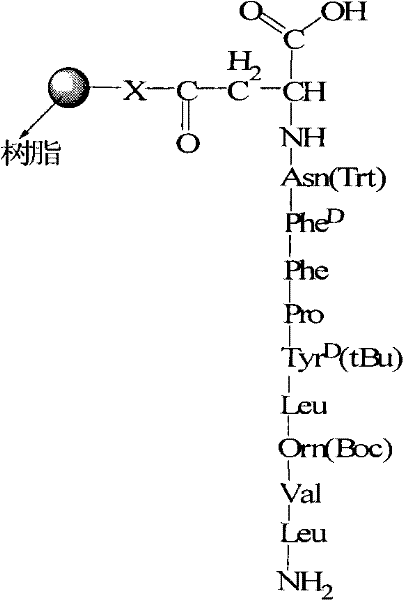
Following the exposure of the cyclization site, the addition of potent coupling reagents such as PyBOP (benzotriazol-1-yl-oxytripyrrolidinophosphonium hexafluorophosphate) in the presence of HOBt and DIEA drives the amide bond formation. The solid support restricts the conformational freedom of the peptide chain, effectively increasing the local concentration of the reacting termini relative to other chains, thereby favoring intramolecular cyclization over intermolecular polymerization. This mechanistic advantage is crucial for forming the stable 10-membered ring characteristic of Laterocidin. Finally, the cyclic peptide is cleaved from the resin using a cocktail of trifluoroacetic acid (TFA), triisopropylsilane, phenol, and water, which simultaneously removes all remaining side-chain protecting groups to yield the biologically active target molecule with high structural fidelity.
How to Synthesize Laterocidin Efficiently
Implementing this synthesis route requires strict adherence to the orthogonal protection strategy and precise control over reaction times to ensure complete conversion at each step. The protocol outlined in the patent provides a clear roadmap for transitioning from resin swelling to final precipitation, emphasizing the importance of thorough washing steps to remove excess reagents that could lead to side reactions. For R&D teams looking to replicate or optimize this process, the key lies in the monitoring of the Kaiser test after each coupling and deprotection cycle to guarantee quantitative reactions before proceeding. The detailed standardized synthesis steps, including specific molar ratios of coupling agents and exact cleavage conditions, are essential for reproducing the high purity profiles reported in the patent documentation.
- Load Fmoc-Asp-ODmab onto amino resin and sequentially couple protected amino acids to form the linear peptide chain.
- Selectively remove the Dmab protecting group using hydrazine to expose the side-chain carboxylic acid for cyclization.
- Perform on-resin cyclization using PyBOP/HOBt/DIEA, followed by cleavage with TFA to obtain the final cyclic decapeptide.
Commercial Advantages for Procurement and Supply Chain Teams
For procurement managers and supply chain directors, the transition from natural extraction to this defined chemical synthesis represents a paradigm shift in risk management and cost structure. The reliance on bacterial fermentation subjects supply chains to biological variability, batch-to-batch inconsistency, and potential contamination issues that can halt production for months. In contrast, this solid-phase chemical route utilizes commercially available, off-the-shelf protected amino acids and standard resins, decoupling production from biological constraints. This shift ensures a predictable and continuous supply of Laterocidin intermediates, allowing for better inventory planning and reduced safety stock requirements. Furthermore, the elimination of complex extraction and purification from biomass significantly reduces the environmental footprint and waste disposal costs associated with traditional bioprocessing.
- Cost Reduction in Manufacturing: The synthetic route eliminates the need for expensive fermentation infrastructure and the vast quantities of solvents required for extracting trace compounds from biomass. By utilizing standard SPPS reagents and optimizing the cyclization yield through the Dmab strategy, the overall process efficiency is drastically improved. The ability to perform cyclization on-resin avoids the need for high-dilution conditions, which translates to substantial savings in solvent purchase and recovery costs. Additionally, the streamlined workflow reduces labor hours and reactor occupancy time, leading to a significantly lower cost of goods sold compared to isolation from natural sources.
- Enhanced Supply Chain Reliability: Sourcing complex natural products often involves geopolitical risks and seasonal variations in raw material availability. This chemical synthesis method relies on a robust supply chain of fine chemical building blocks that are produced globally in large volumes. The modular nature of peptide synthesis allows for rapid scaling; if demand increases, production capacity can be expanded simply by adding more reactors or increasing resin batch sizes without the long lead times associated with developing new fermentation strains. This reliability is critical for pharmaceutical partners who require guaranteed continuity of supply for clinical trials and eventual commercial launch.
- Scalability and Environmental Compliance: Solid-phase synthesis is inherently scalable, with established protocols for moving from gram-scale laboratory synthesis to multi-kilogram pilot production. The process generates less hazardous waste compared to traditional solution-phase macrocyclization because it avoids the massive solvent volumes needed for dilution. The use of recyclable solvents like DMF and DCM, combined with efficient filtration techniques for resin handling, aligns with modern green chemistry principles. This scalability ensures that the technology can meet the demands of commercial API manufacturing while maintaining strict compliance with environmental regulations regarding solvent emissions and waste treatment.
Frequently Asked Questions (FAQ)
The following questions address common technical and commercial inquiries regarding the implementation of this solid-phase cyclization technology. These insights are derived directly from the patent specifications and are designed to clarify the operational advantages for potential manufacturing partners. Understanding these nuances is vital for evaluating the feasibility of integrating Laterocidin into your drug development pipeline.
Q: Why is solid-phase cyclization preferred over solution-phase for Laterocidin?
A: Solid-phase synthesis utilizes the 'pseudo-dilution' effect, which significantly suppresses intermolecular polymerization (dimerization) during the critical ring-closing step, leading to higher purity and yield compared to traditional solution-phase methods.
Q: What is the role of the Dmab protecting group in this synthesis?
A: The Dmab group acts as an orthogonal protecting group on the side-chain carboxyl of Aspartic Acid. It remains stable during standard Fmoc deprotection but can be selectively removed by hydrazine, creating the specific nucleophilic-electrophilic pairing required for head-to-side-chain cyclization.
Q: Can this method be scaled for commercial production?
A: Yes, the method utilizes standard SPPS reagents and resin handling techniques that are well-established in the industry, allowing for straightforward scale-up from gram-scale R&D to multi-kilogram commercial manufacturing without complex equipment changes.
Partnering with NINGBO INNO PHARMCHEM: Your Reliable Laterocidin Supplier
The technological advancements detailed in CN101792487A underscore the immense potential of Laterocidin as a therapeutic agent, yet realizing this potential requires a manufacturing partner with deep expertise in complex peptide chemistry. NINGBO INNO PHARMCHEM stands at the forefront of this field, possessing extensive experience scaling diverse pathways from 100 kgs to 100 MT/annual commercial production. Our facilities are equipped with state-of-the-art solid-phase synthesis reactors and rigorous QC labs capable of meeting stringent purity specifications required for pharmaceutical intermediates. We understand that the transition from patent to product involves navigating complex regulatory and technical challenges, and our team is dedicated to ensuring a seamless transfer of technology.
We invite you to collaborate with us to leverage this innovative synthesis route for your specific needs. By engaging with our technical procurement team, you can request a Customized Cost-Saving Analysis tailored to your project volume. We encourage potential partners to reach out for specific COA data and route feasibility assessments to verify how our optimized solid-phase cyclization process can enhance your supply chain security and reduce overall development costs. Let us be your trusted partner in bringing high-purity cyclic peptides from the laboratory to the market.