
Advanced Synthetic Route for L-BMAA Hydrochloride: Scaling High-Purity Neurochemical Intermediates
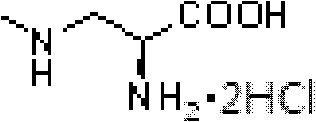
The global demand for high-purity neurochemical research intermediates has surged, driven by the critical need to understand the pathogenesis of neurodegenerative disorders such as Amyotrophic Lateral Sclerosis (ALS) and Parkinsonism-Dementia Complex (PDC). At the forefront of this research is L-BMAA (Beta-Methylamino L-Alanine) hydrochloride, a non-protein amino acid toxin increasingly scrutinized for its role in neuronal damage. A pivotal advancement in the accessible production of this compound is detailed in patent CN102234240B, which outlines a robust, five-step synthetic methodology. This technical breakthrough addresses historical bottlenecks in yield and scalability, offering a streamlined pathway that eliminates the need for labor-intensive purification techniques. For R&D directors and procurement specialists seeking a reliable pharmaceutical intermediate supplier, understanding the nuances of this patented route is essential for securing a stable supply chain of research-grade materials. The following analysis dissects the chemical ingenuity behind this process and its implications for commercial manufacturing efficiency.
The Limitations of Conventional Methods vs. The Novel Approach
The Limitations of Conventional Methods
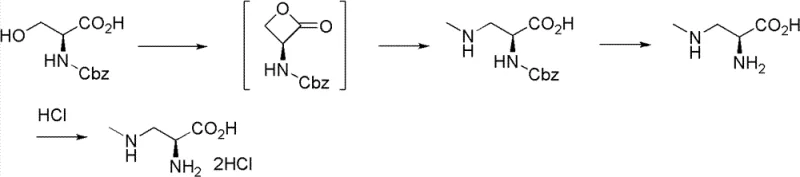
Historically, the synthesis of L-BMAA has been plagued by inefficiencies that hinder large-scale production and drive up costs for research institutions. Traditional routes, such as those documented in earlier literature like Organic Syntheses, often rely on the formation of unstable lactone intermediates. These intermediates are notoriously difficult to handle, requiring stringent control over reaction conditions to prevent decomposition before the next synthetic step can occur. Furthermore, conventional methods typically suffer from low overall yields, often hovering around 28%, which necessitates the processing of significantly larger quantities of starting materials to obtain the desired final mass. Perhaps most critically for industrial application, these older pathways frequently mandate the use of column chromatography for purification. This requirement not only introduces substantial time delays but also escalates solvent consumption and waste generation, creating a bottleneck that makes pilot-scale amplification economically unviable for many manufacturers.
The Novel Approach
In stark contrast to the limitations of legacy methods, the novel approach described in the patent data utilizes a strategic sequence of Hofmann degradation and sequential reductive aminations to bypass unstable intermediates entirely. By starting with L-carbobenzoxy asparagine, the process leverages a carbon-shortening reaction that cleanly generates the 2,3-diaminopropionic acid core without the formation of problematic lactone rings. This fundamental shift in synthetic strategy allows for a dramatic increase in total recovery, pushing the overall yield beyond the 50% threshold. Moreover, the design of this route ensures that each intermediate can be isolated through simple filtration and washing procedures, completely obviating the need for column chromatography. This simplification of the workflow translates directly into enhanced operational efficiency, reducing both the time-to-market for the intermediate and the environmental footprint associated with solvent-heavy purification processes.
Mechanistic Insights into Hofmann Degradation and Reductive Amination
The cornerstone of this improved synthesis is the initial Hofmann degradation step, which effectively shortens the carbon chain of the starting asparagine derivative. Under the influence of iodobenzene diacetyl at controlled temperatures between 20°C and 30°C, the amide group is converted into an amine with one fewer carbon atom, yielding the crucial 2,3-diaminopropionic acid intermediate. This reaction is highly sensitive to stoichiometry, with the patent specifying an optimal molar ratio of 1:1.3 between the substrate and the hypervalent iodine reagent to maximize conversion while minimizing side reactions. Following this, the process employs a dual reductive amination strategy to install the necessary nitrogen substituents. The first amination utilizes benzaldehyde to introduce a benzyl protecting group, which serves a dual purpose: it protects the amine functionality during subsequent steps and facilitates easy removal later via hydrogenolysis. The use of sodium borohydride as the reducing agent in methanol ensures mild conditions that preserve the stereochemical integrity of the chiral center, a critical factor for maintaining the biological activity of the final L-isomer.
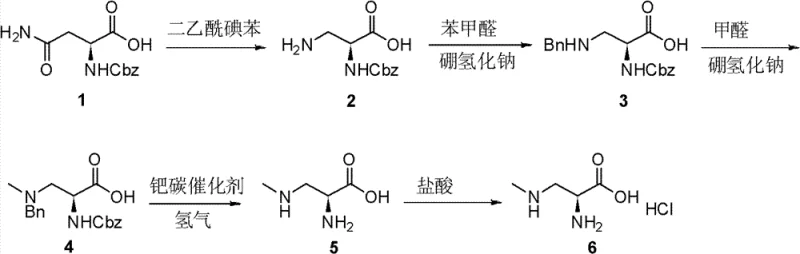
The final stages of the synthesis demonstrate exceptional elegance in their ability to streamline deprotection and salt formation. The third step involves a second reductive amination, this time with formaldehyde, to install the methyl group on the beta-amino position, completing the carbon skeleton of the target molecule. The true brilliance of the process, however, is revealed in the fourth step, where catalytic hydrogenation over palladium on carbon (Pd/C) is employed. This single operation simultaneously removes both the benzyl protecting group introduced in step two and the carbobenzoxy (Cbz) group from the starting material. This convergent deprotection strategy significantly reduces the number of unit operations required, thereby minimizing product loss and handling time. Finally, acidification with hydrochloric acid precipitates the product as the stable hydrochloride salt, ensuring high purity and stability for long-term storage and transport without the need for further recrystallization or chromatographic polishing.
How to Synthesize L-BMAA Hydrochloride Efficiently
Implementing this synthetic route requires precise adherence to the reaction parameters outlined in the patent to ensure reproducibility and safety on a commercial scale. The process begins with the dispersion of L-carbobenzoxy asparagine in a mixed solvent system of ethyl acetate and acetonitrile, where temperature control is paramount during the addition of the iodine reagent. Subsequent steps involve careful management of exothermic reactions during the reduction phases, particularly when adding sodium borohydride in batches to maintain temperatures below 30°C. The final hydrogenation step must be conducted under controlled pressure, typically ranging from 1 to 5 atmospheres, to ensure complete removal of protecting groups without over-reduction of the amino acid backbone. For detailed operational protocols, safety data sheets, and specific equipment requirements necessary for GMP-compliant manufacturing, please refer to the standardized synthesis guide provided below.
- Perform Hofmann degradation on L-carbobenzoxy asparagine using iodobenzene diacetyl to obtain 2,3-diaminopropionic acid.
- Conduct reductive amination with benzaldehyde and sodium borohydride to introduce the benzyl protecting group.
- Execute a second reductive amination with formaldehyde to install the methyl group, followed by catalytic hydrogenation.
Commercial Advantages for Procurement and Supply Chain Teams
For procurement managers and supply chain heads, the transition to this patented synthesis method represents a significant opportunity to optimize cost structures and mitigate supply risks. The elimination of column chromatography is not merely a technical improvement; it is a major economic driver that drastically reduces solvent procurement costs and waste disposal fees. Furthermore, the use of readily available raw materials such as L-asparagine derivatives and common aldehydes ensures that the supply chain is not dependent on exotic or scarce reagents that could lead to production stoppages. The robustness of the reaction conditions, which operate at near-ambient temperatures and pressures, also lowers the energy consumption profile of the manufacturing process. These factors combine to create a more resilient supply chain capable of meeting the fluctuating demands of the global research community without compromising on quality or delivery timelines.
- Cost Reduction in Manufacturing: The primary driver for cost optimization in this process is the significant simplification of the purification workflow. By removing the requirement for column chromatography, manufacturers can eliminate the substantial costs associated with silica gel, large volumes of high-purity solvents, and the specialized labor required for fraction collection. Additionally, the high overall yield exceeding 50% means that less starting material is wasted, directly improving the cost of goods sold (COGS). The ability to isolate intermediates via simple filtration further reduces equipment downtime and cleaning validation costs, allowing for faster batch turnover and higher throughput in existing production facilities without the need for capital-intensive infrastructure upgrades.
- Enhanced Supply Chain Reliability: Supply continuity is often threatened by the reliance on complex, multi-step syntheses with low yields. This new route enhances reliability by utilizing stable intermediates that do not require immediate downstream processing or cryogenic storage. The raw materials, including iodobenzene diacetyl and palladium catalysts, are commodity chemicals with established global supply networks, reducing the risk of vendor lock-in or raw material shortages. Moreover, the scalability of the process from gram to kilogram scales has been demonstrated in the patent examples, providing confidence that production can be ramped up quickly to meet urgent project deadlines or sudden spikes in demand from pharmaceutical partners.
- Scalability and Environmental Compliance: As regulatory scrutiny on chemical manufacturing intensifies, the environmental profile of a synthesis route becomes a critical selection criterion. This method aligns with green chemistry principles by minimizing solvent usage and avoiding the generation of hazardous waste streams associated with chromatographic separations. The catalytic hydrogenation step is clean, producing only water and the deprotected amine, while the final acidification step generates minimal saline waste. This reduced environmental footprint simplifies the permitting process for new production lines and ensures compliance with increasingly strict environmental, health, and safety (EHS) regulations, making it a sustainable choice for long-term commercial production.
Frequently Asked Questions (FAQ)
To assist technical teams in evaluating the feasibility of this synthesis for their specific applications, we have compiled answers to common inquiries regarding the process specifications and quality attributes. These responses are derived directly from the experimental data and claims within the patent documentation, ensuring accuracy and relevance for R&D planning. Understanding these technical details is crucial for integrating this intermediate into broader drug discovery pipelines or toxicological study programs. We encourage stakeholders to review these insights to fully appreciate the operational benefits and quality assurances provided by this advanced manufacturing route.
Q: What is the total yield advantage of this new L-BMAA synthesis method?
A: The patented process achieves a total yield exceeding 50%, which is a significant improvement over conventional methods that typically yield around 28%.
Q: Does this process require complex purification steps like column chromatography?
A: No, a key advantage of this method is that intermediates and the final product do not require purification by column chromatography, simplifying the workflow.
Q: Is this synthesis route suitable for large-scale industrial production?
A: Yes, the process uses readily available raw materials and avoids unstable intermediates, making it highly suitable for commercial scale-up.
Partnering with NINGBO INNO PHARMCHEM: Your Reliable L-BMAA Hydrochloride Supplier
At NINGBO INNO PHARMCHEM, we recognize that the integrity of your research depends on the quality and consistency of your chemical inputs. As a leading CDMO partner, we possess extensive experience scaling diverse pathways from 100 kgs to 100 MT/annual commercial production, ensuring that we can meet your volume requirements whether you are in early-stage discovery or late-stage development. Our facilities are equipped with rigorous QC labs and adhere to stringent purity specifications, guaranteeing that every batch of L-BMAA hydrochloride meets the exacting standards required for neurochemical research. We are committed to delivering not just a product, but a partnership that supports your scientific goals with reliable, high-performance intermediates.
We invite you to engage with our technical procurement team to discuss how this optimized synthesis route can benefit your specific projects. By requesting a Customized Cost-Saving Analysis, you can gain deeper insights into how our manufacturing efficiencies translate into value for your organization. We are ready to provide specific COA data and route feasibility assessments to demonstrate our capability to be your trusted partner in the supply of complex pharmaceutical intermediates. Contact us today to secure your supply chain with a manufacturer dedicated to excellence and innovation.