
Advanced Synthesis of Peryleneimide-Nojirimycin Derivatives for High-Potency Diabetes Inhibitors
Introduction to Next-Generation Glycosidase Inhibitors
The global landscape of type II diabetes treatment is undergoing a significant transformation driven by the need for more potent and selective therapeutic agents. As highlighted in recent intellectual property developments, specifically patent CN108794473B, a novel class of peryleneimide-nojirimycin derivatives has emerged as a promising candidate for next-generation antidiabetic medication. This breakthrough technology centers on the compound designated as PBI-A-6DNJ, which leverages the unique photophysical and self-assembly properties of perylene bisimide cores combined with the biological efficacy of nojirimycin toxins. Unlike traditional small molecule inhibitors, this derivative is engineered to form stable supramolecular assemblies in aqueous environments, thereby enhancing its interaction with target enzymes. For pharmaceutical developers seeking a reliable pharmaceutical intermediate supplier, understanding the structural nuances of this molecule is critical, as it represents a shift from covalent multivalent inhibitors to supramolecular systems that offer superior bioavailability and potency.
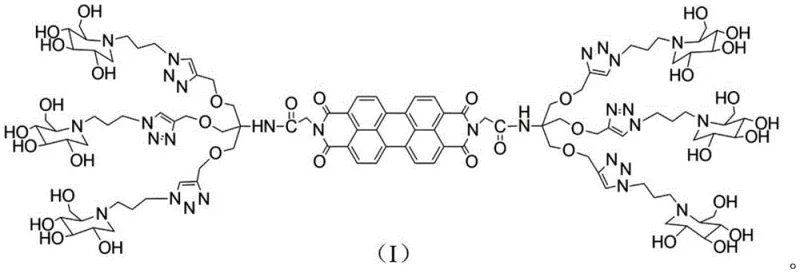
The chemical architecture of PBI-A-6DNJ, as depicted in the structural formula, reveals a sophisticated design where multiple nojirimycin units are tethered to a central perylene bisimide scaffold via triazole linkers. This multivalent presentation is not merely a structural feature but a functional necessity that amplifies the inhibitory effect through the cluster glycoside effect. The patent data indicates that this specific arrangement allows the molecule to act as a self-assembling glycosidase inhibitor, maintaining stability in physiological conditions while delivering exceptional hypoglycemic effects in vivo. For R&D teams focused on high-purity pharmaceutical intermediates, this structure offers a robust template for developing drugs that can overcome the limitations of current market leaders like miglitol and acarbose, particularly regarding dosage efficiency and side effect profiles.
The Limitations of Conventional Methods vs. The Novel Approach
The Limitations of Conventional Methods
Historically, the development of multivalent glycosidase inhibitors has relied heavily on covalent bonding strategies using scaffolds such as fullerenes or cyclic peptides. While these approaches have demonstrated improved activity over monomeric molecules, they are plagued by significant synthetic challenges and physicochemical drawbacks. For instance, fullerene derivatives modified with 1-deoxynojirimycin often suffer from poor solubility in aqueous media, which severely limits their bioavailability and practical application in oral formulations. Furthermore, the synthesis of these covalent multivalent systems frequently involves complex, multi-step procedures with low overall yields, driving up the cost of goods and complicating the supply chain. The rigid nature of some covalent scaffolds can also lead to suboptimal spatial arrangement of the inhibitory units, failing to maximize the synergistic binding affinity required for potent enzyme inhibition. These factors collectively create a bottleneck in the commercial scale-up of complex polymer additives and pharmaceutical intermediates, necessitating a paradigm shift in molecular design.
The Novel Approach
The innovative strategy presented in patent CN108794473B addresses these historical pain points by utilizing a perylene bisimide core that facilitates non-covalent supramolecular assembly. This approach fundamentally changes the solubility profile of the inhibitor, allowing it to form stable aggregates in water without the need for harsh solubilizing groups that might interfere with biological activity. By employing a modular synthesis route involving click chemistry, the new method allows for the precise attachment of six nojirimycin units to the perylene core, ensuring a defined multivalency that is difficult to achieve with polymer-based random conjugation. This structural precision translates directly to enhanced biological performance, as evidenced by the compound's ability to inhibit α-mannosidase with a Ki value of 0.038 μM. For procurement managers focused on cost reduction in API manufacturing, this novel approach offers a pathway to higher potency drugs that require lower dosages, effectively reducing the total volume of active ingredient needed per treatment course while simplifying the formulation process.
Mechanistic Insights into Click Chemistry and Supramolecular Assembly
The synthesis of PBI-A-6DNJ is a masterclass in modern organic synthesis, leveraging the reliability of copper-catalyzed azide-alkyne cycloaddition (CuAAC) to construct the complex molecular architecture. The process begins with the condensation of perylene anhydride with a glycine-modified alkynyl derivative in the presence of zinc acetate, forming the alkyne-functionalized perylene bisimide intermediate (Compound B). This step is critical as it establishes the fluorescent and self-assembling core of the molecule. Subsequently, the click reaction connects this core to the azide-functionalized nojirimycin toxin (Compound C). The use of copper sulfate and sodium ascorbate in a tetrahydrofuran-water system ensures high conversion rates under mild thermal conditions (55°C), minimizing the risk of degradation to the sensitive sugar moieties. This mechanistic pathway is highly favorable for industrial adoption because click reactions are known for their high atom economy and tolerance to various functional groups, reducing the formation of difficult-to-remove impurities.
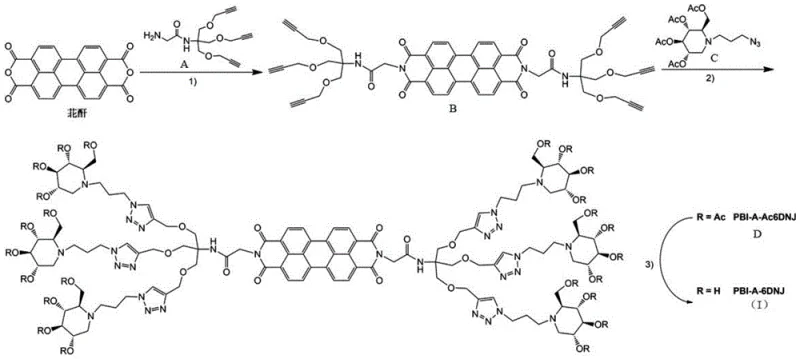
Following the assembly of the multivalent scaffold, the final deacetylation step unveils the active hydroxyl groups on the nojirimycin rings, which are essential for hydrogen bonding with the enzyme active site. The use of sodium methoxide in absolute methanol for this deprotection is a standard yet effective method that preserves the integrity of the triazole linkers and the perylene core. From a quality control perspective, this three-step sequence allows for rigorous monitoring at each stage; Intermediate B can be purified via silica gel chromatography, and the final product is purified by dialysis, a technique that effectively removes small molecule impurities and metal residues. This purification strategy is vital for meeting the stringent purity specifications required for pharmaceutical ingredients, ensuring that the final supramolecular assembly is free from cytotoxic contaminants. The resulting supramolecular structure is not static but dynamic, allowing the molecule to adapt its conformation upon binding to the glycosidase enzyme, thereby maximizing the inhibitory potential through cooperative interactions.
How to Synthesize PBI-A-6DNJ Efficiently
The preparation of this high-value glycosidase inhibitor follows a logical progression of condensation, conjugation, and deprotection, designed to maximize yield and purity at every stage. The protocol outlined in the patent provides specific molar ratios and reaction conditions that have been optimized to ensure reproducibility, which is essential for transferring the process from the laboratory to pilot plant scales. Operators must pay close attention to the removal of solvents like pyridine and tetrahydrofuran, as residual solvents can interfere with the subsequent steps and the final biological activity. The detailed standardized synthesis steps below provide a roadmap for achieving the dark red solid product with the characteristic spectral properties described in the intellectual property documentation.
- Perform a condensation reaction between perylene anhydride and a glycine-modified alkynyl derivative using zinc acetate in pyridine at 115°C to form intermediate Compound B.
- Execute a copper-catalyzed azide-alkyne cycloaddition (Click reaction) between Compound B and a protected nojirimotoxin compound in tetrahydrofuran to yield Compound D.
- Conduct a deacetylation reaction using sodium methoxide in absolute methanol followed by dialysis to obtain the final target compound PBI-A-6DNJ.
Commercial Advantages for Procurement and Supply Chain Teams
For supply chain leaders and procurement specialists, the adoption of the PBI-A-6DNJ synthesis route offers distinct strategic advantages over traditional inhibitor manufacturing. The primary benefit lies in the dramatic increase in biological potency, which fundamentally alters the cost dynamics of the final drug product. With an inhibitory activity against α-mannosidase that is 2526 times greater than that of miglitol, the required therapeutic dose of the active pharmaceutical ingredient is drastically reduced. This reduction in dosage requirement translates directly into substantial cost savings in downstream formulation, packaging, and logistics, as less material is needed to treat the same number of patients. Furthermore, the synthetic route avoids the use of exotic or scarce reagents; starting materials like perylene anhydride and glycine derivatives are readily available from bulk chemical suppliers, mitigating the risk of raw material shortages that often plague the production of complex biologics or natural product extracts.
- Cost Reduction in Manufacturing: The synthetic pathway eliminates the need for expensive transition metal catalysts often used in cross-coupling reactions, relying instead on abundant copper salts and zinc acetate. Additionally, the high yield of the final deacetylation step (reported at 92.0%) ensures that the majority of the valuable intermediate is converted into the final product, minimizing waste and maximizing material efficiency. The use of dialysis for final purification, while requiring time, avoids the high costs associated with preparative HPLC on a large scale, offering a more economically viable method for removing impurities from large supramolecular structures.
- Enhanced Supply Chain Reliability: The robustness of the click chemistry reaction ensures consistent batch-to-batch quality, which is critical for maintaining regulatory compliance and avoiding production delays. Because the reaction conditions are relatively mild and do not require extreme pressures or temperatures, the process can be easily scaled using standard stainless steel reactors found in most fine chemical manufacturing facilities. This compatibility with existing infrastructure reduces the capital expenditure required for technology transfer, allowing for faster time-to-market and a more resilient supply chain capable of meeting fluctuating demand for antidiabetic medications.
- Scalability and Environmental Compliance: The process generates minimal hazardous waste compared to traditional peptide synthesis or fullerene functionalization methods. The solvents used, such as methanol and dichloromethane, are common industrial solvents with well-established recovery and recycling protocols. The elimination of heavy metal catalysts like palladium further simplifies the waste treatment process, aligning with increasingly strict environmental regulations in the pharmaceutical industry. This green chemistry profile not only reduces disposal costs but also enhances the sustainability credentials of the final product, a factor that is becoming increasingly important for hospital formularies and government procurement agencies.
Frequently Asked Questions (FAQ)
The following questions address common technical and commercial inquiries regarding the production and application of peryleneimide-nojirimycin derivatives. These answers are derived directly from the experimental data and technical disclosures within the patent literature, providing a factual basis for decision-making. Understanding these details is essential for partners evaluating the feasibility of integrating this novel inhibitor into their existing product pipelines or research programs.
Q: What is the primary advantage of PBI-A-6DNJ over existing glycosidase inhibitors?
A: PBI-A-6DNJ exhibits significantly higher inhibitory activity against α-mannosidase, with a Ki value of 0.038 μM, which is approximately 2526 times more potent than the commercial drug miglitol, due to its stable supramolecular assembly in aqueous solutions.
Q: Is the synthesis process scalable for commercial manufacturing?
A: Yes, the synthesis utilizes standard organic reactions such as condensation and click chemistry with commercially available reagents like perylene anhydride, making it highly suitable for scale-up from laboratory to industrial production levels.
Q: Does this derivative show selectivity for specific enzymes?
A: The compound demonstrates strong selectivity for α-glycosidases, particularly α-mannosidase and α-galactosidase, while showing no activity against β-mannosidase or β-galactosidase, minimizing potential off-target effects.
Partnering with NINGBO INNO PHARMCHEM: Your Reliable PBI-A-6DNJ Supplier
As the demand for advanced antidiabetic agents continues to grow, partnering with a manufacturer that possesses deep technical expertise in complex organic synthesis is paramount. NINGBO INNO PHARMCHEM stands at the forefront of this industry, leveraging our extensive experience scaling diverse pathways from 100 kgs to 100 MT/annual commercial production to bring cutting-edge molecules like PBI-A-6DNJ to the market. Our facility is equipped with state-of-the-art reaction vessels and purification systems capable of handling the specific requirements of supramolecular assembly synthesis, ensuring that every batch meets stringent purity specifications. We understand that the transition from patent to commercial product requires more than just chemical capability; it demands a partnership built on trust, transparency, and rigorous quality assurance, which is why our rigorous QC labs are dedicated to verifying the identity and potency of every intermediate and final product.
We invite pharmaceutical companies and research institutions to collaborate with us to unlock the full potential of this novel glycosidase inhibitor. Our technical team is ready to provide a Customized Cost-Saving Analysis tailored to your specific production volumes and formulation needs, helping you identify opportunities to optimize your supply chain. We encourage you to contact our technical procurement team today to request specific COA data and route feasibility assessments, ensuring that your next generation of diabetes treatments is built on a foundation of scientific excellence and manufacturing reliability.