
Advanced Deep Blue TADF Emitters: Breakthroughs in Color Purity and Commercial Scalability
The landscape of organic light-emitting diode (OLED) technology is currently undergoing a significant transformation driven by the urgent demand for high-performance deep blue emitters that do not compromise on efficiency or stability. Patent CN110790782A introduces a groundbreaking class of dark blue organic luminescent materials characterized by a unique B/Bi-N host structure, which effectively addresses the longstanding challenges of broad emission spectra and poor stability found in conventional Thermally Activated Delayed Fluorescence (TADF) materials. This innovation leverages enhanced resonance effects between atoms within the molecular framework to achieve a distinct separation of the Highest Occupied Molecular Orbital (HOMO) and Lowest Unoccupied Molecular Orbital (LUMO), resulting in an exceptionally narrow emission spectrum with a half-peak width of less than 40nm. For R&D directors and procurement specialists in the electronic chemicals sector, this represents a pivotal shift towards cost-effective, high-purity OLED materials that can be manufactured without reliance on scarce precious metals like Iridium, thereby offering a sustainable pathway for next-generation display technologies.
The Limitations of Conventional Methods vs. The Novel Approach
The Limitations of Conventional Methods
Traditional approaches to achieving blue emission in OLED devices have historically relied heavily on phosphorescent materials containing heavy metals such as Iridium, exemplified by complexes like FirPic, which suffer from inherently broad emission spectra with half-peak widths often exceeding 80nm. This broad spectral output severely compromises the color purity of the blue sub-pixel, necessitating complex optical filtering that reduces overall device efficiency and increases manufacturing costs. Furthermore, the synthesis of these precious metal complexes involves intricate multi-step procedures with low atom economy, creating significant supply chain vulnerabilities and price volatility associated with the fluctuating market value of Iridium. Additionally, many existing TADF materials based on standard Donor-Acceptor (D-A) architectures struggle with stability issues under operational conditions, leading to shortened device lifespans that are unacceptable for commercial consumer electronics applications requiring thousands of hours of reliable performance.
The Novel Approach
The novel synthetic strategy outlined in the patent circumvents these limitations by employing a robust Boron or Bismuth-centered core that facilitates strong molecular orbital coupling without the need for expensive transition metals. This approach utilizes a straightforward two-step synthesis beginning with a palladium-catalyzed amination to construct the precursor backbone, followed by a high-temperature cyclization with MBr3 to lock in the rigid B/Bi-N structure. 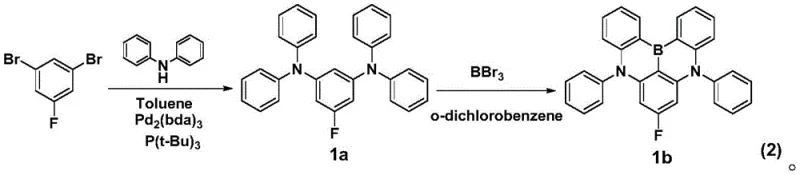 As demonstrated in the specific embodiment for compound 1b, this method yields materials with remarkable thermal stability, evidenced by decomposition temperatures reaching approximately 420°C, which ensures compatibility with standard vacuum deposition processes. By eliminating the dependency on Iridium and simplifying the molecular design to focus on resonance-enhanced main group elements, this technology offers a scalable and economically viable solution for producing high-purity deep blue emitters that meet rigorous commercial standards.
Mechanistic Insights into Pd-Catalyzed Amination and Boron Cyclization
The core of this technological advancement lies in the precise manipulation of electronic properties through the strategic construction of the B/Bi-N主体结构 (host structure), which is achieved via a sophisticated catalytic cycle involving palladium and subsequent Lewis acid-mediated cyclization. The initial step involves a Buchwald-Hartwig type amination where tris(dibenzylideneacetone)dipalladium and tri-tert-butylphosphine act as a highly active catalytic system to couple 1,3-dibromobenzene derivatives with secondary amines. This reaction is critical for establishing the steric and electronic environment necessary for the subsequent ring closure, occurring under inert atmosphere in anhydrous toluene at temperatures between 105-115°C to ensure complete conversion while minimizing side reactions. The mechanistic precision here allows for the introduction of diverse substituents (R1-R4) that can fine-tune the solubility and film-forming properties of the final material without disrupting the core emissive properties.
Following the formation of the ditertiary amine intermediate, the system undergoes a transformative cyclization reaction with MBr3 (where M is Boron or Bismuth) in anhydrous o-dichlorobenzene at elevated temperatures of 175-185°C. 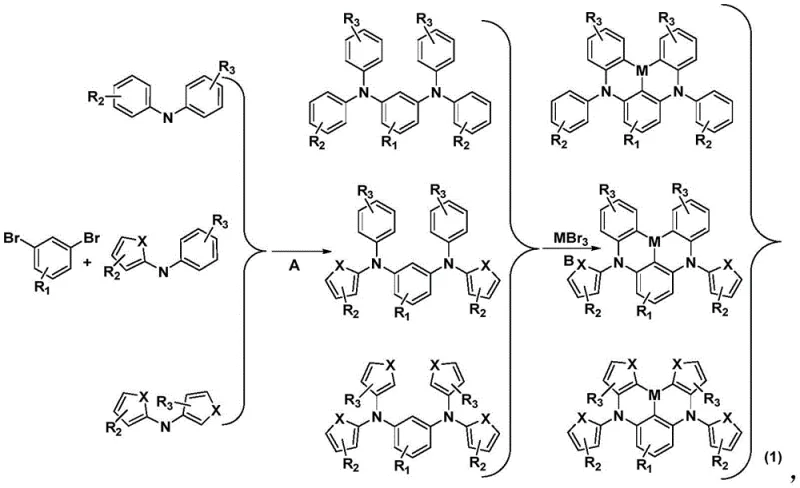 This high-energy step is essential for forming the rigid planar structure that enforces the separation of HOMO and LUMO orbitals, thereby reducing the singlet-triplet energy gap (ΔEST) to less than 0.4 eV and enabling efficient TADF. The heavy atom effect introduced by Bismuth variants further enhances spin-orbit coupling, potentially boosting radiative decay rates and overall quantum efficiency. This dual-mechanism approach ensures that the resulting materials not only possess the desired narrow-band deep blue emission but also maintain structural integrity under the thermal stress of device operation, providing a robust foundation for high-performance OLED applications.
How to Synthesize Deep Blue Organic Luminescent Material Efficiently
The synthesis protocol described in the patent provides a clear and reproducible pathway for manufacturing these advanced emitters, emphasizing the use of readily available starting materials and standard laboratory equipment that can be easily adapted for industrial scale-up. The process begins with the careful preparation of the amine precursor under strictly anhydrous conditions to prevent catalyst deactivation, followed by a high-temperature cyclization that requires precise thermal control to maximize yield and purity. Detailed standardized synthesis steps for the efficient production of these compounds are provided in the guide below, outlining the specific molar ratios, solvent choices, and purification techniques necessary to achieve the high quality required for electronic grade materials.
- Perform Pd-catalyzed amination of R1-substituted 1,3-dibromobenzene with secondary amines in anhydrous toluene at 105-115°C to form ditertiary amine intermediates.
- React the ditertiary amine intermediate with MBr3 (where M is B or Bi) in anhydrous o-dichlorobenzene at 175-185°C to achieve cyclization and form the final deep blue emitter.
Commercial Advantages for Procurement and Supply Chain Teams
From a procurement and supply chain perspective, the adoption of this B/Bi-N based technology offers substantial strategic advantages by decoupling production costs from the volatile precious metals market and simplifying the raw material sourcing landscape. The elimination of Iridium and other rare earth metals removes a significant cost driver and supply risk, allowing manufacturers to secure long-term contracts for base chemicals like bromobenzenes and amines which are produced in vast quantities globally. Furthermore, the high thermal stability of the final products reduces waste associated with material degradation during storage and processing, contributing to a more lean and efficient inventory management system for OLED panel manufacturers.
- Cost Reduction in Manufacturing: The replacement of expensive Iridium complexes with abundant Boron or Bismuth centers fundamentally alters the cost structure of blue emitter production, leading to significant savings in raw material expenditures. By utilizing a palladium-catalyzed route that operates with high efficiency and selectivity, the process minimizes the need for complex purification steps often required to remove trace metal contaminants, further driving down the cost of goods sold. This economic efficiency makes high-quality deep blue emission accessible for a broader range of display applications, from premium smartphones to large-area television panels, without compromising margin.
- Enhanced Supply Chain Reliability: Sourcing strategies are greatly simplified as the key precursors, such as substituted dibromobenzenes and various secondary amines, are commodity chemicals with established global supply chains. This abundance ensures consistent availability and mitigates the risk of production stoppages due to raw material shortages, a common issue with specialty organometallic reagents. Additionally, the robust nature of the synthesis intermediates allows for flexible logistics and storage options, ensuring that production schedules can be maintained even during periods of global supply chain disruption.
- Scalability and Environmental Compliance: The synthetic route is designed with scalability in mind, utilizing solvents like toluene and o-dichlorobenzene that are well-understood in industrial chemical engineering contexts and can be efficiently recovered and recycled. The high yields reported in the embodiments, such as the 94% yield for the intermediate and 45-83% for the final cyclized products, indicate a process that generates minimal waste relative to product output, aligning with increasingly stringent environmental regulations. This green chemistry profile facilitates easier permitting for new manufacturing facilities and supports corporate sustainability goals regarding waste reduction and energy efficiency.
Frequently Asked Questions (FAQ)
The following questions address common technical and commercial inquiries regarding the implementation of this deep blue organic luminescent material technology in OLED manufacturing workflows. These answers are derived directly from the experimental data and technical specifications disclosed in the patent documentation to provide accurate guidance for engineering teams.
Q: How does this material improve color purity compared to traditional TADF emitters?
A: By utilizing a B/Bi-N host structure that enhances resonance effects to separate HOMO and LUMO distributions, the material achieves a very narrow emission spectrum with a half-peak width of less than 40nm, significantly improving blue color purity.
Q: Does this synthesis route rely on expensive precious metal catalysts like Iridium?
A: No, unlike traditional phosphorescent materials that require expensive Iridium complexes, this invention utilizes Boron or Bismuth centers, which drastically reduces raw material costs and dependency on scarce precious metals.
Q: What is the thermal stability profile of these new deep blue emitters?
A: The materials exhibit excellent thermal stability with decomposition temperatures around 420°C, ensuring robustness during the vacuum evaporation processes required for OLED device fabrication.
Partnering with NINGBO INNO PHARMCHEM: Your Reliable Deep Blue Organic Luminescent Material Supplier
As the demand for high-performance display materials continues to surge, partnering with an experienced CDMO like NINGBO INNO PHARMCHEM ensures access to cutting-edge synthesis capabilities and rigorous quality assurance protocols. We possess extensive experience scaling diverse pathways from 100 kgs to 100 MT/annual commercial production, leveraging our state-of-the-art facilities to deliver materials with stringent purity specifications required for advanced optoelectronic applications. Our dedicated rigorous QC labs employ advanced analytical techniques to verify the narrow emission spectra and thermal stability of every batch, guaranteeing that the deep blue emitters you receive will perform consistently in your final OLED devices.
We invite you to engage with our technical procurement team to discuss how this innovative B/Bi-N technology can be integrated into your supply chain to drive down costs and enhance product performance. By requesting a Customized Cost-Saving Analysis, you can gain deeper insights into the economic benefits of switching to our metal-free emitter platform. We encourage potential partners to contact us directly to obtain specific COA data and route feasibility assessments tailored to your unique manufacturing requirements, ensuring a seamless transition to next-generation deep blue OLED materials.