
Advanced Silicon-Benzanthracene Derivatives: Revolutionizing Blue OLED Efficiency and Stability
Advanced Silicon-Benzanthracene Derivatives: Revolutionizing Blue OLED Efficiency and Stability
The rapid evolution of organic light-emitting diode (OLED) technology has placed immense pressure on material scientists to develop blue emitters that match the efficiency and longevity of their red and green counterparts. As detailed in patent CN103805169A, a breakthrough class of silicon-containing benzanthracene organic electroluminescent materials has emerged to address these critical industrial bottlenecks. This proprietary technology leverages the unique steric and electronic properties of silicon-substituted polycyclic aromatic hydrocarbons to achieve exceptional luminous efficiency, reported at 94.8% in dilute solution and 61.7% in thin films. For R&D directors and procurement specialists seeking a reliable OLED material supplier, this innovation represents a paradigm shift, offering a pathway to devices with half-lives extending up to 20000 hours while maintaining superior color coordinates.
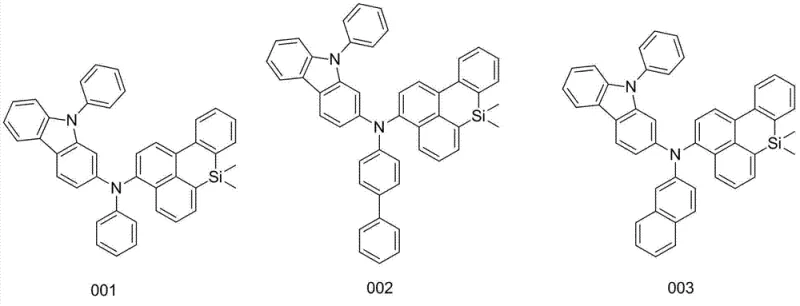
Beyond mere performance metrics, the true value of this technology lies in its manufacturability. Traditional blue emitters often suffer from complex synthetic routes that hinder cost reduction in electronic chemical manufacturing. In contrast, the silicon-benzanthracene series described in the patent utilizes a streamlined palladium-catalyzed coupling strategy. This approach not only simplifies the molecular architecture but also enhances the solubility of the final product, a crucial factor for solution-processable OLEDs. By integrating silicon atoms into the benzanthracene core, the material achieves a balance between rigid conjugation for charge transport and flexible substituents for processability, making it an ideal candidate for next-generation display and lighting applications.
The Limitations of Conventional Methods vs. The Novel Approach
The Limitations of Conventional Methods
Historically, the development of blue organic发光 materials has been plagued by intrinsic stability issues and processing difficulties. Conventional systems based on triarylamines, simple anthracene derivatives, or carbazole complexes often exhibit short operational lifespans and poor film-forming characteristics. These deficiencies stem from the tendency of planar aromatic systems to aggregate or crystallize unpredictably during vacuum deposition, leading to pinholes and non-uniform emission zones. Furthermore, the synthetic pathways for many high-performance blue dopants involve multi-step sequences with harsh reaction conditions, resulting in low overall yields and difficult purification processes. For supply chain heads, this translates to inconsistent batch quality and extended lead times for high-purity electronic chemicals, ultimately inflating the cost of goods sold for OLED panel manufacturers.
The Novel Approach
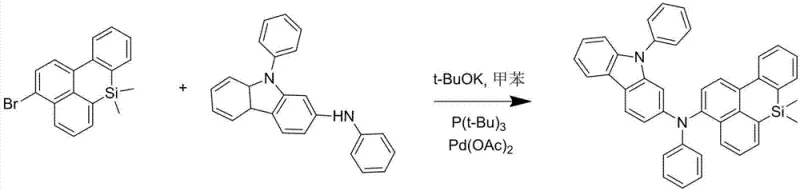
The novel approach presented in patent CN103805169A overcomes these hurdles through strategic molecular engineering. By introducing a silicon atom bearing methyl groups into the benzanthracene scaffold, the inventors have created a material with significantly improved solubility and thermal stability. This structural modification disrupts excessive pi-stacking interactions that typically lead to quenching, thereby enhancing the photoluminescence quantum yield. The synthetic route is remarkably efficient, relying on a direct coupling between a silicon-containing benzanthracene bromide and various amine derivatives. This modularity allows for the fine-tuning of emission wavelengths and energy levels without compromising the core stability. Consequently, this method offers a robust solution for the commercial scale-up of complex polymer additives and small molecule emitters, ensuring consistent quality from gram-scale lab synthesis to ton-scale production.
Mechanistic Insights into Pd-Catalyzed C-N Coupling
The core of this synthesis relies on a sophisticated palladium-catalyzed amination reaction, commonly known as the Buchwald-Hartwig coupling. In this mechanism, the silicon-containing benzanthracene bromide serves as the electrophilic partner, undergoing oxidative addition with the Pd(0) species generated in situ from Pd(OAc)2 and the bulky phosphine ligand P(t-Bu)3. The use of tri-tert-butylphosphine is critical; its large cone angle and electron-donating capability facilitate the oxidative addition step even with sterically hindered substrates and stabilize the active catalytic species against decomposition. Following oxidative addition, the deprotonated amine nucleophile, activated by the strong base potassium tert-butoxide (t-BuOK), coordinates to the palladium center. This is followed by reductive elimination, which forms the new C-N bond and regenerates the Pd(0) catalyst, completing the cycle. This mechanistic precision ensures high conversion rates and minimizes the formation of homocoupling byproducts.
Impurity control is another vital aspect of this mechanism that appeals to quality assurance teams. The reaction conditions—specifically the temperature range of 80°C to 90°C and the nitrogen atmosphere—are optimized to prevent side reactions such as debromination or ligand degradation. The choice of toluene as a solvent provides an ideal medium for dissolving both the organic precursors and the inorganic base, ensuring homogeneous reaction kinetics. Post-reaction, the crude product can be easily purified through standard silica gel chromatography followed by recrystallization. This simplicity in downstream processing is a direct result of the clean reaction profile afforded by the specific catalyst system, allowing manufacturers to achieve HPLC purity greater than 98% with minimal material loss, a key metric for cost-effective production.
How to Synthesize Silicon-Containing Benzanthracene Efficiently
The synthesis protocol outlined in the patent provides a clear roadmap for producing these high-value materials with reproducibility. The process begins with the precise weighing of the silicon-containing benzanthracene bromide and the chosen amine substituent, maintaining a molar ratio of 1:2.0 to 2.5 to drive the reaction to completion. These reactants are dissolved in toluene, creating a homogeneous solution ready for catalysis. The addition of the catalyst system—comprising Pd(OAc)2, P(t-Bu)3, and t-BuOK—must be handled under strict inert conditions to prevent oxidation of the sensitive phosphine ligand. Once the reagents are combined, the mixture is heated to promote the coupling reaction, after which standard workup procedures yield the final high-purity product.
- Charge a reactor with silicon-containing benzanthracene bromide and substituted amine at a 1: 2.0~2.5 molar ratio in toluene.
- Add potassium tert-butoxide, palladium acetate, and tri-tert-butylphosphine catalysts under nitrogen protection.
- Heat the mixture to 80°C~90°C for 6~8 hours, then filter, purify via column chromatography, and recrystallize.
Commercial Advantages for Procurement and Supply Chain Teams
For procurement managers and supply chain strategists, the adoption of this silicon-benzanthracene technology offers tangible benefits beyond mere technical specifications. The primary advantage lies in the simplification of the supply chain for raw materials. The precursors required for this synthesis, specifically the brominated benzanthracene derivatives and various substituted amines, are chemically stable and can be sourced from established chemical suppliers. This reduces the risk of supply disruptions that often plague exotic or highly specialized OLED intermediates. Furthermore, the robustness of the reaction conditions means that the process is less sensitive to minor variations in temperature or reagent quality, leading to higher batch-to-b consistency. This reliability is crucial for maintaining continuous production lines in the fast-paced consumer electronics sector.
- Cost Reduction in Manufacturing: The economic viability of this material is driven by its high yield and simplified purification. Traditional OLED materials often require multiple sublimation steps to reach device-grade purity, a process that is energy-intensive and results in significant material loss. In contrast, the method described in CN103805169A achieves yields exceeding 93% with purity levels sufficient for device fabrication after simple recrystallization. By eliminating the need for complex and costly purification stages, manufacturers can realize substantial cost savings. Additionally, the use of common solvents like toluene and standard catalysts avoids the expense of specialized reagents, further driving down the cost of goods.
- Enhanced Supply Chain Reliability: The modular nature of the synthesis allows for flexible production scheduling. Since the core silicon-benzanthracene bromide can be coupled with a variety of amines to produce different derivatives (such as Compounds 001-006), a single production line can be adapted to manufacture multiple SKUs with minimal changeover time. This flexibility enhances supply chain resilience, allowing suppliers to respond quickly to shifting market demands for specific emission colors or efficiency profiles. Moreover, the stability of the intermediates ensures that inventory can be held safely without significant degradation, providing a buffer against demand spikes.
- Scalability and Environmental Compliance: Scaling this chemistry from the laboratory to industrial reactors is straightforward due to the absence of extreme conditions. The reaction operates at moderate temperatures (80°C-90°C) and atmospheric pressure, reducing the engineering controls required for safety. From an environmental perspective, the high atom economy of the coupling reaction and the ability to recover and recycle the toluene solvent contribute to a greener manufacturing footprint. The reduction in waste generation aligns with increasingly stringent global environmental regulations, mitigating the risk of compliance-related shutdowns and enhancing the sustainability profile of the final electronic product.
Frequently Asked Questions (FAQ)
The following questions address common technical and commercial inquiries regarding the implementation of silicon-containing benzanthracene materials in OLED architectures. These insights are derived directly from the experimental data and beneficial effects reported in the patent documentation, providing a factual basis for decision-making.
Q: How does the silicon substitution improve OLED performance compared to traditional anthracene?
A: The introduction of silicon atoms with methyl groups significantly enhances solubility and film-forming properties compared to pure benzanthracene, leading to better device morphology and a prolonged half-life of up to 20000 hours.
Q: What is the typical purity and yield achievable with this synthesis method?
A: The patented process consistently achieves yields exceeding 93% with HPLC purity greater than 98%, ensuring high-quality material suitable for vacuum evaporation without extensive sublimation cycles.
Q: Is this material suitable for large-scale commercial production?
A: Yes, the synthesis utilizes standard Buchwald-Hartwig coupling conditions with readily available catalysts and solvents like toluene, making it highly scalable for industrial manufacturing of electronic chemicals.
Partnering with NINGBO INNO PHARMCHEM: Your Reliable Silicon-Containing Benzanthracene Supplier
At NINGBO INNO PHARMCHEM, we understand that the transition from patent concept to commercial reality requires a partner with deep technical expertise and robust manufacturing capabilities. Our team possesses extensive experience scaling diverse pathways from 100 kgs to 100 MT/annual commercial production, ensuring that your supply needs are met with precision and consistency. We are committed to delivering materials that meet stringent purity specifications, utilizing our rigorous QC labs to verify every batch against the high standards set by patents like CN103805169A. Whether you require custom synthesis of specific derivatives or large-scale supply of standard emitters, our infrastructure is designed to support your growth in the competitive OLED market.
We invite you to collaborate with us to optimize your material sourcing strategy. Our technical sales team is ready to provide a Customized Cost-Saving Analysis tailored to your specific production volumes and purity requirements. By partnering with NINGBO INNO PHARMCHEM, you gain access to specific COA data and route feasibility assessments that can accelerate your product development cycles. Contact our technical procurement team today to discuss how our advanced silicon-benzanthracene solutions can enhance the performance and profitability of your next-generation display technologies.