
Advanced Biocatalytic Synthesis of Chiral Alcohols Using Recombinant ScCR Oxidoreductase
The pharmaceutical and fine chemical industries are constantly seeking more efficient pathways to synthesize optically active chiral alcohols, which serve as critical building blocks for numerous active pharmaceutical ingredients (APIs). A significant technological breakthrough in this domain is documented in Chinese Patent CN102154377B, which discloses the novel application of a specific oxidoreductase, known as ScCR, derived from Streptomyces coelicolor. This patent details a recombinant enzyme capable of catalyzing the asymmetric reduction of prochiral carbonyl compounds with exceptional efficiency. Unlike traditional methods that struggle with cofactor costs or harsh reaction conditions, this innovation introduces a streamlined biocatalytic system that achieves high conversion rates and superior optical purity. For procurement managers and R&D directors alike, understanding the implications of this technology is vital for optimizing supply chains and reducing the overall cost of goods sold for complex chiral intermediates.
The Limitations of Conventional Methods vs. The Novel Approach
The Limitations of Conventional Methods
Historically, the production of optically active chiral alcohols has relied heavily on chemically catalyzed asymmetric reduction or older biocatalytic methods, both of which present significant operational drawbacks. Chemical catalysis typically necessitates the use of precious metal catalysts such as rhodium or ruthenium, which are not only prohibitively expensive but also pose severe environmental hazards due to heavy metal contamination risks. Furthermore, removing trace metal residues from the final product to meet stringent pharmaceutical purity standards requires additional downstream processing steps, thereby inflating production costs. On the biological front, conventional enzymatic reductions often suffer from the high cost of cofactors; specifically, the necessity of adding stoichiometric amounts of expensive reduced cofactors like NADPH or implementing complex dual-enzyme systems (such as glucose dehydrogenase) for regeneration adds layers of complexity and expense to the manufacturing process.
The Novel Approach
The technology described in patent CN102154377B offers a transformative solution by utilizing the recombinant ScCR oxidoreductase, which simplifies the reaction architecture significantly. This novel approach eliminates the dependency on expensive auxiliary enzymes for cofactor regeneration by leveraging the enzyme's inherent ability to utilize isopropanol as a hydrogen donor. This means the system can regenerate its own NADH cofactor in situ, driving the reaction forward without the need for external glucose or secondary enzyme additions. Moreover, the process operates under mild conditions, typically between 25°C and 30°C, and remarkably does not require precise pH control during the reaction phase, which drastically reduces the engineering controls needed for large-scale fermentation and synthesis. This simplicity translates directly into a more robust and cost-effective manufacturing protocol for high-value chiral intermediates.
Mechanistic Insights into ScCR-Catalyzed Asymmetric Reduction
The core of this technology lies in the unique catalytic cycle of the ScCR enzyme, which facilitates a coupled redox reaction that ensures thermodynamic favorability and high atom economy. The ScCR oxidoreductase acts as a carbonyl reductase, transferring a hydride ion from the reduced cofactor NADH to the prochiral carbonyl substrate, thereby converting it into the desired chiral alcohol while oxidizing NADH back to NAD+. Crucially, the enzyme also exhibits alcohol dehydrogenase activity, allowing it to simultaneously oxidize isopropanol into acetone. This secondary reaction reduces NAD+ back to NADH, effectively closing the catalytic loop and ensuring a continuous supply of the reducing equivalent without external intervention. This self-sufficient cofactor regeneration mechanism is the key to the process's economic viability, as it removes the need for costly external regeneration systems.
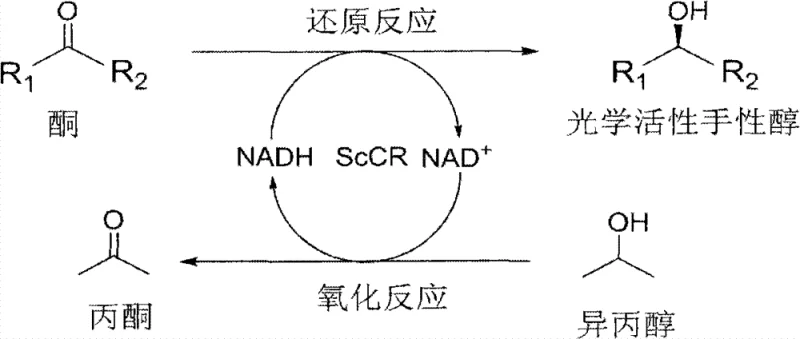
In terms of impurity control and stereoselectivity, the ScCR enzyme demonstrates remarkable specificity, producing chiral alcohols with an enantiomeric excess (ee) value greater than 99%. This high level of stereocontrol is essential for pharmaceutical applications where the wrong enantiomer can be inactive or even toxic. The patent data indicates that the enzyme maintains this high selectivity even at high substrate loadings, such as 600g/L for ethyl 4-chloroacetoacetate (COBE), achieving nearly 100% conversion. The ability to operate in a two-phase system (organic solvent/water) further aids in managing substrate inhibition and product toxicity, allowing for higher concentrations of reactants and simplifying the extraction of the hydrophobic chiral alcohol product from the aqueous enzymatic phase.
How to Synthesize Optically Active Chiral Alcohols Efficiently
Implementing this biocatalytic route involves a straightforward sequence of operations that begins with the expression of the recombinant enzyme and concludes with the isolation of the pure chiral product. The process is designed to be scalable, moving seamlessly from laboratory benchtop experiments to industrial fermenters. The initial step involves cultivating the recombinant host, typically E. coli BL21(DE3), to produce the ScCR enzyme, which can then be harvested as freeze-dried cells or crude enzyme powder for immediate use. The subsequent reduction reaction is conducted in a buffered aqueous system, optionally with an organic overlay, where the substrate, cofactor, and hydrogen donor are mixed under controlled thermal conditions. Detailed standardized synthetic steps for this process are provided in the guide below.
- Prepare the recombinant ScCR enzyme by cultivating E. coli BL21(DE3) transformed with the ScCR gene, followed by cell harvesting and lysis to obtain crude enzyme powder or freeze-dried cells.
- Establish a reaction system containing the prochiral carbonyl substrate (e.g., ethyl 4-chloroacetoacetate), NAD+ cofactor, and isopropanol as the hydrogen donor in a phosphate buffer.
- Incubate the mixture at mild temperatures (25-30°C) allowing the ScCR to catalyze the reduction while simultaneously regenerating NADH via isopropanol oxidation, yielding high-purity chiral alcohols.
Commercial Advantages for Procurement and Supply Chain Teams
For procurement managers and supply chain heads, the adoption of the ScCR-mediated reduction process offers tangible strategic advantages that extend beyond mere technical feasibility. The elimination of expensive noble metal catalysts and auxiliary enzyme systems directly impacts the bill of materials, leading to substantial cost savings in raw material procurement. Furthermore, the robustness of the enzyme under mild conditions reduces the energy consumption associated with heating, cooling, and rigorous pH monitoring, contributing to a lower overall carbon footprint and operational expenditure. The high substrate tolerance of the ScCR system means that manufacturers can achieve higher throughput per batch, optimizing facility utilization rates and reducing the lead time required to fulfill large-volume orders for critical pharmaceutical intermediates.
- Cost Reduction in Manufacturing: The most significant economic driver of this technology is the removal of the auxiliary cofactor regeneration system. Traditional biocatalytic processes often require the addition of glucose and glucose dehydrogenase to recycle NADPH, which represents a recurring and significant cost center. By utilizing isopropanol, a commodity chemical, for in situ NADH regeneration, the ScCR process drastically simplifies the reagent list. Additionally, the absence of heavy metal catalysts negates the need for expensive metal scavenging resins and specialized waste treatment protocols, further lowering the total cost of production for high-purity chiral alcohols.
- Enhanced Supply Chain Reliability: Supply chain resilience is bolstered by the use of widely available and stable reagents. Isopropanol and NAD+ are commoditized chemicals with secure global supply lines, unlike specialized enzymes or precious metals which can be subject to geopolitical volatility or supply shortages. The recombinant nature of the ScCR enzyme also ensures a consistent and renewable source of the biocatalyst, as it can be produced on-demand via fermentation. This reliability minimizes the risk of production stoppages due to raw material unavailability, ensuring a steady flow of intermediates to downstream API manufacturing sites.
- Scalability and Environmental Compliance: From an environmental and scaling perspective, the process is highly favorable. The reaction conditions are mild and aqueous-based, reducing the reliance on volatile organic solvents compared to purely chemical syntheses. The high conversion rates and selectivity minimize the formation of by-products, simplifying purification and reducing solvent waste generation. This aligns well with green chemistry principles and increasingly stringent environmental regulations, making it easier for manufacturers to obtain necessary permits and maintain sustainable operations while scaling up from pilot batches to multi-ton commercial production.
Frequently Asked Questions (FAQ)
The following questions address common technical and commercial inquiries regarding the implementation of ScCR oxidoreductase technology. These insights are derived directly from the experimental data and claims within the patent documentation, providing a factual basis for evaluating the technology's fit within your existing manufacturing framework. Understanding these nuances is crucial for making informed decisions about process adoption and supplier qualification.
Q: What is the primary advantage of ScCR oxidoreductase over traditional chemical catalysts?
A: Unlike chemical catalysts requiring expensive heavy metals like rhodium or ruthenium which are difficult to recover, ScCR operates under mild conditions without toxic metals, offering superior environmental compliance and easier product separation.
Q: How does the ScCR system manage cofactor regeneration costs?
A: The ScCR enzyme possesses dual activity, catalyzing both carbonyl reduction and alcohol dehydrogenation. This allows it to use inexpensive isopropanol to regenerate the necessary NADH cofactor in situ, eliminating the need for costly auxiliary enzyme systems like glucose dehydrogenase.
Q: Can this process handle high substrate concentrations for industrial scale-up?
A: Yes, the patent demonstrates that the ScCR catalyst maintains high conversion rates and optical purity even at substrate concentrations as high as 600g/L in a two-phase system, indicating robust scalability for commercial manufacturing.
Partnering with NINGBO INNO PHARMCHEM: Your Reliable Chiral Alcohols Supplier
At NINGBO INNO PHARMCHEM, we recognize the transformative potential of advanced biocatalytic technologies like the ScCR oxidoreductase system in modernizing the synthesis of pharmaceutical intermediates. As a dedicated CDMO partner, we possess extensive experience scaling diverse pathways from 100 kgs to 100 MT/annual commercial production, ensuring that innovative laboratory processes are successfully translated into robust industrial realities. Our facilities are equipped with rigorous QC labs and adhere to stringent purity specifications, guaranteeing that every batch of chiral alcohol delivered meets the exacting standards required for global pharmaceutical markets.
We invite you to collaborate with us to leverage this cutting-edge technology for your specific project needs. Our technical team is prepared to provide a Customized Cost-Saving Analysis tailored to your target molecule, demonstrating exactly how this enzymatic route can optimize your budget. Please contact our technical procurement team today to request specific COA data and route feasibility assessments, and let us help you secure a reliable, cost-effective supply of high-purity chiral intermediates.