
Advanced Iridium-Catalyzed Synthesis of 2-Silyl Indoles for Scalable Pharmaceutical Production
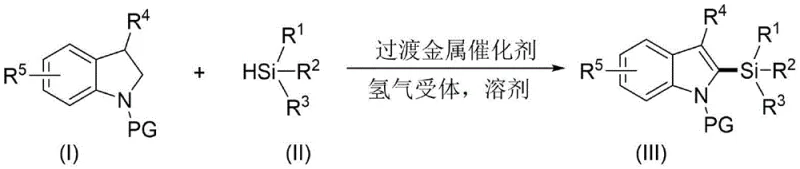
The pharmaceutical and fine chemical industries are constantly seeking more efficient pathways to access complex heterocyclic scaffolds, particularly those containing silicon-carbon bonds which offer unique metabolic stability and electronic properties. Patent CN114736230A introduces a groundbreaking preparation method for 2-silyl indole compounds, utilizing indoline derivatives and hydrosilanes as primary raw materials. This innovation represents a significant leap forward in synthetic methodology, employing a transition metal catalyst and a hydrogen acceptor to facilitate a direct hydrocarbon silylation reaction in an organic solvent. By bypassing traditional multi-step sequences, this technology provides a high-atom economical route that is not only theoretically robust but also practically viable for the production of high-purity pharmaceutical intermediates. The ability to construct the indole core and install the silyl group simultaneously addresses long-standing challenges in process chemistry, offering a streamlined solution for manufacturers aiming to optimize their supply chains for advanced drug substances.
The Limitations of Conventional Methods vs. The Novel Approach
The Limitations of Conventional Methods
Historically, the synthesis of C2-silyl indole derivatives has relied heavily on methods that are fraught with operational complexities and environmental drawbacks. One prevalent approach involves the direct dehydrocoupling of indoles with hydrosilanes, which often requires harsh conditions or specific catalysts that may not be universally applicable across diverse substrate scopes. More critically, another common strategy, often referred to as Method Two in prior art, necessitates the use of stoichiometric amounts of organolithium reagents such as butyllithium for pre-lithiation at the C2 position. This traditional route demands cryogenic temperatures to control reactivity, followed by quenching with chlorosilanes and a subsequent oxidative dehydrogenation step. Such a multi-step protocol generates substantial quantities of difficult-to-dispose inorganic salts, suffers from poor atom economy, and poses significant safety risks due to the handling of pyrophoric reagents, making it less desirable for modern green chemistry standards and large-scale commercial operations.
The Novel Approach
In stark contrast to these legacy techniques, the methodology disclosed in CN114736230A utilizes a one-pot oxidative dehydrosilylation strategy that transforms readily available indoline derivatives directly into the desired 2-silyl indoles. This novel approach leverages the power of transition metal catalysis, specifically employing iridium complexes in conjunction with a hydrogen acceptor like norbornene (NBE), to drive the reaction forward under relatively mild thermal conditions. By starting from the saturated indoline ring, the process effectively combines C-H activation with oxidative aromatization in a single operational sequence. This eliminates the need for hazardous organometallic reagents and cryogenic setups, thereby simplifying the reactor requirements and significantly enhancing the safety profile of the manufacturing process. The result is a cleaner reaction profile with fewer byproducts, aligning perfectly with the industry's push towards sustainable and cost-effective synthetic routes for complex organic molecules.
Mechanistic Insights into Iridium-Catalyzed Oxidative Dehydrosilylation
The core of this technological advancement lies in the sophisticated interplay between the transition metal catalyst and the hydrogen acceptor, which facilitates a cascade of elementary steps leading to the final product. The mechanism likely initiates with the coordination of the indoline nitrogen to the iridium center, directing the metal to activate the proximal C-H bond at the C2 position through a cyclometalation process. Once the C-Ir bond is formed, the hydrosilane undergoes sigma-bond metathesis or oxidative addition to transfer the silyl group to the carbon framework. Crucially, the presence of the hydrogen acceptor, such as norbornene, serves to scavenge the hydrogen atoms released during the aromatization of the indoline ring to the indole system. This dehydrogenation step is thermodynamically driven by the hydrogenation of the acceptor, pushing the equilibrium towards the formation of the aromatic indole product. This elegant mechanistic design ensures high efficiency and selectivity, minimizing side reactions that typically plague direct functionalization strategies on sensitive heterocyclic systems.
From an impurity control perspective, this catalytic cycle offers distinct advantages over stoichiometric methods. Because the reaction proceeds through a well-defined organometallic cycle rather than highly reactive anionic intermediates like lithiated species, the formation of regioisomers or over-silylated byproducts is significantly suppressed. The mild reaction conditions, typically ranging from 25°C to 140°C, further prevent thermal degradation of sensitive functional groups that might be present on the indoline scaffold or the hydrosilane reagent. Furthermore, the use of a hydrogen acceptor ensures that the oxidative step is integrated seamlessly into the catalytic turnover, avoiding the need for external oxidants that could introduce oxygenated impurities or require complex removal steps. This inherent cleanliness of the reaction mechanism translates directly to easier downstream processing, allowing for the isolation of high-purity 2-silyl indole compounds through standard purification techniques without the need for extensive recrystallization or specialized chromatography.
How to Synthesize 2-Silyl Indole Derivatives Efficiently
Implementing this synthesis in a laboratory or pilot plant setting requires careful attention to the reaction parameters outlined in the patent to ensure optimal yields and reproducibility. The process begins by charging a reaction vessel with the indoline derivative, the hydrosilane coupling partner, the iridium catalyst precursor, and the hydrogen acceptor in a suitable organic solvent such as toluene. It is imperative to maintain an inert atmosphere, typically nitrogen or argon, throughout the procedure to prevent catalyst deactivation by oxygen. The mixture is then heated to the specified temperature, with 80°C often serving as a robust starting point for many substrates, and stirred for a period ranging from 12 to 48 hours depending on the specific electronic nature of the reactants. Following the reaction, the workup involves standard aqueous extraction and drying, followed by purification via silica gel column chromatography to afford the pure target molecule.
- Prepare the reaction mixture by combining indoline derivatives, hydrosilane, transition metal catalyst (e.g., [Ir(cod)Cl]2), and hydrogen acceptor (e.g., NBE) in an organic solvent like toluene under inert atmosphere.
- Heat the reaction mixture to a temperature between 25°C and 140°C, preferably 80°C, and maintain stirring for 12 to 48 hours to ensure complete conversion.
- Upon completion, cool the mixture, perform extraction with ethyl acetate, wash with saturated brine, dry over anhydrous sodium sulfate, and purify via column chromatography.
Commercial Advantages for Procurement and Supply Chain Teams
For procurement managers and supply chain directors, the adoption of this synthetic route offers tangible benefits that extend beyond mere chemical elegance. The elimination of stoichiometric organolithium reagents removes a major cost driver and safety liability from the manufacturing process, as these reagents are not only expensive but also require specialized storage and handling infrastructure. By shifting to a catalytic system that operates under milder conditions, facilities can utilize standard glass-lined or stainless steel reactors without the need for cryogenic cooling capabilities, thereby reducing capital expenditure and energy consumption. This simplification of the process hardware directly contributes to cost reduction in pharmaceutical intermediate manufacturing, allowing for more competitive pricing structures while maintaining high margins. Additionally, the reduced generation of inorganic waste streams lowers disposal costs and simplifies regulatory compliance regarding environmental emissions.
- Cost Reduction in Manufacturing: The transition from stoichiometric lithiation to a catalytic dehydrogenative silylation fundamentally alters the cost structure of production. By utilizing low loading levels of transition metal catalysts, often in the range of 0.1 to 5 mol%, the consumption of precious metals is minimized while still achieving high turnover numbers. This efficiency means that the raw material costs per kilogram of product are significantly lowered compared to traditional methods that consume equivalent amounts of expensive lithiating agents. Furthermore, the simplified workup procedure, which avoids the quenching of reactive metal species and the filtration of large volumes of inorganic salts, reduces labor hours and solvent usage. These cumulative efficiencies result in substantial cost savings that can be passed down the supply chain, enhancing the overall economic viability of projects relying on 2-silyl indole building blocks.
- Enhanced Supply Chain Reliability: The reliance on commercially available and stable starting materials, such as indoline derivatives and hydrosilanes, ensures a robust and resilient supply chain. Unlike organolithium reagents which have limited shelf lives and require cold chain logistics, the reagents for this process are stable at ambient temperatures and can be sourced from multiple global suppliers. This diversity in sourcing mitigates the risk of supply disruptions and allows for better inventory management. Moreover, the scalability of the reaction, demonstrated by its successful execution on gram scales with consistent yields, suggests that scaling up to multi-kilogram or tonne levels is feasible without encountering unforeseen engineering bottlenecks. This predictability is crucial for supply chain heads who need to guarantee continuous availability of critical intermediates for downstream API synthesis.
- Scalability and Environmental Compliance: As regulatory pressures regarding chemical manufacturing intensify, the green chemistry attributes of this method become a significant strategic asset. The high atom economy means that a larger proportion of the input mass is incorporated into the final product, inherently reducing the E-factor (mass of waste per mass of product). The avoidance of halogenated solvents in favor of greener alternatives like toluene, where possible, and the reduction of heavy metal waste due to low catalyst loading, simplify the wastewater treatment processes. This alignment with environmental, social, and governance (ESG) goals not only reduces the risk of regulatory fines but also enhances the corporate reputation of manufacturers. The process is designed to be easily adaptable to continuous flow chemistry or large batch reactors, ensuring that environmental compliance does not come at the expense of production capacity.
Frequently Asked Questions (FAQ)
The following questions address common technical and commercial inquiries regarding the implementation of this patented synthesis method. These insights are derived directly from the experimental data and claims presented in CN114736230A, providing a clear understanding of the technology's capabilities and limitations. Understanding these details is essential for R&D teams evaluating the feasibility of this route for their specific pipeline candidates and for procurement teams assessing the long-term viability of the supply source.
Q: What are the advantages of this method over traditional organolithium routes?
A: This method eliminates the need for stoichiometric organolithium reagents and cryogenic conditions, significantly improving safety and atom economy while reducing inorganic salt waste.
Q: Which catalysts are most effective for this transformation?
A: Iridium complexes, particularly [Ir(cod)Cl]2, have shown superior performance, though rhodium and ruthenium catalysts are also viable depending on the specific substrate requirements.
Q: Is this process suitable for large-scale manufacturing?
A: Yes, the patent demonstrates gram-scale synthesis with simple workup procedures involving standard extraction and column chromatography, indicating strong potential for industrial scale-up.
Partnering with NINGBO INNO PHARMCHEM: Your Reliable 2-Silyl Indole Supplier
At NINGBO INNO PHARMCHEM, we recognize the transformative potential of the iridium-catalyzed oxidative dehydrosilylation technology described in CN114736230A for the production of high-value pharmaceutical intermediates. Our team of expert process chemists has extensive experience scaling diverse pathways from 100 kgs to 100 MT/annual commercial production, ensuring that the transition from laboratory discovery to industrial reality is seamless and efficient. We are committed to delivering high-purity 2-silyl indole compounds that meet stringent purity specifications, supported by our rigorous QC labs equipped with state-of-the-art analytical instrumentation. By leveraging this advanced catalytic methodology, we can offer our partners a supply solution that balances cost-effectiveness with uncompromising quality, enabling faster time-to-market for your critical drug development programs.
We invite you to collaborate with us to explore how this innovative synthesis route can optimize your specific project requirements. Our technical procurement team is ready to provide a Customized Cost-Saving Analysis tailored to your volume needs, demonstrating exactly how switching to this catalytic process can improve your bottom line. Please contact us to request specific COA data for our catalog items or to discuss route feasibility assessments for your custom synthesis projects. Let us be your strategic partner in navigating the complexities of modern chemical manufacturing.
Engineering Bottleneck?
Can't scale up this synthesis? Upload your target structure or CAS, and our CDMO team will evaluate the industrial feasibility within 24 hours. Request Evaluation →