
Industrial Scale Continuous Decarbonylation for High-Purity 3,5-Dichlorobenzoyl Chloride Production
Industrial Scale Continuous Decarbonylation for High-Purity 3,5-Dichlorobenzoyl Chloride Production
The global demand for high-performance acyl chlorides as critical building blocks in medicinal chemistry and crop protection continues to surge, driving the need for more efficient and sustainable manufacturing protocols. Patent CN113429284B introduces a groundbreaking synthetic methodology for 3,5-dichlorobenzoyl chloride that fundamentally shifts the paradigm from traditional batch processing to a highly optimized continuous production system. This innovation leverages a novel fibrous silicon dioxide/palladium nanoparticle catalyst to facilitate the acyl chloride decarbonylation of 5-chloroisophthaloyl chloride with exceptional selectivity. By integrating real-time product distillation with simultaneous raw material replenishment, the process effectively manages reaction kinetics to minimize by-product formation while maximizing throughput. For R&D directors and procurement strategists, this technology represents a significant leap forward in securing a reliable supply of high-purity intermediates essential for complex molecule assembly. The technical robustness of this approach ensures that manufacturers can meet stringent quality specifications without compromising on economic efficiency or environmental compliance standards.
The Limitations of Conventional Methods vs. The Novel Approach
The Limitations of Conventional Methods
Historically, the synthesis of 3,5-dichlorobenzoyl chloride has relied heavily on decarbonylation reactions utilizing supported palladium catalysts such as Pd/BaSO4 or Pd/Al2O3, which suffer from inherent stability issues under harsh thermal conditions. These traditional catalytic systems often exhibit rapid deactivation due to metal sintering or leaching, necessitating frequent catalyst replacement that disrupts production continuity and inflates operational expenditures. Furthermore, alternative pathways involving rhodium-based catalysts, while effective, introduce prohibitive costs due to the scarcity and high market price of rhodium metals, making them economically unviable for large-scale commodity chemical production. Another conventional route involves multi-step chlorination of toluene derivatives followed by oxidation and chlorination, a sequence that generates substantial quantities of hazardous waste and requires complex purification steps to remove isomeric impurities. The cumulative effect of these limitations is a fragmented supply chain characterized by inconsistent batch quality, extended lead times, and an inability to scale efficiently to meet sudden spikes in market demand. Consequently, the industry has long sought a catalytic system that combines the activity of noble metals with the durability required for continuous industrial operation.
The Novel Approach
The patented methodology overcomes these historical bottlenecks by employing a specialized fibrous silicon dioxide support functionalized with polyethyleneimine to anchor palladium nanoparticles with superior stability. This unique catalyst architecture not only provides an expansive specific surface area for enhanced reaction rates but also creates a robust chemical environment that prevents the agglomeration of active metal sites during prolonged exposure to high temperatures. Crucially, the process operates as a continuous loop where the reaction mixture is maintained at a precise thermal equilibrium while the product is continuously distilled off and fresh reactant is fed in to maintain a constant reactor volume. This dynamic equilibrium prevents the accumulation of the product in the reaction zone, thereby kinetically suppressing the secondary decarbonylation that leads to the formation of 1,3,5-trichlorobenzene, a difficult-to-remove impurity. The result is a streamlined manufacturing workflow that delivers consistently high yields and purity levels, effectively transforming a traditionally problematic batch reaction into a predictable and scalable continuous process suitable for modern fine chemical facilities.
Mechanistic Insights into Fibrous Silica/Pd Nanoparticle Catalysis
The core of this technological advancement lies in the sophisticated design of the heterogeneous catalyst, where fibrous silica serves as a high-surface-area scaffold for the dispersion of palladium nanoparticles. The fibrous morphology of the silica support is critical, as it offers a three-dimensional network of reaction sites that far exceeds the capacity of conventional spherical or granular supports, facilitating rapid mass transfer of the bulky 5-chloroisophthaloyl chloride substrate. The surface of these fibers is further modified with polyethyleneimine via a silane coupling agent, creating a dense array of amine groups that act as powerful chelating ligands for palladium ions prior to reduction. This strong coordination ensures that the resulting palladium nanoparticles remain uniformly distributed and firmly anchored, resisting the thermal migration that typically leads to catalyst death in high-temperature decarbonylation reactions. The presence of these well-dispersed active sites allows the decarbonylation to proceed efficiently at temperatures between 260°C and 305°C, striking an optimal balance between reaction rate and catalyst longevity. Such precise engineering at the nanoscale translates directly to macroscopic process benefits, including reduced catalyst loading requirements and the ability to run the reactor for hundreds of hours without significant loss in activity.
Controlling the impurity profile is equally dependent on the interplay between the catalyst's selectivity and the continuous distillation strategy employed in the reactor design. In standard batch operations, the product 3,5-dichlorobenzoyl chloride remains in contact with the hot catalyst for the entire duration of the reaction, increasing the probability of undergoing a second decarbonylation to form 1,3,5-trichlorobenzene. The patented process mitigates this risk by installing a rectification column that selectively removes the product as soon as it forms, leveraging the boiling point difference between the reactant and the product to drive the equilibrium forward. By maintaining the rectification column temperature strictly between 200°C and 240°C, the system ensures that the heavier reactant refluxes back into the reactor while the lighter product is collected, effectively isolating the desired molecule from the catalytic environment. This physical separation acts as a kinetic barrier against over-reaction, ensuring that the impurity levels remain minimal without the need for extensive downstream purification. The combination of a highly selective catalyst and this intelligent process engineering results in a product stream that consistently meets the rigorous purity specifications demanded by pharmaceutical and agrochemical applications.
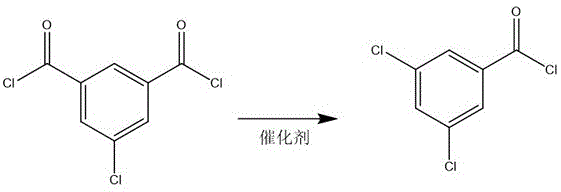
How to Synthesize 3,5-Dichlorobenzoyl Chloride Efficiently
Implementing this synthesis route requires careful attention to thermal gradients and feed rates to maximize the benefits of the continuous operation mode described in the patent literature. The process begins with the preheating of the 5-chloroisophthaloyl dichloride feedstock to ensure smooth introduction into the heated reactor zone, followed by the initiation of the catalytic cycle once the system reaches the target operating temperature. Operators must monitor the concentration of the product within the reactor closely, waiting until it reaches a threshold of 10-20% before opening the distillation pathway to begin the continuous withdrawal phase. Maintaining the volume of the reaction system constant through synchronized feeding and distillation is the key operational parameter that sustains the steady-state conditions necessary for high efficiency. For a detailed breakdown of the specific equipment setup, catalyst preparation protocols, and exact temperature ramping schedules, please refer to the standardized synthesis guide provided below.
- Preheat 5-chloroisophthaloyl dichloride to 100°C and add the fibrous silica/Pd nanoparticle catalyst to the reactor.
- Heat the reaction system to 280-295°C and maintain until product concentration reaches 10-20%.
- Initiate continuous production by distilling off the product at 230-240°C while simultaneously replenishing the raw material to maintain constant volume.
Commercial Advantages for Procurement and Supply Chain Teams
For procurement managers and supply chain directors, the adoption of this continuous decarbonylation technology offers profound strategic advantages that extend far beyond simple yield improvements. The shift from batch to continuous processing inherently reduces the variability associated with campaign manufacturing, leading to a more predictable and reliable supply of critical intermediates for downstream drug and pesticide synthesis. By utilizing a catalyst system that demonstrates exceptional durability and resistance to deactivation, manufacturers can significantly reduce the frequency of reactor shutdowns required for catalyst change-outs, thereby maximizing asset utilization and overall plant throughput. This operational stability translates directly into cost reduction in pharma intermediates manufacturing, as the expenses related to catalyst consumption, waste disposal, and labor for batch turnover are drastically minimized. Furthermore, the elimination of complex multi-step synthetic routes in favor of this direct decarbonylation simplifies the supply chain for raw materials, reducing exposure to volatility in the pricing of diverse precursor chemicals. Ultimately, this technology enables a leaner, more responsive production model that aligns perfectly with the just-in-time delivery expectations of modern global chemical logistics.
- Cost Reduction in Manufacturing: The implementation of the fibrous silica/Pd nanoparticle catalyst eliminates the need for expensive rhodium-based systems and reduces the total load of palladium required per ton of product due to its extended service life. By avoiding the rapid deactivation seen in traditional Pd/BaSO4 catalysts, the process minimizes the downtime and labor costs associated with frequent catalyst regeneration or replacement cycles. Additionally, the continuous nature of the reaction reduces energy consumption per unit of output by maintaining a steady thermal state rather than repeatedly heating and cooling large batch reactors. These factors combine to create a substantially lower cost base for production, allowing suppliers to offer more competitive pricing structures without sacrificing margin integrity.
- Enhanced Supply Chain Reliability: The continuous production capability ensures a steady stream of output that is less susceptible to the bottlenecks and scheduling conflicts typical of batch manufacturing facilities. Because the catalyst maintains high activity over prolonged periods, the risk of unexpected production halts due to catalyst failure is significantly mitigated, ensuring consistent availability for customers. This reliability is crucial for maintaining the production schedules of downstream pharmaceutical and agrochemical clients who depend on uninterrupted flows of high-quality intermediates. Consequently, partners adopting this technology can position themselves as a reliable agrochemical intermediate supplier capable of meeting long-term contractual obligations with confidence.
- Scalability and Environmental Compliance: The process design is inherently scalable, allowing for seamless transition from pilot plant verification to full commercial scale-up of complex organic intermediates without fundamental changes to the reaction chemistry. The reduction in by-product formation, specifically 1,3,5-trichlorobenzene, simplifies waste treatment protocols and lowers the environmental burden associated with hazardous waste disposal. Moreover, the atom economy of the direct decarbonylation route is superior to multi-step alternatives, resulting in less solvent usage and fewer auxiliary chemicals required for purification. This alignment with green chemistry principles not only reduces regulatory compliance risks but also enhances the sustainability profile of the final product for environmentally conscious end-users.
Frequently Asked Questions (FAQ)
The following questions address common technical and commercial inquiries regarding the implementation and benefits of this advanced synthesis technology. These answers are derived directly from the experimental data and process descriptions found in the underlying patent documentation to ensure accuracy and relevance. Understanding these details is essential for technical teams evaluating the feasibility of integrating this route into their existing manufacturing portfolios. We encourage stakeholders to review these points carefully to appreciate the full scope of the operational improvements offered by this method.
Q: How does the fibrous silica/Pd catalyst improve upon traditional Pd/BaSO4 catalysts?
A: The fibrous silica support provides a significantly higher specific surface area and more reaction sites compared to traditional supports. When modified with polyethyleneimine, it anchors palladium nanoparticles more effectively, preventing aggregation and deactivation, which drastically extends catalyst service life and maintains high activity over prolonged continuous operation.
Q: What is the primary advantage of the continuous distillation method described in the patent?
A: The continuous removal of the product (3,5-dichlorobenzoyl chloride) while replenishing the reactant prevents the product from staying in the high-temperature reaction zone for too long. This kinetic control significantly suppresses the formation of the stubborn by-product 1,3,5-trichlorobenzene, thereby enhancing both the yield and the purity of the final acyl chloride.
Q: Is this synthesis method suitable for large-scale industrial manufacturing?
A: Yes, the patent explicitly designs the process for industrial scalability. The use of a durable heterogeneous catalyst combined with a continuous feed-and-distill protocol eliminates the bottlenecks of batch processing, allowing for consistent, high-efficiency production that meets the rigorous demands of global supply chains for pharmaceutical and agrochemical intermediates.
Partnering with NINGBO INNO PHARMCHEM: Your Reliable 3,5-Dichlorobenzoyl Chloride Supplier
At NINGBO INNO PHARMCHEM, we recognize that the successful commercialization of advanced intermediates requires more than just laboratory success; it demands robust engineering and unwavering quality control. Our team possesses extensive experience scaling diverse pathways from 100 kgs to 100 MT/annual commercial production, ensuring that the transition from patent concept to industrial reality is seamless and efficient. We are committed to delivering products that meet stringent purity specifications through our rigorous QC labs, which utilize state-of-the-art analytical instrumentation to verify every batch against the highest industry standards. By leveraging technologies like the fibrous silica/Pd catalytic system, we empower our clients to access high-performance materials that drive innovation in their own R&D pipelines while maintaining cost competitiveness.
We invite you to engage with our technical procurement team to discuss how our capabilities align with your specific project requirements and volume needs. Request a Customized Cost-Saving Analysis today to understand how switching to our optimized continuous production route can impact your bottom line. We are ready to provide specific COA data and comprehensive route feasibility assessments to support your decision-making process and secure your supply chain for the future.