
Advanced Organic Luminescent Materials for Next-Generation OLED Displays and Lighting
The rapid evolution of the organic light-emitting diode (OLED) industry has created an urgent demand for high-performance luminescent materials that can overcome the limitations of traditional technologies. Patent CN113831315B introduces a groundbreaking class of organic luminescent materials based on cyano-substituted benzocoumarin derivatives, specifically designed to function as Thermally Activated Delayed Fluorescence (TADF) emitters. This innovation addresses the critical bottleneck of efficiency roll-off in long-wavelength emissions, a challenge that has hindered the widespread adoption of metal-free OLEDs in full-color displays and lighting applications. By combining the excellent optical properties of coumarin with a novel acceptor group structure, this technology offers a viable pathway to achieve 100% internal quantum efficiency without relying on scarce noble metals. For industry leaders, this represents a significant opportunity to secure a supply chain for next-generation display materials that are both cost-effective and technically superior.
The Limitations of Conventional Methods vs. The Novel Approach
The Limitations of Conventional Methods
Traditional organic electroluminescent materials have long been dominated by fluorescent and phosphorescent technologies, each carrying significant drawbacks for modern commercial applications. Fluorescent materials are restricted by spin conservation laws to a theoretical internal quantum efficiency of only 25%, wasting the majority of generated excitons and limiting device brightness and energy efficiency. On the other hand, second-generation phosphorescent materials, while achieving 100% efficiency, rely heavily on noble metals such as iridium and platinum. These metals are not only extremely expensive and subject to volatile market pricing but also pose environmental and supply chain risks due to their scarcity. Furthermore, phosphorescent devices often suffer from severe efficiency roll-off at high brightness levels due to the long triplet state lifetime of the metal complexes, which limits their utility in high-performance displays and lighting solutions that require sustained high luminance.
The Novel Approach
The novel approach detailed in the patent leverages the structural versatility of coumarin derivatives to construct a new generation of long-wavelength TADF materials that eliminate the need for heavy metals entirely. By utilizing a cyano-substituted benzocoumarin moiety as an electron-accepting group and connecting it with various electron-donating groups, the material achieves a twisted molecular configuration that effectively separates the highest occupied molecular orbital (HOMO) and the lowest unoccupied molecular orbital (LUMO). This separation minimizes the energy gap between singlet and triplet states, allowing for efficient reverse intersystem crossing and 100% exciton utilization similar to phosphorescent materials but at a fraction of the cost. 
Mechanistic Insights into Cyano-Substituted Benzocoumarin TADF Synthesis
The core of this technological breakthrough lies in the precise molecular engineering of the donor-acceptor (D-A) architecture, which facilitates the TADF mechanism through careful control of electronic states. The benzocoumarin core expands the conjugated system compared to traditional coumarin, shifting the emission wavelength into the desirable long-wavelength region while maintaining high photoluminescence quantum yields. The introduction of the cyano group further enhances the electron-withdrawing capability of the acceptor, strengthening the D-A interaction and promoting the necessary charge transfer state for delayed fluorescence. This structural design ensures that the material can harvest both singlet and triplet excitons for light emission, effectively bypassing the 25% efficiency limit of conventional fluorescent dyes without the burden of heavy metal coordination chemistry.
The synthesis mechanism involves a straightforward yet highly effective two-step process that ensures high purity and reproducibility, critical factors for R&D directors evaluating process feasibility. The first step involves a condensation reaction between a naphthol derivative, a substituted benzaldehyde, and malononitrile in the presence of a base catalyst like triethylamine. This forms an intermediate which is then subjected to an oxidative cyclization using iodine in ethanol to close the coumarin ring and finalize the conjugated system. 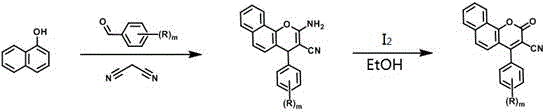
Impurity control is inherently built into this synthetic route through the use of precipitation and filtration steps that naturally exclude many side products. The reaction conditions, typically involving reflux in ethanol at moderate temperatures between 75°C and 85°C, are mild enough to prevent thermal degradation of the sensitive organic structures while being robust enough for large-scale production. The final purification involves washing the precipitated solid with ethanol, which removes residual iodine and unreacted starting materials, resulting in a product with high elemental purity as confirmed by analysis. This level of control over the impurity profile is essential for OLED applications, where trace impurities can act as quenching sites and drastically reduce device lifetime and efficiency.
How to Synthesize High-Purity Organic Luminescent Materials Efficiently
Implementing this synthesis route requires careful attention to molar ratios and reaction times to maximize yield and minimize byproduct formation, ensuring that the final material meets the stringent specifications required for commercial OLED devices. The process begins with the precise weighing of 1-naphthol, 2-naphthol, or 9-phenanthrol as the first raw material, which dictates the specific core structure of the final luminescent compound. These are reacted with R-group substituted benzaldehydes and malononitrile in ethanol, with triethylamine added dropwise to initiate the condensation under a nitrogen atmosphere to prevent oxidation of sensitive intermediates. 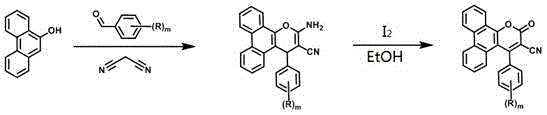
- Condensation of naphthol, benzaldehyde, and malononitrile in ethanol with triethylamine.
- Oxidative cyclization using iodine in ethanol under reflux conditions.
- Purification via filtration, washing with ethanol, and drying to obtain the final solid product.
Commercial Advantages for Procurement and Supply Chain Teams
For procurement managers and supply chain heads, the transition to this metal-free TADF technology offers substantial strategic advantages that go beyond mere technical performance metrics. The elimination of iridium and platinum from the bill of materials removes a major source of cost volatility and supply risk, allowing for more stable long-term pricing agreements and budget forecasting. Additionally, the use of common organic solvents like ethanol and readily available starting materials such as naphthols and benzaldehydes simplifies the procurement process, reducing the need for specialized hazardous chemical handling and storage infrastructure that is often required for heavy metal precursors.
- Cost Reduction in Manufacturing: The removal of noble metal catalysts and precursors from the synthesis pathway leads to a drastic reduction in raw material costs, which is a primary driver for overall manufacturing expense in the OLED industry. By avoiding the need for expensive metal purification and recovery processes, manufacturers can achieve significant cost savings that can be passed down the supply chain or reinvested into R&D. Furthermore, the simplified synthetic route reduces energy consumption and waste treatment costs associated with heavy metal disposal, contributing to a leaner and more economically efficient production model.
- Enhanced Supply Chain Reliability: Relying on abundant organic feedstocks rather than geographically concentrated noble metals significantly enhances the resilience of the supply chain against geopolitical disruptions and market shortages. The raw materials required for this synthesis are produced by a wide network of chemical suppliers globally, ensuring multiple sourcing options and reducing the risk of single-supplier dependency. This diversification allows for more flexible inventory management and shorter lead times, enabling manufacturers to respond more quickly to fluctuations in market demand for OLED panels and lighting products.
- Scalability and Environmental Compliance: The synthesis process is inherently scalable, utilizing standard reactor equipment and moderate conditions that are easily adapted from laboratory to commercial production scales without complex re-engineering. The use of ethanol as a primary solvent aligns with green chemistry principles, reducing the environmental footprint of the manufacturing process and simplifying compliance with increasingly stringent environmental regulations. This ease of scale-up ensures that supply can be rapidly expanded to meet growing market demand for high-efficiency OLED materials without the long lead times typically associated with setting up heavy metal processing lines.
Frequently Asked Questions (FAQ)
The following questions address common technical and commercial inquiries regarding the implementation and performance of these novel organic luminescent materials in industrial settings. Understanding these details is crucial for stakeholders evaluating the integration of this technology into their existing product lines or supply chains. The answers are derived directly from the technical specifications and experimental data provided in the patent documentation, ensuring accuracy and relevance for decision-making processes.
Q: What is the primary advantage of this TADF material over traditional phosphorescent materials?
A: The primary advantage is the elimination of scarce and expensive noble metals like iridium and platinum, which significantly reduces raw material costs while maintaining high exciton utilization efficiency.
Q: What is the emission wavelength range of these coumarin derivatives?
A: These materials are designed for long-wavelength emission, specifically targeting the yellow and red regions, which addresses the scarcity of efficient red TADF emitters in the market.
Q: Is the synthesis process scalable for industrial production?
A: Yes, the synthesis utilizes common solvents like ethanol and standard reflux conditions, making it highly suitable for commercial scale-up without requiring specialized high-pressure or cryogenic equipment.
Partnering with NINGBO INNO PHARMCHEM: Your Reliable Organic Luminescent Material Supplier
As a leading CDMO expert, NINGBO INNO PHARMCHEM possesses extensive experience scaling diverse pathways from 100 kgs to 100 MT/annual commercial production, ensuring that your transition to these advanced TADF materials is seamless and efficient. Our rigorous QC labs and commitment to stringent purity specifications guarantee that every batch of organic luminescent material meets the exacting standards required for high-performance OLED devices. We understand the critical nature of supply continuity in the electronics industry and have established robust processes to maintain consistent quality and delivery schedules for our global partners.
We invite you to engage with our technical procurement team to discuss how we can support your specific material needs through a Customized Cost-Saving Analysis. By requesting specific COA data and route feasibility assessments, you can gain deeper insights into how our manufacturing capabilities align with your product requirements. Let us help you optimize your supply chain and reduce costs while accessing the next generation of high-efficiency luminescent technology.
Engineering Bottleneck?
Can't scale up this synthesis? Upload your target structure or CAS, and our CDMO team will evaluate the industrial feasibility within 24 hours. Request Evaluation →