
Revolutionizing Biaryl Synthesis: Direct Nickel-Catalyzed Cross-Coupling of Aryl Fluorides
Revolutionizing Biaryl Synthesis: Direct Nickel-Catalyzed Cross-Coupling of Aryl Fluorides
The landscape of organic synthesis is constantly evolving, driven by the need for more efficient, cost-effective, and sustainable methodologies for constructing carbon-carbon bonds. A significant breakthrough in this domain is detailed in Chinese Patent CN116283515A, which discloses a novel direct cross-coupling method between aryl fluorides and aryl bromides. Traditionally, aryl fluorides have been considered inert electrophiles in transition metal-catalyzed reactions due to the high strength of the carbon-fluorine bond. However, this new technology leverages a specific nickel catalytic system activated by metallic magnesium to overcome this kinetic barrier. For R&D directors and process chemists, this represents a paradigm shift, allowing the direct use of inexpensive and abundant aryl fluorides without the need for pre-functionalization into more reactive but costly aryl iodides or triflates. The method operates under mild conditions, typically at room temperature, and utilizes earth-abundant nickel rather than expensive palladium, offering a compelling value proposition for the large-scale manufacturing of pharmaceutical intermediates and fine chemicals.
The Limitations of Conventional Methods vs. The Novel Approach
The Limitations of Conventional Methods
Historically, the construction of biaryl scaffolds, which are ubiquitous in active pharmaceutical ingredients (APIs) and agrochemicals, has relied heavily on palladium-catalyzed cross-coupling reactions such as Suzuki-Miyaura or Negishi couplings. These conventional pathways often necessitate the use of highly reactive aryl halides like iodides or bromides, or sulfonates like triflates, which are significantly more expensive than their fluoride counterparts. Furthermore, traditional methods involving organometallic reagents, such as Grignard or organozinc species, require the pre-preparation of these sensitive intermediates. This pre-activation step introduces substantial operational complexity, as organometallic reagents are notoriously sensitive to moisture and air, demanding strict anhydrous conditions and specialized handling equipment. The generation of stoichiometric amounts of metal waste and the need for rigorous purification to remove residual heavy metals further exacerbate the environmental footprint and production costs. For supply chain managers, the reliance on specialized, moisture-sensitive reagents creates bottlenecks and increases the risk of batch failures, making the scaling of these processes both economically and logistically challenging.
The Novel Approach
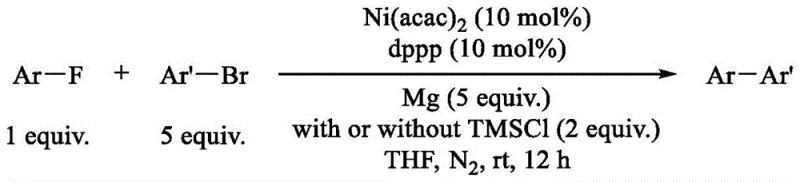
The methodology described in the patent data introduces a streamlined, one-pot strategy that bypasses the need for pre-formed organometallic reagents. By utilizing aryl fluorides directly alongside aryl bromides in the presence of a nickel catalyst and magnesium powder, the process effectively merges the activation and coupling steps. This approach capitalizes on the in situ generation of reactive organomagnesium species from the aryl bromide, which then participate in the catalytic cycle with the nickel-activated aryl fluoride. The use of nickel diacetylacetonate [Ni(acac)₂] paired with bidentate phosphine ligands like 1,3-bis(diphenylphosphine)propane (dppp) creates a robust catalytic system capable of cleaving the strong C-F bond. This innovation not only reduces the number of synthetic steps but also eliminates the hazards associated with handling bulk quantities of sensitive organometallics. The reaction proceeds efficiently in tetrahydrofuran (THF) at room temperature, demonstrating remarkable tolerance for various functional groups including methoxy, tert-butyl, and heterocyclic moieties. This simplicity translates directly into operational excellence, offering a greener and more economically viable route for the commercial scale-up of complex biaryl structures.
Mechanistic Insights into Nickel-Catalyzed Direct Cross-Coupling
Understanding the mechanistic underpinnings of this transformation is crucial for R&D teams aiming to optimize the process for specific substrates. The proposed catalytic cycle begins with the reduction of the nickel(II) precatalyst, Ni(acac)₂, by metallic magnesium to generate the active low-valent nickel species. This active nickel center then undergoes oxidative addition with the aryl fluoride substrate. This step is particularly noteworthy because the oxidative addition of aryl fluorides to nickel is kinetically challenging due to the strong C-F bond dissociation energy; however, the specific electronic properties of the ligand system facilitate this difficult transformation. Simultaneously, the magnesium metal inserts into the aryl bromide bond to form an organomagnesium intermediate in situ. This transient species then engages in transmetallation with the nickel-aryl fluoride complex. The resulting diaryl-nickel intermediate subsequently undergoes reductive elimination to release the desired biaryl product and regenerate the active nickel catalyst, closing the loop. This mechanism highlights the dual role of magnesium as both a reductant for the catalyst and a source of the nucleophilic coupling partner, elegantly simplifying the reaction stoichiometry.
From an impurity control perspective, this mechanism offers distinct advantages. Because the organomagnesium species is generated in situ and consumed rapidly in the transmetallation step, its concentration remains low, minimizing side reactions such as homocoupling of the aryl bromide or nucleophilic attack on other sensitive functional groups within the molecule. Furthermore, the use of nickel, while requiring careful removal to meet pharmaceutical standards, avoids the extreme toxicity profiles associated with some other transition metals. The reaction conditions are sufficiently mild that thermal degradation of sensitive substrates is minimized. The patent data indicates that the choice of solvent is critical; THF provides the necessary solvation for the magnesium salts and stabilizes the organometallic intermediates, whereas other ethers like DME or dioxane fail to support the reaction, yielding no product. This specificity suggests a tight coordination sphere around the magnesium and nickel centers that is uniquely satisfied by THF, ensuring high selectivity for the cross-coupled product over potential byproducts.
How to Synthesize Biaryl Compounds Efficiently
Implementing this synthesis route requires attention to detail regarding reagent quality and atmospheric control to ensure reproducibility and high yields. The procedure outlined in the patent emphasizes the importance of excluding moisture and oxygen, as both the magnesium activator and the nickel catalyst are sensitive to oxidation. The standard protocol involves drying reaction vessels thoroughly and maintaining a nitrogen atmosphere throughout the process. While the reaction is robust, the ratio of reagents plays a pivotal role; using an excess of the aryl bromide (typically 5 equivalents) relative to the aryl fluoride (1 equivalent) drives the reaction to completion and compensates for any inefficiencies in the in situ generation of the organomagnesium species. The detailed standardized synthesis steps for producing high-purity biaryl intermediates using this method are provided in the guide below.
- Prepare a dry sealed tube equipped with a magnetic stirrer by heating in an oven, then seal with a rubber stopper and purge with nitrogen gas three times to ensure an inert atmosphere.
- Weigh and add magnesium powder (5 equivalents), nickel diacetylacetonate catalyst (10 mol%), and 1,3-bis(diphenylphosphine)propane ligand (10 mol%) into the reaction vessel under nitrogen protection.
- Add ultra-dry tetrahydrofuran (THF) solvent, followed by the aryl fluoride substrate (1 equivalent) and aryl bromide coupling partner (5 equivalents), then stir the mixture at room temperature for 12 hours.
- Quench the reaction with saturated ammonium chloride solution, extract with ethyl acetate, wash with brine, dry over anhydrous sodium sulfate, and purify the crude product via silica gel column chromatography.
Commercial Advantages for Procurement and Supply Chain Teams
For procurement managers and supply chain heads, the adoption of this direct cross-coupling technology offers transformative benefits that extend beyond simple yield improvements. The primary advantage lies in the raw material cost structure. Aryl fluorides are generally cheaper and more readily available than their iodide or triflate analogues, which are often custom-synthesized at a premium. By enabling the direct use of these commodity chemicals, manufacturers can significantly reduce the cost of goods sold (COGS). Furthermore, the elimination of pre-formed organometallic reagents removes a major logistical hurdle. Sourcing and storing moisture-sensitive Grignard reagents require specialized infrastructure and incur higher transportation costs. By generating the reactive species in situ from stable aryl bromides and magnesium powder, the process simplifies inventory management and reduces the risk of supply disruptions caused by the degradation of sensitive reagents. This stability enhances overall supply chain reliability, ensuring consistent production schedules.
- Cost Reduction in Manufacturing: The economic impact of this process is driven by the substitution of expensive catalysts and reagents with earth-abundant alternatives. Replacing palladium with nickel drastically lowers the catalyst cost, which is a significant factor in large-scale production. Additionally, the avoidance of pre-functionalization steps means fewer unit operations, less solvent consumption, and reduced labor hours. The mild reaction conditions (room temperature) also translate to lower energy consumption compared to processes requiring reflux or cryogenic cooling. These cumulative efficiencies result in substantial cost savings without compromising the quality of the final API intermediate.
- Enhanced Supply Chain Reliability: The robustness of the reaction conditions contributes to a more resilient supply chain. Since the reagents (aryl fluorides, aryl bromides, magnesium powder) are stable solids or liquids with long shelf lives, they can be sourced from multiple global suppliers, reducing dependency on single-source vendors. The tolerance for various functional groups means that a wider range of starting materials can be utilized, providing flexibility in raw material sourcing. This flexibility is crucial for mitigating risks associated with market volatility or geopolitical disruptions in the chemical supply chain, ensuring continuous availability of critical intermediates for downstream drug manufacturing.
- Scalability and Environmental Compliance: Scaling chemical processes often amplifies safety and environmental challenges, but this method is inherently designed for scalability. The absence of highly pyrophoric reagents reduces the safety burden on manufacturing facilities, lowering insurance and compliance costs. From an environmental standpoint, the atom economy is improved by avoiding the leaving groups associated with triflates or the boron waste from Suzuki couplings. The simplified workup procedure, involving standard aqueous quenching and extraction, generates less hazardous waste, aligning with modern green chemistry principles and facilitating easier regulatory approval for commercial manufacturing sites.
Frequently Asked Questions (FAQ)
The following questions address common technical inquiries regarding the implementation and scope of this nickel-catalyzed cross-coupling technology. These answers are derived directly from the experimental data and optimization studies presented in the patent documentation, providing clarity for technical teams evaluating this route for their specific projects. Understanding these nuances is essential for successful technology transfer and process validation.
Q: Why is tetrahydrofuran (THF) critical for this nickel-catalyzed reaction?
A: According to patent data, THF is the optimal solvent because alternative ethers like DME, 1,4-dioxane, and 2-MeTHF resulted in zero yield. THF likely facilitates the specific coordination environment required for the magnesium activation and nickel catalytic cycle.
Q: Can this method tolerate sensitive functional groups on the aryl ring?
A: Yes, the method demonstrates excellent functional group tolerance. It successfully couples substrates containing methoxy, tert-butyl, trifluoromethyl, and even pyridine nitrogen atoms without requiring protective groups, simplifying the synthetic route.
Q: What is the role of trimethylchlorosilane (TMSCl) in this process?
A: TMSCl acts as an additive that can enhance reaction efficiency in certain substrate combinations. While not always mandatory, its inclusion (2 equivalents) helps activate the magnesium surface and stabilize intermediates, leading to improved yields in challenging couplings.
Partnering with NINGBO INNO PHARMCHEM: Your Reliable Biaryl Compounds Supplier
At NINGBO INNO PHARMCHEM, we recognize the strategic importance of adopting cutting-edge synthetic methodologies to maintain a competitive edge in the global pharmaceutical market. Our team of expert process chemists has extensively evaluated the nickel-catalyzed direct cross-coupling of aryl fluorides and is fully prepared to implement this technology for your custom synthesis needs. We possess extensive experience scaling diverse pathways from 100 kgs to 100 MT/annual commercial production, ensuring that the transition from laboratory bench to pilot plant is seamless. Our state-of-the-art facilities are equipped with rigorous QC labs capable of meeting stringent purity specifications, guaranteeing that every batch of biaryl intermediate delivered meets the highest industry standards for potency and impurity profiles.
We invite you to collaborate with us to leverage this cost-effective and sustainable synthesis route for your next project. By partnering with our technical procurement team, you can access a Customized Cost-Saving Analysis tailored to your specific molecule, demonstrating exactly how this technology can optimize your budget. We encourage you to contact us today to request specific COA data and route feasibility assessments, allowing us to demonstrate our commitment to delivering high-quality chemical solutions that drive your business forward.