
Scalable Synthesis of Heptafluoroisopropyl Bisamide Intermediates for Modern Insecticides
The global agrochemical sector is constantly evolving to combat pest resistance, driving the demand for novel insecticidal scaffolds with superior efficacy and environmental profiles. Patent CN115974717A introduces a significant advancement in the synthesis of heptafluoroisopropyl-containing bisamide compounds, which serve as potent intermediates for next-generation insecticides targeting Lepidoptera and Coleoptera pests. This technology addresses critical bottlenecks in traditional manufacturing, such as harsh reaction conditions and low selectivity, by optimizing the preparation of key intermediate compounds represented by General Formula (I). For procurement leaders and R&D directors seeking a reliable agrochemical intermediate supplier, understanding the nuances of this patented route is essential for securing a stable supply chain of high-purity active ingredients.
The Limitations of Conventional Methods vs. The Novel Approach
The Limitations of Conventional Methods
Traditional synthetic routes for diamide insecticide intermediates often rely on expensive and less stable alkylating agents, such as iodoalkanes, to introduce necessary side chains. While iodoalkanes exhibit high reactivity, their industrial application is hindered by prohibitive costs and the generation of difficult-to-remove iodine-containing impurities. Furthermore, conventional N-alkylation processes frequently suffer from poor selectivity, requiring complex purification steps that drastically reduce overall yield and increase waste disposal burdens. The reliance on harsh conditions and non-recyclable catalysts in older methodologies creates significant volatility in production costs, making it challenging to achieve cost reduction in insecticide manufacturing at a commercial scale.
The Novel Approach
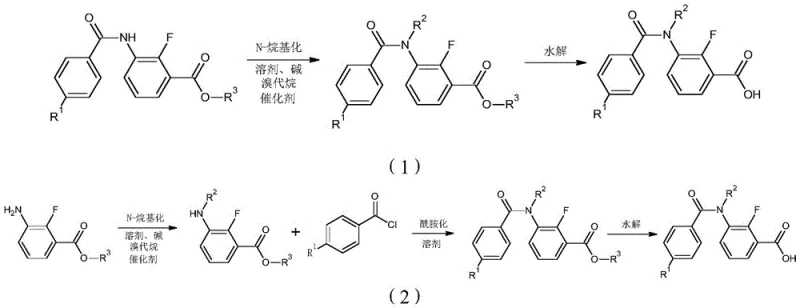
The methodology disclosed in CN115974717A overcomes these hurdles by utilizing more economical bromoalkanes in conjunction with specialized phase transfer catalysts, such as tetrabutylammonium bromide or crown ethers. This strategic substitution allows for efficient N-alkylation under milder conditions while maintaining high conversion rates and selectivity. The process flow, illustrated below, demonstrates the streamlined transition from nitro-precursors to the final carboxylic acid intermediates without the need for excessive protecting groups or extreme temperatures. By optimizing solvent systems and catalyst loading, this approach ensures a robust pathway suitable for commercial scale-up of complex agrochemical intermediates.
Mechanistic Insights into Catalytic N-Alkylation and Hydrogenation
A deep dive into the reaction mechanism reveals that the success of this synthesis hinges on the precise activation of the nitrogen center during the alkylation step. The use of phase transfer catalysts facilitates the transport of anionic species into the organic phase, significantly enhancing the nucleophilic attack on the bromoalkane. This mechanistic advantage allows the reaction to proceed efficiently even with the lower intrinsic reactivity of bromine compared to iodine, effectively suppressing side reactions that lead to impurity formation. Additionally, the patent details a catalytic hydrogenation step for reducing the nitro group to an amine using palladium carbon or Raney nickel at pressures as low as 0-0.5 MPa. This low-pressure hydrogenation is not only safer but also allows the catalyst to be recycled 5-10 times, demonstrating a commitment to sustainable chemistry principles.
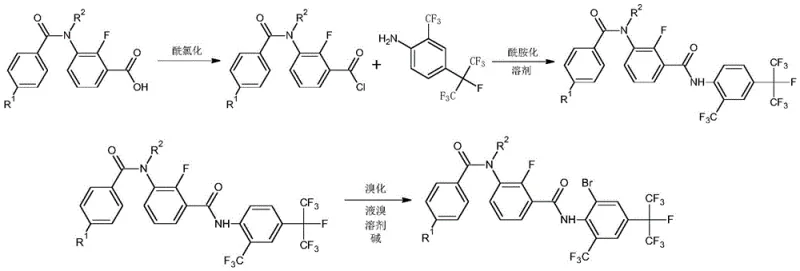
Impurity control is rigorously managed through the selection of specific solvents and bases during the amidation and alkylation stages. For instance, the use of potassium carbonate or sodium hydride in polar aprotic solvents like DMF or toluene ensures that the deprotonation of the amide nitrogen is complete before the alkylating agent is introduced. This prevents the formation of dialkylated byproducts and ensures that the final intermediate, General Formula (I), meets stringent purity specifications required for downstream coupling reactions. The subsequent conversion to the final bisamide structure, General Formula (II), involves a bromination step that is carefully controlled to avoid over-halogenation, preserving the integrity of the fluorinated side chains which are critical for biological activity.
How to Synthesize Heptafluoroisopropyl Bisamide Intermediates Efficiently
The synthesis protocol outlined in the patent provides a clear roadmap for producing these high-value intermediates with consistent quality. The process begins with the esterification of 2-fluoro-3-nitrobenzoic acid, followed by reduction and amidation to set the core scaffold. The critical N-alkylation step is then performed under optimized thermal conditions to install the diverse R2 substituents. Finally, hydrolysis yields the free acid ready for coupling with the heptafluoroisopropyl aniline derivative. Detailed standard operating procedures for each unit operation, including specific temperature ramps and workup techniques, are essential for replicating the high yields reported in the examples.
- Perform esterification of 2-fluoro-3-nitrobenzoic acid with alcohol using sulfuric acid catalyst, followed by catalytic hydrogenation to reduce the nitro group.
- Conduct amidation with benzoyl chloride derivatives to form the amide backbone, ensuring strict temperature control.
- Execute N-alkylation using bromoalkanes and phase transfer catalysts like tetrabutylammonium bromide to introduce the R2 substituent efficiently.
Commercial Advantages for Procurement and Supply Chain Teams
For supply chain managers, the shift from iodoalkanes to bromoalkanes represents a substantial opportunity for cost reduction in agrochemical intermediate manufacturing. Bromoalkanes are significantly cheaper and more readily available on the global market than their iodine counterparts, reducing raw material expenditure and mitigating supply risks associated with scarce halogens. Furthermore, the ability to recycle the palladium catalyst multiple times lowers the consumption of precious metals, directly impacting the cost of goods sold. The mild reaction conditions also translate to lower energy consumption, as the process does not require extreme heating or high-pressure equipment, thereby reducing the operational overhead for production facilities.
- Cost Reduction in Manufacturing: The replacement of expensive iodoalkanes with cost-effective bromoalkanes, enabled by efficient phase transfer catalysis, eliminates a major cost driver in the synthesis. Additionally, the recyclability of the hydrogenation catalyst reduces the need for frequent replenishment of precious metal catalysts, leading to significant long-term savings in material costs without compromising reaction efficiency.
- Enhanced Supply Chain Reliability: By utilizing common industrial solvents like toluene, dichloroethane, and DMF, the process avoids dependency on specialized or regulated chemicals that might face supply disruptions. The robustness of the reaction conditions ensures consistent batch-to-batch quality, which is vital for maintaining uninterrupted production schedules and meeting the delivery commitments of a reliable agrochemical intermediate supplier.
- Scalability and Environmental Compliance: The process generates fewer hazardous byproducts compared to traditional methods, simplifying waste treatment and disposal protocols. The use of liquid bromine with recoverable byproduct salts further enhances the environmental profile, making it easier to comply with increasingly strict environmental regulations while scaling up from pilot batches to multi-ton commercial production.
Frequently Asked Questions (FAQ)
The following questions address common technical and commercial inquiries regarding the production and application of these heptafluoroisopropyl bisamide intermediates. The answers are derived directly from the technical specifications and experimental data provided in the patent documentation, ensuring accuracy for R&D and procurement teams evaluating this technology for potential integration into their supply chains.
Q: Why is the N-alkylation step critical in this synthesis?
A: The N-alkylation step introduces the specific ether or alkyl side chains (R2) that modulate biological activity. The patent highlights using cost-effective bromoalkanes instead of expensive iodoalkanes by employing specific phase transfer catalysts.
Q: What are the advantages of the hydrogenation conditions described?
A: The process utilizes palladium carbon or Raney nickel at low pressures (0-0.5 MPa) and mild temperatures (5-50°C), allowing for catalyst recycling up to 10 times, which significantly reduces operational costs.
Q: How does this method improve supply chain reliability?
A: By avoiding rare or highly regulated reagents and using common industrial solvents like toluene and dichloroethane, the method ensures consistent raw material availability and simplifies waste treatment protocols.
Partnering with NINGBO INNO PHARMCHEM: Your Reliable Heptafluoroisopropyl Bisamide Supplier
At NINGBO INNO PHARMCHEM, we recognize the strategic importance of secure and efficient supply chains for advanced agrochemical intermediates. Our team possesses extensive experience scaling diverse pathways from 100 kgs to 100 MT/annual commercial production, ensuring that we can meet your volume requirements with consistency. We operate rigorous QC labs to verify that every batch meets stringent purity specifications, minimizing the risk of downstream processing failures. Our commitment to technical excellence allows us to adapt quickly to specific client needs while maintaining the highest standards of quality and safety.
We invite you to contact our technical procurement team to discuss how we can support your project goals. Request a Customized Cost-Saving Analysis to understand how our optimized synthesis routes can benefit your bottom line. We are ready to provide specific COA data and route feasibility assessments to help you make informed decisions for your upcoming production cycles.