
Optimizing Chlorfenapyr Production: A Cost-Effective Ketone Solvent Strategy for Global Agrochemical Manufacturers
Optimizing Chlorfenapyr Production: A Cost-Effective Ketone Solvent Strategy for Global Agrochemical Manufacturers
The global demand for high-efficiency insecticides continues to drive innovation in agrochemical intermediate manufacturing, particularly for potent compounds like Chlorfenapyr, also known as Bromothalonil. A pivotal advancement in this sector is detailed in patent CN101591284B, which discloses a robust method for preparing Chlorfenapyr and its analogues using 4-bromo-2-(4-chlorophenyl)-5-trifluoromethylpyrrole-3-nitrile as the core starting material. This technology represents a significant departure from conventional synthetic routes by utilizing ketone solvents and inorganic mineral alkalis as acid-binding agents. For R&D directors and procurement specialists, this shift offers a compelling value proposition: the replacement of hazardous, expensive reagents with commoditized, safer alternatives without compromising reaction efficiency. The method demonstrates exceptional industrial applicability, providing a pathway to reduce production costs while maintaining the rigorous purity standards required for modern crop protection formulations.
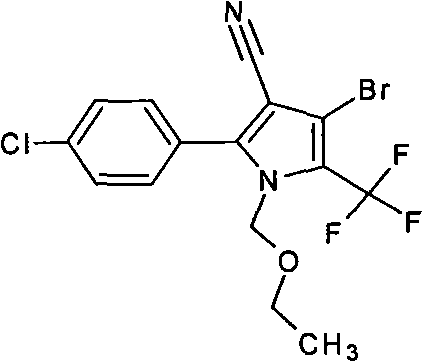
The Limitations of Conventional Methods vs. The Novel Approach
The Limitations of Conventional Methods
Historically, the synthesis of Chlorfenapyr and related pyrrole nitriles has relied heavily on strong, non-nucleophilic bases such as sodium hydride (NaH) or sodium tert-butoxide, often dissolved in tetrahydrofuran (THF). While effective in laboratory settings, these conventional methods present substantial challenges for large-scale commercial manufacturing. Sodium hydride is notoriously hazardous, requiring strict anhydrous conditions and specialized handling protocols to mitigate fire risks, which inevitably drives up operational safety costs. Furthermore, THF is a relatively expensive solvent with a low boiling point, making its recovery and recycling energy-intensive. Alternative methods utilizing triethylamine as a base have been explored, yet they suffer from significant downstream processing issues; the triethylamine salt byproducts are difficult to separate mechanically and often require complex dehydration or rectification steps. These inefficiencies create bottlenecks in the supply chain, leading to higher lead times and increased overall manufacturing expenses for agrochemical intermediates.
The Novel Approach
In stark contrast, the methodology outlined in CN101591284B introduces a paradigm shift by employing ketone solvents—such as butanone, methyl isobutyl ketone (MIBK), or pimelinketone—paired with inexpensive mineral alkalis like sodium hydroxide, potassium hydroxide, or potassium carbonate. This novel approach eliminates the need for hazardous hydride bases and costly ether solvents, fundamentally altering the economic landscape of production. The reaction proceeds smoothly under mild thermal conditions, typically between 40°C and 120°C, allowing for precise temperature control that minimizes thermal degradation of the sensitive pyrrole ring. By switching to this system, manufacturers can achieve high conversion rates with a simplified workup procedure involving simple acidification and filtration. This transition not only enhances process safety but also drastically simplifies the isolation of the crude product, making it an ideal candidate for cost reduction in agrochemical manufacturing.
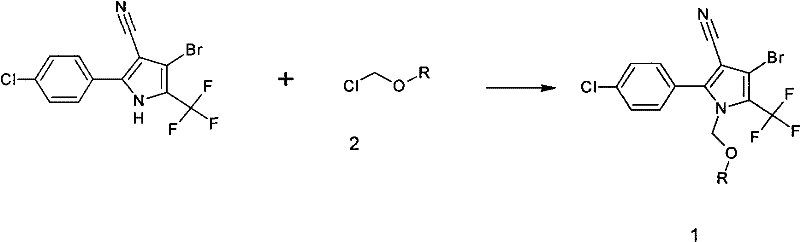
Mechanistic Insights into Mineral Alkali-Catalyzed N-Alkylation
The core of this synthetic breakthrough lies in the efficient N-alkylation of the pyrrole nitrogen atom. In the presence of a ketone solvent, the mineral alkali acts as a proton scavenger, deprotonating the nitrogen at the 1-position of the 4-bromo-2-(4-chlorophenyl)-5-trifluoromethylpyrrole-3-nitrile scaffold. Unlike strong organic bases that might induce unwanted side reactions or decomposition of the trifluoromethyl group, mineral alkalis provide a controlled basicity that favors the formation of the nitrogen anion. This anion then acts as a potent nucleophile, attacking the electrophilic carbon of the chloromethyl ether reagent (where R can be ethyl, 2-chloroethyl, etc.). The choice of ketone solvent is critical; these solvents possess excellent solvating power for both the organic substrate and the inorganic base interface, facilitating a homogeneous or semi-homogeneous reaction environment that accelerates the kinetics. This mechanistic elegance ensures that the reaction proceeds to completion with minimal formation of bis-alkylated impurities or hydrolysis byproducts.
From an impurity control perspective, the use of mineral alkalis significantly reduces the complexity of the crude reaction mixture. Traditional methods using sodium hydride often generate hydrogen gas and require quenching steps that can introduce moisture-related impurities. Conversely, the mineral alkali method generates simple inorganic salts (e.g., NaCl, KCl) upon acidification, which are easily removed during the aqueous wash and precipitation steps. The patent data indicates that crude products obtained via this route often exhibit content levels around 90%, which can be further purified to over 98% through straightforward recrystallization using alcohol-water mixtures. This high level of intrinsic purity is crucial for high-purity agrochemical intermediates, as it reduces the burden on downstream purification units and ensures consistent quality for the final active ingredient formulation.
How to Synthesize Chlorfenapyr Efficiently
The practical implementation of this synthesis route is designed for scalability and ease of operation within standard chemical reactors. The process begins by charging the reactor with the pyrrole nitrile starting material and the chosen mineral alkali base in a ketone solvent, followed by stirring to ensure adequate suspension or dissolution. Once the mixture is homogenized, the chloromethyl ether alkylating agent is added, and the temperature is raised to the optimal range to initiate the reaction. Monitoring is typically conducted via HPLC or TLC until the starting material is fully consumed. Upon completion, the reaction mixture is cooled, and water is added to dissolve the inorganic salts. The pH is then adjusted to acidic conditions to neutralize excess base and precipitate the product, which is subsequently filtered and dried. For a detailed, step-by-step breakdown of the specific molar ratios, temperature profiles, and purification techniques described in the patent, please refer to the standardized guide below.
- Dissolve 4-bromo-2-(4-chlorophenyl)-5-trifluoromethylpyrrole-3-nitrile and a mineral alkali acid-binding agent in a ketone solvent such as methyl isobutyl ketone.
- Add chloromethyl ether (e.g., chloromethyl ethyl ether) to the mixture and heat to a temperature between 40°C and 120°C for 1 to 8 hours.
- Cool the reaction, add water, adjust pH to less than 7 with dilute acid, separate layers, and precipitate the crude product for purification.
Commercial Advantages for Procurement and Supply Chain Teams
For procurement managers and supply chain heads, the adoption of this ketone-based synthesis method offers transformative benefits that extend far beyond simple chemistry. The primary advantage lies in the drastic simplification of the raw material portfolio. By replacing specialty reagents like sodium hydride and sodium tert-butoxide with commodity chemicals like caustic soda or potash, companies can leverage existing bulk purchasing agreements and reduce exposure to volatile pricing in the fine chemical market. Furthermore, the substitution of THF with methyl isobutyl ketone (MIBK) or acetone aligns the process with widely available, lower-cost solvent streams. This strategic shift in raw materials directly translates to a more resilient supply chain, minimizing the risk of production stoppages due to the scarcity of niche reagents. The simplified workup procedure also means faster batch turnover times, allowing facilities to maximize asset utilization and respond more agilely to market demand fluctuations.
- Cost Reduction in Manufacturing: The economic impact of switching to mineral alkalis and ketone solvents is profound. Eliminating expensive, hazardous bases removes the need for specialized storage and handling infrastructure, thereby lowering capital expenditure and operational overhead. Additionally, the high reaction yields demonstrated in the patent examples suggest that raw material utilization is maximized, reducing waste generation. The ability to recover and reuse ketone solvents efficiently further compounds these savings, creating a leaner, more cost-effective production model that enhances overall profit margins without sacrificing product quality.
- Enhanced Supply Chain Reliability: Reliability is paramount in the agrochemical sector, where seasonal demand peaks require uninterrupted supply. The reliance on ubiquitous mineral alkalis ensures that production is never held hostage by the supply constraints of exotic reagents. Since sodium hydroxide and potassium carbonate are produced on a massive global scale, their availability is virtually guaranteed. This stability allows supply chain planners to forecast production schedules with greater confidence, reducing lead time for high-purity agrochemical intermediates and ensuring that downstream formulation plants receive their materials on time, every time.
- Scalability and Environmental Compliance: From an environmental and safety standpoint, this process is inherently greener and safer to scale. The absence of pyrophoric reagents like sodium hydride significantly reduces the risk of fire and explosion, lowering insurance premiums and regulatory compliance burdens. The waste stream consists primarily of benign inorganic salts and recyclable organic solvents, simplifying wastewater treatment and disposal. This alignment with green chemistry principles facilitates easier permitting for capacity expansion, supporting the commercial scale-up of complex agrochemical intermediates from pilot plants to multi-tonne annual production capacities.
Frequently Asked Questions (FAQ)
Understanding the technical nuances of this synthesis method is essential for stakeholders evaluating its integration into their manufacturing portfolios. The following questions address common inquiries regarding the feasibility, safety, and quality implications of adopting this ketone solvent technology. These answers are derived directly from the experimental data and technical disclosures within the patent literature, providing a factual basis for decision-making. Whether you are concerned about reaction kinetics, impurity profiles, or equipment compatibility, the insights below offer a clear perspective on the operational realities of this advanced synthetic route.
Q: Why is the ketone solvent method superior to traditional THF methods for Chlorfenapyr synthesis?
A: Traditional methods often utilize tetrahydrofuran (THF) and expensive bases like sodium hydride or sodium tert-butoxide. The ketone solvent method replaces these with cost-effective mineral alkalis (like NaOH or K2CO3) and common ketones (like MIBK), significantly reducing raw material costs and simplifying solvent recovery.
Q: What are the typical reaction conditions for this novel synthesis route?
A: The process operates under mild conditions, typically requiring temperatures between 40°C and 120°C. The reaction time ranges from 1 to 8 hours depending on the specific ketone solvent and base used, allowing for flexible process control in large-scale manufacturing.
Q: How does this method impact the purity and yield of the final agrochemical intermediate?
A: Experimental data from the patent indicates high conversion rates, with yields reaching up to 99% and crude content around 90%. The use of mineral alkalis minimizes side reactions associated with stronger, more hazardous bases, facilitating easier purification to high-purity specifications.
Partnering with NINGBO INNO PHARMCHEM: Your Reliable Chlorfenapyr Supplier
At NINGBO INNO PHARMCHEM, we recognize that the transition to more efficient synthetic routes requires a partner with deep technical expertise and proven manufacturing capabilities. As a leading CDMO and supplier in the fine chemical industry, we possess extensive experience scaling diverse pathways from 100 kgs to 100 MT/annual commercial production. Our state-of-the-art facilities are equipped to handle the specific requirements of ketone-based chemistries, ensuring that every batch meets stringent purity specifications through our rigorous QC labs. We are committed to delivering high-quality Chlorfenapyr intermediates that empower your formulation teams to develop superior crop protection solutions, leveraging the latest advancements in process chemistry to drive your success.
We invite you to collaborate with us to explore how this optimized synthesis method can benefit your specific supply chain needs. Our technical team is ready to provide a Customized Cost-Saving Analysis tailored to your volume requirements, demonstrating exactly how this technology can lower your total cost of ownership. Please contact our technical procurement team today to request specific COA data, route feasibility assessments, and samples. Let us help you secure a competitive edge in the global agrochemical market with reliable, cost-effective, and high-quality intermediates.