
Advanced Naphtho-Bis-Thiadiazole Organic Semiconductors for Next-Gen Optoelectronics Manufacturing
Advanced Naphtho-Bis-Thiadiazole Organic Semiconductors for Next-Gen Optoelectronics Manufacturing
The rapid evolution of the organic electronics sector demands materials that offer superior charge transport, tunable bandgaps, and robust thermal stability. Patent CN102060982B introduces a groundbreaking class of organic semiconductor materials based on the naphtho[1,2-c:5,6-c]bis[1,2,5]thiadiazole core. Unlike traditional benzothiadiazole derivatives, this fused four-ring system provides enhanced electron-withdrawing capabilities and a more rigid planar conformation, which are critical for high-performance organic photovoltaics (OPV) and organic light-emitting diodes (OLED). As a leading entity in fine chemical synthesis, we recognize the transformative potential of this architecture in lowering the levelized cost of energy for thin-film solar applications while enabling next-generation flexible displays.
This technology addresses the historical challenge of functionalizing the highly electron-deficient naphtho-bis-thiadiazole unit, which previously suffered from poor solubility and low chemical reactivity. By employing a novel direct halogenation strategy followed by transition metal-catalyzed cross-coupling, the patent enables the precise integration of solubilizing aromatic groups without compromising the electronic integrity of the backbone. For R&D directors and procurement specialists seeking a reliable organic semiconductor material supplier, understanding the mechanistic advantages of this synthesis route is essential for securing a competitive edge in the supply of high-purity electronic chemicals.
The Limitations of Conventional Methods vs. The Novel Approach
The Limitations of Conventional Methods
Historically, the development of high-efficiency organic semiconductors has been bottlenecked by the limitations of the benzothiadiazole (BT) unit. While BT-based polymers have served as industry workhorses, their two-ring fused structure imposes a ceiling on planarity and electron affinity, limiting the open-circuit voltage (Voc) and charge mobility in final devices. Furthermore, attempts to utilize the larger naphtho[1,2-c:5,6-c]bis[1,2,5]thiadiazole (NT) core were largely abandoned due to severe synthetic hurdles. The NT core possesses an extremely low electron cloud density on its aromatic rings, rendering it inert to standard electrophilic substitution reactions. Additionally, the strong intermolecular π-π stacking of the unmodified NT core leads to aggregation and near-insolubility in common organic solvents, making purification and solution processing—a prerequisite for roll-to-roll manufacturing—virtually impossible.
The Novel Approach
The methodology outlined in CN102060982B circumvents these obstacles through a strategic two-stage functionalization protocol. Instead of attempting difficult direct substitutions on the parent core, the process first activates the NT unit via direct bromination using N-bromosuccinimide (NBS) in a concentrated acidic medium. This generates a reactive dibromo-intermediate that serves as a versatile building block. Subsequently, this intermediate undergoes palladium-catalyzed coupling with pre-functionalized aromatic monomers containing solubilizing alkyl chains. This modular approach allows for the decoupling of electronic optimization (handled by the NT core) from solubility management (handled by the aromatic 'Ar' groups). 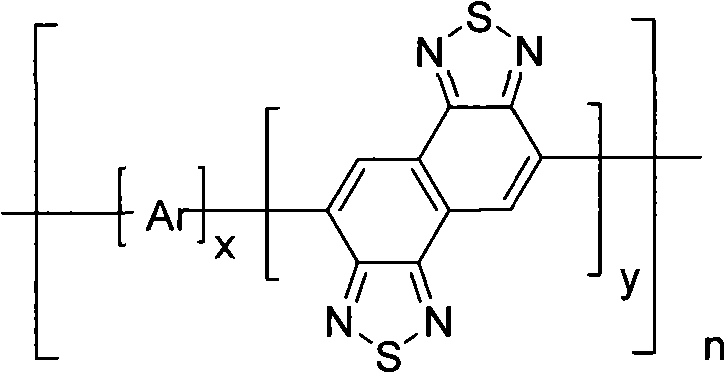 This flexibility enables the creation of a diverse library of copolymers, such as PCz-DOTNBT and PF-DHBTNBT, tailored for specific optoelectronic applications, thereby facilitating significant cost reduction in display & optoelectronic materials manufacturing by streamlining the material design phase.
Mechanistic Insights into Pd-Catalyzed Cross-Coupling and Halogenation
The core innovation lies in the efficient activation of the recalcitrant naphtho-bis-thiadiazole ring system. The synthesis initiates with the direct halogenation of the parent heterocycle. As detailed in the patent examples, reacting naphtho[1,2-c:5,6-c]bis[1,2,5]thiadiazole with NBS in concentrated sulfuric acid at 60°C effectively installs bromine atoms at the 3 and 7 positions. This electrophilic aromatic substitution is driven by the strong acidic environment which likely protonates the nitrogen atoms, temporarily modulating the electron density to allow bromination. The resulting 3,7-dibromo derivative is isolated as a crude solid and, crucially, can often be used directly in subsequent steps without rigorous purification, a factor that significantly enhances process throughput.
Following activation, the dibromo-intermediate participates in a Stille or Suzuki-Miyaura cross-coupling reaction. For instance, reacting the dibromo-NT with tributyltin-functionalized thiophenes in the presence of a tetrakis(triphenylphosphine)palladium(0) catalyst at 120°C in DMF yields the functionalized small molecule or polymer precursor. 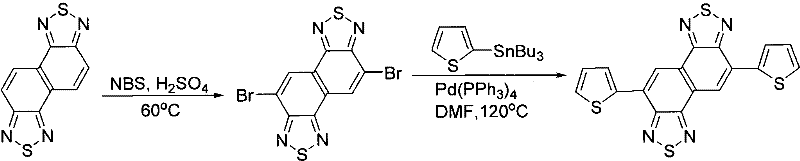 The choice of the 'Ar' group is pivotal; incorporating alkylated thiophenes or carbazoles introduces steric bulk that disrupts excessive aggregation, thereby enhancing solubility in solvents like chloroform or tetrahydrofuran. This balance between planarity (for charge transport) and solubility (for processability) is the key mechanistic achievement, allowing for the fabrication of uniform thin films essential for high-performance organic field-effect transistors (OFETs) and solar cells.
How to Synthesize Naphtho-Bis-Thiadiazole Derivatives Efficiently
The synthesis of these advanced materials follows a robust, scalable pathway suitable for industrial production. The process begins with the preparation of the reactive dibromo-core, followed by coupling with specific aromatic monomers to tune the bandgap and solubility profile. Finally, polycondensation reactions link these units into high molecular weight conjugated polymers. The detailed standardized synthesis steps, including precise stoichiometry, temperature controls, and workup procedures required to achieve the reported yields of up to 73% for polymerization, are outlined below.
- Direct Halogenation: React naphtho[1,2-c:5,6-c]bis[1,2,5]thiadiazole with N-bromosuccinimide (NBS) in concentrated sulfuric acid at 60°C to obtain the dibromo derivative.
- Stille Coupling: React the dibromo derivative with tributyltin-functionalized aromatic monomers (e.g., thiophene derivatives) using a Pd(PPh3)4 catalyst in DMF at 120°C.
- Polymerization: Perform Suzuki or Stille polycondensation between the functionalized core and aromatic boronic acid or tin monomers to form the final conjugated polymer.
Commercial Advantages for Procurement and Supply Chain Teams
For procurement managers and supply chain heads, the adoption of this naphtho-bis-thiadiazole technology offers distinct logistical and economic benefits over legacy materials. The synthetic route described eliminates the need for exotic or unstable reagents, relying instead on commodity chemicals like NBS, sulfuric acid, and standard palladium catalysts. This reliance on established chemical feedstocks ensures a stable supply chain and mitigates the risk of raw material shortages that often plague specialty electronic chemical manufacturing. Furthermore, the ability to use crude intermediates in certain steps reduces solvent consumption and waste generation, aligning with increasingly stringent environmental compliance standards.
- Cost Reduction in Manufacturing: The process design inherently lowers production costs by simplifying purification protocols. Since the halogenated intermediate can be utilized without extensive recrystallization in certain sequences, the overall number of unit operations is reduced. Additionally, the high thermal stability of the resulting polymers (decomposition > 400°C) reduces material loss during device annealing processes. By eliminating the need for complex post-synthesis treatments to improve solubility, manufacturers can achieve substantial cost savings in both raw material usage and energy consumption.
- Enhanced Supply Chain Reliability: The modular nature of the synthesis allows for the decoupling of core unit production from monomer functionalization. This means that the critical naphtho-bis-thiadiazole core can be stockpiled as a stable intermediate, while various 'Ar' monomers can be sourced or synthesized independently based on demand. This flexibility drastically simplifies inventory management and reduces lead times for custom material requests, ensuring a continuous supply of high-purity naphtho-bis-thiadiazole derivatives even during market fluctuations.
- Scalability and Environmental Compliance: The reactions operate at moderate temperatures (60°C to 120°C) and utilize solvents like DMF and toluene, which are well-understood in large-scale chemical engineering contexts. The solution-processable nature of the final polymers supports scalable deposition techniques such as slot-die coating and inkjet printing. This compatibility with roll-to-roll manufacturing infrastructure facilitates the commercial scale-up of complex conjugated polymers, enabling the transition from laboratory gram-scale synthesis to metric-ton production with minimal re-engineering of the process line.
Frequently Asked Questions (FAQ)
The following questions address common technical inquiries regarding the stability, processing, and performance metrics of these novel semiconductor materials. Our technical team has compiled these insights based on the experimental data provided in the patent literature to assist your evaluation process.
Q: How does naphtho-bis-thiadiazole improve upon traditional benzothiadiazole materials?
A: Naphtho[1,2-c:5,6-c]bis[1,2,5]thiadiazole features a larger rigid planar structure and stronger electron-deficiency compared to benzothiadiazole. This results in lower LUMO energy levels, improved π-π stacking, and potentially higher charge carrier mobility in organic solar cells and OFETs.
Q: What strategies are used to overcome the poor solubility of this core structure?
A: The patent describes introducing functionalized aromatic groups (Ar) such as alkylated thiophenes, carbazoles, or fluorenes via metal-catalyzed coupling. These side chains provide necessary solubility for solution processing while maintaining the conjugated backbone's electronic properties.
Q: What are the thermal stability characteristics of these polymers?
A: Thermogravimetric analysis (TGA) indicates excellent thermal stability, with decomposition temperatures typically exceeding 400°C. This robustness is critical for withstanding the thermal stresses of device fabrication and long-term operation.
Partnering with NINGBO INNO PHARMCHEM: Your Reliable Naphtho-Bis-Thiadiazole Supplier
The transition from laboratory curiosity to commercial viability requires a partner with deep expertise in process chemistry and scale-up engineering. NINGBO INNO PHARMCHEM stands ready to support your development of next-generation organic electronic devices. We possess extensive experience scaling diverse pathways from 100 kgs to 100 MT/annual commercial production, ensuring that the transition from pilot batches to full-scale manufacturing is seamless. Our rigorous QC labs and stringent purity specifications guarantee that every batch of naphtho-bis-thiadiazole derivatives meets the exacting standards required for high-efficiency OPV and OLED applications.
We invite you to collaborate with us to optimize your material supply chain. Contact our technical procurement team today to request a Customized Cost-Saving Analysis tailored to your specific volume requirements. We are prepared to provide specific COA data and route feasibility assessments to demonstrate how our optimized synthesis of these advanced semiconductors can enhance your product performance while reducing lead time for high-purity electronic chemicals.