
Scaling High-Efficiency Orange-Red TADF Emitters for Next-Generation OLED Displays
The rapid evolution of organic light-emitting diode (OLED) technology has created an urgent demand for emitters that balance high efficiency with cost-effectiveness, particularly in the red and orange-red spectral regions where traditional materials often struggle. Patent CN115160316A addresses this critical industry bottleneck by disclosing a novel class of orange-red thermally activated delayed fluorescence (TADF) materials, specifically 3,6,11-triTPA-BPQ and 3,6,12-triTPA-BPQ. These compounds represent a significant technological leap, offering ultra-high horizontal dipole orientation and exceptional thermal stability, which are paramount for the longevity and performance of commercial display panels. Unlike conventional phosphorescent systems that depend on precious metals, these metal-free organic emitters utilize a unique donor-acceptor architecture to harvest both singlet and triplet excitons, theoretically achieving 100% internal quantum efficiency. For R&D directors and procurement specialists alike, this patent outlines a pathway to high-purity OLED material production that drastically simplifies the supply chain while maintaining rigorous performance standards required for next-generation flat panel displays.
The Limitations of Conventional Methods vs. The Novel Approach
The Limitations of Conventional Methods
Historically, the development of efficient red OLED emitters has been plagued by the inherent limitations of the energy gap law, which dictates that as the emission wavelength increases, the non-radiative decay rate accelerates, leading to reduced efficiency. Second-generation phosphorescent materials attempted to solve efficiency issues by utilizing heavy metal complexes such as Iridium (Ir), Platinum (Pt), or Osmium (Os); however, this approach introduced severe economic and supply chain vulnerabilities due to the scarcity and exorbitant cost of these precious metals. Furthermore, the synthesis of these metal complexes often involves multi-step procedures with harsh reaction conditions, resulting in complex impurity profiles that are difficult to remove to the stringent purity levels required for electronic applications. The reliance on these expensive catalysts not only inflates the bill of materials but also creates a bottleneck for mass production, making it challenging for manufacturers to achieve cost reduction in electronic chemical manufacturing without compromising on device performance or color purity.
The Novel Approach
The methodology presented in patent CN115160316A offers a transformative solution by shifting towards third-generation TADF materials that eliminate the need for heavy metals entirely. This novel approach leverages a rigid dibenzo[f,h]pyrido[2,3-b]quinoxaline core coupled with triphenylamine donors to create a molecule with a small singlet-triplet energy gap (ΔEST), facilitating efficient reverse intersystem crossing (RISC). By avoiding the use of scarce transition metals, the synthesis becomes inherently more sustainable and economically viable, relying instead on abundant organic precursors. The patent highlights a streamlined preparation method that utilizes readily available starting materials like 3,6-dibromophenanthrenequinone and bromopyridine-diamines, significantly reducing the number of synthetic steps compared to traditional routes. This simplification not only enhances the overall yield but also minimizes the generation of hazardous waste, aligning with modern green chemistry principles while ensuring that the final product possesses the necessary thermal stability and high fluorescence quantum yield for commercial viability.
Mechanistic Insights into Condensation and Suzuki Coupling
The synthesis of these high-performance emitters relies on a robust two-step mechanistic pathway that ensures high regioselectivity and purity. The first stage involves a condensation reaction between 3,6-dibromophenanthrenequinone and a brominated pyridine diamine (either 6-bromo or 5-bromo isomer) in an ethanol solvent system. This reaction is conducted under a protective nitrogen atmosphere at temperatures ranging from 80°C to 100°C for a duration of 6 to 8 hours, facilitating the formation of the crucial tribromo-intermediate, 3,6,11-tribromodibenzo[f,h]pyrido[2,3-b]quinoxaline. The choice of ethanol as a solvent is particularly advantageous for industrial scale-up due to its low toxicity and ease of removal, while the nitrogen protection prevents oxidative degradation of the sensitive amine intermediates. Following isolation of the intermediate, the second stage employs a palladium-catalyzed Suzuki-Miyaura cross-coupling reaction, where the tribromo-intermediate reacts with 4-(diphenylamino)phenylboronic acid. This step is critical for installing the electron-donating triphenylamine groups that define the TADF characteristics of the final molecule.
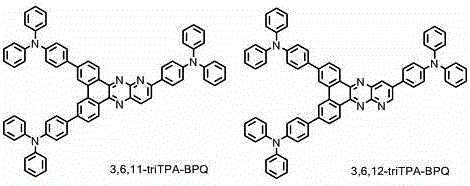
In the Suzuki coupling phase, the reaction mixture typically includes a base such as potassium carbonate and a catalyst like tetrakis(triphenylphosphine)palladium(0), heated to 90-100°C for 36 to 48 hours to ensure complete conversion of the bromide sites. The mechanistic precision here is vital for controlling the impurity profile; incomplete coupling can lead to mono- or di-substituted byproducts that act as quenchers in the final OLED device, severely impacting efficiency. The patent specifies a molar ratio of approximately 1:3.3 to 1:3.6 for the intermediate to boronic acid, ensuring an excess of the coupling partner to drive the equilibrium towards the desired tri-substituted product. Post-reaction, the purification process involves extraction with dichloromethane followed by column chromatography, a standard yet effective technique for removing palladium residues and unreacted starting materials. This rigorous control over the reaction parameters and purification steps results in materials with high horizontal dipole orientation factors exceeding 90%, a structural feature that maximizes light outcoupling in the horizontal direction parallel to the substrate, thereby boosting the external quantum efficiency of the device without the need for complex optical outcoupling structures.
How to Synthesize 3,6,11-triTPA-BPQ Efficiently
The synthesis protocol detailed in the patent provides a clear roadmap for laboratory and pilot-scale production, emphasizing reproducibility and safety. The process begins with the careful weighing and mixing of 3,6-dibromophenanthrenequinone and the appropriate bromopyridine-diamine isomer in ethanol, followed by refluxing under inert gas to form the core heterocyclic structure. Once the intermediate is isolated and dried, it is subjected to the cross-coupling reaction in a mixture of 1,4-dioxane and water, utilizing standard Schlenk techniques to maintain an oxygen-free environment essential for palladium catalysis. The detailed standardized synthesis steps见下方的指南 ensure that operators can replicate the high yields reported in the examples, achieving up to 91% yield for the intermediate and 70-77% for the final TADF emitter. This level of efficiency is critical for minimizing batch-to-batch variability and ensuring a consistent supply of high-quality material for device fabrication.
- Condense 3,6-dibromophenanthrenequinone with bromopyridine-diamine in ethanol at 80-100°C under nitrogen to form the tribromo-intermediate.
- Perform Suzuki coupling between the tribromo-intermediate and 4-(diphenylamino)phenylboronic acid using Pd(PPh3)4 catalyst in dioxane/water at 90°C.
- Purify the crude orange solid product via column chromatography using dichloromethane as the eluent to achieve high purity specifications.
Commercial Advantages for Procurement and Supply Chain Teams
For procurement managers and supply chain heads, the adoption of the technology described in CN115160316A offers substantial strategic benefits beyond mere technical performance. The primary advantage lies in the drastic simplification of the raw material portfolio; by eliminating the dependency on Iridium and other platinum-group metals, manufacturers can insulate themselves from the volatile pricing and geopolitical supply risks associated with these critical minerals. The synthesis route utilizes commodity chemicals that are widely available in the global market, ensuring a stable and continuous supply chain that is less prone to disruption. Furthermore, the reduction in synthetic steps directly translates to lower operational expenditures, as fewer unit operations mean reduced energy consumption, lower solvent usage, and decreased labor hours per kilogram of produced material. This streamlined process facilitates faster time-to-market for new OLED formulations, allowing companies to respond more agilely to consumer demands for higher resolution and more energy-efficient displays.
- Cost Reduction in Manufacturing: The elimination of expensive heavy metal catalysts and ligands represents a fundamental shift in the cost structure of OLED emitter production. Traditional phosphorescent dopants require complex coordination chemistry and extensive purification to remove trace metal contaminants, which adds significant cost and time to the manufacturing process. In contrast, the metal-free nature of these TADF materials removes the need for expensive metal scavenging resins and specialized analytical testing for heavy metal residuals. Additionally, the high yields reported in the patent examples indicate a highly atom-economical process, meaning less raw material is wasted as byproduct, further driving down the cost of goods sold (COGS) and improving overall profit margins for large-scale production runs.
- Enhanced Supply Chain Reliability: The reliance on easily obtainable organic precursors such as phenanthrenequinone derivatives and boronic acids ensures a robust supply chain that is not constrained by the mining and refining bottlenecks typical of rare earth elements. These starting materials are produced by numerous chemical suppliers globally, fostering a competitive sourcing environment that prevents vendor lock-in and ensures price stability. The simplicity of the synthesis also means that the technology can be transferred to multiple contract manufacturing organizations (CMOs) with relative ease, diversifying the supply base and mitigating the risk of production stoppages due to facility-specific issues. This redundancy is crucial for maintaining the continuity of supply required by major display panel manufacturers who operate on tight just-in-time delivery schedules.
- Scalability and Environmental Compliance: The use of common solvents like ethanol and dichloromethane, combined with standard reaction conditions (reflux temperatures below 100°C), makes this process highly amenable to scale-up from kilogram to tonne quantities without requiring exotic high-pressure or cryogenic equipment. The reduced complexity of the workflow lowers the barrier for commercial scale-up of complex OLED materials, allowing for rapid expansion of production capacity to meet growing market demand. Moreover, the absence of toxic heavy metals simplifies waste treatment and disposal protocols, helping manufacturers meet increasingly stringent environmental regulations and sustainability goals. This eco-friendly profile enhances the brand value of the final electronic products, appealing to environmentally conscious consumers and corporate buyers.
Frequently Asked Questions (FAQ)
The following questions address common technical and commercial inquiries regarding the implementation of these novel TADF materials in industrial settings. These answers are derived directly from the experimental data and beneficial effects outlined in the patent documentation, providing a reliable basis for decision-making. Understanding the specific processing requirements and performance metrics is essential for integrating these emitters into existing OLED fabrication lines effectively.
Q: What are the key advantages of these TADF materials over traditional phosphorescent emitters?
A: Unlike second-generation phosphorescent materials that rely on scarce and expensive heavy metals like Iridium or Platinum, these third-generation TADF materials achieve 100% internal quantum efficiency through reverse intersystem crossing (RISC) without heavy metals, significantly reducing raw material costs.
Q: How does the molecular structure contribute to device efficiency?
A: The materials possess an ultra-high horizontal dipole orientation factor of not less than 90%, which optimizes light outcoupling efficiency in OLED devices, alongside high fluorescence quantum yields of up to 94%.
Q: Is the synthesis process suitable for large-scale industrial production?
A: Yes, the patent describes a streamlined two-step synthesis using commercially available raw materials and standard solvents like ethanol and dioxane, avoiding complex purification steps and enabling scalable manufacturing.
Partnering with NINGBO INNO PHARMCHEM: Your Reliable 3,6,11-triTPA-BPQ Supplier
As the global demand for high-efficiency, metal-free OLED materials continues to surge, partnering with an experienced chemical manufacturer is essential for securing a competitive edge in the display market. NINGBO INNO PHARMCHEM stands at the forefront of this technological transition, leveraging our extensive experience scaling diverse pathways from 100 kgs to 100 MT/annual commercial production to deliver consistent, high-quality batches of advanced electronic chemicals. Our state-of-the-art facilities are equipped with rigorous QC labs capable of verifying stringent purity specifications, ensuring that every gram of 3,6,11-triTPA-BPQ or 3,6,12-triTPA-BPQ meets the exacting standards required for high-performance electroluminescent devices. We understand that the transition to new emitter technologies requires not just a supplier, but a strategic partner who can navigate the complexities of process optimization and regulatory compliance.
We invite R&D directors and procurement leaders to engage with our technical team to explore how these innovative TADF materials can enhance your product portfolio. By requesting a Customized Cost-Saving Analysis, you can gain detailed insights into the potential economic benefits of switching to our metal-free emitters. We encourage you to contact our technical procurement team today to索取 specific COA data and route feasibility assessments tailored to your specific application needs, ensuring a seamless integration of these next-generation materials into your supply chain.