
Revolutionizing Conjugated Diene Production: A Scalable Lewis Acid-Catalyzed Approach for High-Purity Intermediates
The landscape of organic synthesis is constantly evolving, driven by the need for more efficient, cost-effective, and environmentally benign methodologies. A significant breakthrough in this domain is detailed in Chinese Patent CN114671850A, which discloses a novel preparation method for conjugated diene compounds. These molecules are pivotal structural motifs found in numerous natural products, pharmaceutical agents, and functional materials, known for their physiological activity and utility in late-stage functionalization. The patented technology introduces a robust synthetic route that leverages beta-halovinyl-1,3-dithiane derivatives and olefin compounds as key starting materials. By employing inexpensive Lewis acids as catalysts, this method facilitates a double sulfur migration sequence to construct the conjugated diene framework. This approach stands out by avoiding the stringent requirements of traditional noble metal catalysis, offering a pathway that is not only chemically elegant but also industrially pragmatic for the production of high-purity pharmaceutical intermediates.
The Limitations of Conventional Methods vs. The Novel Approach
The Limitations of Conventional Methods
Historically, the construction of conjugated diene systems has relied heavily on transition metal-catalyzed cross-coupling reactions. Prominent examples include palladium-catalyzed oxidative coupling of olefins or 1,4-palladium migration cascades. While effective, these conventional methodologies suffer from significant drawbacks that hinder their widespread adoption in large-scale manufacturing. Primarily, they necessitate the use of expensive and often scarce precious metal catalysts such as palladium, ruthenium, and rhodium, which drastically inflate the raw material costs and introduce challenges related to heavy metal residue removal in final drug substances. Furthermore, these reactions typically demand rigorous anhydrous and oxygen-free conditions, requiring specialized equipment like gloveboxes or extensive Schlenk line techniques. The need for stoichiometric or excess oxidants in some protocols further complicates the waste stream management, generating substantial amounts of chemical waste that require costly disposal procedures, thereby impacting the overall sustainability profile of the manufacturing process.
The Novel Approach
The methodology described in patent CN114671850A represents a paradigm shift by replacing precious metals with abundant and affordable Lewis acids. This new approach utilizes catalysts such as zinc dichloride, iron trichloride, indium tribromide, or boron trifluoride etherate, which are commercially available at a fraction of the cost of palladium complexes. Crucially, the reaction proceeds under mild conditions, typically between 0°C and 60°C, and does not require the exclusion of air or moisture, simplifying the operational protocol significantly. The mechanism involves a unique double sulfur migration, transforming the beta-halovinyl-1,3-dithiane precursor into the desired diene with high stereoselectivity. This tolerance to ambient conditions and the use of non-toxic, earth-abundant catalysts make the process inherently safer and more scalable, addressing the critical pain points of cost and complexity associated with legacy synthetic routes for these valuable chemical building blocks.
Mechanistic Insights into Lewis Acid-Catalyzed Double Sulfur Migration
The core of this innovative synthesis lies in the Lewis acid-promoted activation of the beta-halovinyl-1,3-dithiane derivative. Upon coordination with the Lewis acid, the carbon-halogen bond becomes sufficiently polarized to facilitate ionization or nucleophilic attack, initiating the cascade. The reaction proceeds through a cationic intermediate where the 1,3-dithiane moiety acts as a stabilizing group before undergoing migration. This is followed by a second sulfur migration event that ultimately establishes the conjugated diene system. The specific choice of Lewis acid influences the reaction rate and stereoselectivity; for instance, Indium Tribromide (InBr3) and Boron Trifluoride Etherate (BF3·Et2O) have shown particular efficacy in promoting the transformation with excellent (E)-selectivity. The mechanistic pathway avoids the formation of organometallic species typical of Pd-catalysis, thereby sidestepping issues related to beta-hydride elimination side reactions that often plague traditional methods. This distinct mechanistic profile ensures a cleaner reaction mixture and simplifies downstream purification.
From an impurity control perspective, this mechanism offers distinct advantages for producing high-purity intermediates. The absence of transition metals eliminates the risk of metal-catalyzed homocoupling of the olefin substrates, a common side reaction in palladium chemistry. Additionally, the mild reaction conditions minimize thermal degradation of sensitive functional groups present on the aromatic rings, such as methoxy, nitro, or halogen substituents. The high stereoselectivity observed, predominantly yielding the (E)-isomer as confirmed by NMR analysis in the patent examples, reduces the burden of isomer separation. For R&D teams focusing on process development, this means a more predictable impurity profile and a streamlined workflow for qualifying the material for clinical or commercial use, ensuring that the final conjugated diene compounds meet stringent purity specifications required for pharmaceutical applications.
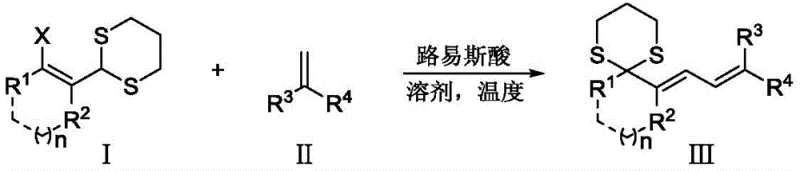
How to Synthesize Conjugated Diene Compounds Efficiently
The practical implementation of this synthesis is straightforward and amenable to standard laboratory and pilot plant equipment. The process begins by dissolving the beta-halovinyl-1,3-dithiane derivative and the olefin compound in a suitable organic solvent such as 1,2-dichloroethane, toluene, or dichloromethane. The Lewis acid catalyst is then introduced, typically in a molar ratio ranging from 0.5 to 3.0 equivalents relative to the limiting reagent. The mixture is stirred at temperatures between 0°C and 60°C for a duration of 3 to 24 hours, depending on the specific substrate reactivity. Reaction progress is conveniently monitored via thin-layer chromatography (TLC). Upon completion, the reaction is quenched with an aqueous sodium bicarbonate solution, followed by extraction with dichloromethane. The organic layers are washed with brine, dried over anhydrous sodium sulfate, and concentrated. Final purification is achieved through standard column chromatography, yielding the target conjugated diene with high purity. For detailed standardized synthesis steps, please refer to the guide below.
- Charge a reactor with beta-halovinyl-1,3-dithiane derivative, olefin compound, and a suitable organic solvent such as 1,2-dichloroethane.
- Add a Lewis acid catalyst (e.g., Indium Tribromide or Boron Trifluoride Etherate) at a molar ratio of 0.5-3.0 relative to the olefin.
- Stir the mixture at 0-60°C for 3-24 hours, monitor by TLC, quench with aqueous sodium bicarbonate, and purify via column chromatography.
Commercial Advantages for Procurement and Supply Chain Teams
For procurement managers and supply chain directors, the adoption of this Lewis acid-catalyzed technology translates into tangible strategic benefits. The primary advantage is the drastic reduction in raw material costs associated with catalyst procurement. By eliminating the dependency on volatile and expensive precious metals like palladium and rhodium, the direct material cost of the synthesis is significantly lowered. Moreover, the operational simplicity of the process—specifically the ability to run reactions without rigorous inert atmosphere protection—reduces the capital expenditure required for specialized reactor setups and lowers the energy consumption associated with maintaining anhydrous conditions. This efficiency gain allows for faster batch turnover times and improved asset utilization in manufacturing facilities. The robustness of the method also enhances supply chain reliability by reducing the risk of batch failures due to trace moisture or oxygen ingress, a common issue with sensitive transition metal catalysts.
- Cost Reduction in Manufacturing: The substitution of precious metal catalysts with commodity Lewis acids results in substantial cost savings. Traditional palladium-catalyzed processes often require expensive ligands and rigorous metal scavenging steps to meet regulatory limits for residual metals in APIs. This new method circumvents those costs entirely. The simplified workup procedure, which avoids complex metal removal resins or additional purification stages, further reduces the consumption of auxiliary materials and solvents. Consequently, the overall cost of goods sold (COGS) for producing these conjugated diene intermediates is optimized, providing a competitive edge in pricing for downstream pharmaceutical products.
- Enhanced Supply Chain Reliability: Supply chain continuity is bolstered by the use of widely available, non-strategic raw materials. Unlike precious metals, which are subject to geopolitical supply risks and price volatility, Lewis acids like zinc chloride or iron trichloride are produced in vast quantities globally. The mild reaction conditions also mean that the process can be transferred to a broader range of manufacturing sites, including those without specialized inert gas infrastructure. This flexibility reduces lead times for high-purity pharmaceutical intermediates by minimizing the logistical constraints associated with setting up complex reaction environments, ensuring a steady and reliable flow of materials to meet production schedules.
- Scalability and Environmental Compliance: Scaling this process from gram to tonnage levels is facilitated by its inherent safety and simplicity. The absence of pyrophoric reagents or high-pressure hydrogenation steps reduces the safety hazards typically associated with scale-up. From an environmental standpoint, the method aligns with green chemistry principles by avoiding toxic heavy metals and reducing the generation of hazardous waste streams. The simpler aqueous workup generates less organic waste compared to multi-step purification protocols required for metal removal. This compliance with increasingly stringent environmental regulations minimizes the risk of production shutdowns due to waste disposal issues and supports the company's sustainability goals.
Frequently Asked Questions (FAQ)
The following questions address common technical and commercial inquiries regarding this synthesis technology. They are derived from the specific experimental data and beneficial effects outlined in the patent documentation. Understanding these details helps stakeholders evaluate the feasibility of integrating this method into their existing manufacturing portfolios. The answers reflect the proven capabilities of the Lewis acid catalytic system in handling diverse substrates and delivering consistent quality.
Q: What are the advantages of this Lewis acid method over traditional palladium-catalyzed routes?
A: Unlike traditional methods requiring expensive precious metal catalysts like palladium, ruthenium, or rhodium, this method utilizes cheap Lewis acids. Furthermore, it eliminates the strict requirement for anhydrous and oxygen-free operating conditions, significantly simplifying the operational complexity and reducing equipment costs.
Q: What is the substrate scope for this conjugated diene synthesis?
A: The method demonstrates broad substrate applicability. It tolerates various substituents on the phenyl rings including methyl, methoxy, fluoro, chloro, bromo, trifluoromethyl, and nitro groups. It is also compatible with naphthyl, thienyl, and even complex steroid derivatives like estrone, making it highly versatile for drug molecule synthesis.
Q: What are the typical reaction conditions and yields?
A: Reactions typically proceed at mild temperatures between 0°C and 60°C using solvents like 1,2-dichloroethane. Lab-scale examples demonstrate isolated yields ranging from 28% to 76%, with high stereoselectivity favoring the (E)-isomer in most cases, ensuring high purity of the final conjugated diene products.
Partnering with NINGBO INNO PHARMCHEM: Your Reliable Conjugated Diene Compounds Supplier
The technological potential of this Lewis acid-catalyzed synthesis is immense, offering a pathway to high-value intermediates with superior economic and operational metrics. At NINGBO INNO PHARMCHEM, we possess extensive experience scaling diverse pathways from 100 kgs to 100 MT/annual commercial production. Our team of expert chemists is well-versed in optimizing such novel catalytic systems to ensure robust performance at an industrial scale. We maintain stringent purity specifications and operate rigorous QC labs to guarantee that every batch of conjugated diene compounds meets the highest international standards. Our commitment to quality assurance ensures that the impurity profiles are tightly controlled, providing our partners with the confidence needed for regulatory filings and clinical trials.
We invite you to explore how this advanced synthesis method can enhance your supply chain efficiency and reduce your manufacturing costs. Contact our technical procurement team today to request a Customized Cost-Saving Analysis tailored to your specific project needs. We are ready to provide specific COA data and route feasibility assessments to demonstrate how our capabilities align with your requirements for high-purity pharmaceutical intermediates. Let us collaborate to bring your next generation of therapeutic molecules to market faster and more economically.