
Revolutionizing 5-Acetylcytosine Production: A One-Step Commercial Scale-Up Strategy
The pharmaceutical industry constantly seeks robust synthetic routes for critical heterocyclic intermediates, and the recent disclosure in patent CN110698414B represents a paradigm shift in the manufacturing of 5-acetylcytosine. This vital compound, chemically known as 5-acetyl-4-amino-2-hydroxypyrimidine, serves as a foundational building block for the synthesis of various potent antitumor agents. Historically, the production of this molecule has been plagued by inefficiencies, but this new intellectual property introduces a streamlined, one-step Friedel-Crafts acylation strategy that fundamentally alters the economic and technical landscape. By leveraging cytosine as a direct starting material rather than complex precursors, the invention offers a pathway that is not only chemically elegant but also commercially viable for large-scale operations. For R&D directors and procurement specialists alike, understanding the nuances of this patent is essential for securing a competitive edge in the supply of high-purity pharmaceutical intermediates.
The Limitations of Conventional Methods vs. The Novel Approach
The Limitations of Conventional Methods
Prior to this innovation, the standard industrial practice for synthesizing 5-acetylcytosine relied heavily on a multi-step sequence originating from cyanoacetone, a raw material notorious for its instability and high cost. As illustrated in the background art of the patent, this legacy route necessitates three distinct chemical transformations involving condensation, substitution, and cyclization, each introducing potential points of failure and yield loss. Experimental data cited in the patent indicates that the cumulative yield of this traditional three-step process is abysmally low, often measuring less than 10 percent, which renders it economically unsustainable for modern high-volume manufacturing. Furthermore, the final cyclization step in the conventional method is prone to significant side reactions, generating complex impurity profiles that are notoriously difficult to separate and purify. These technical bottlenecks result in excessive waste generation and inflated production costs, creating a fragile supply chain that struggles to meet the rigorous purity specifications required for oncology drug development.

The Novel Approach
In stark contrast to the cumbersome legacy methods, the novel approach detailed in CN110698414B simplifies the entire synthetic architecture into a single, highly efficient transformation. By utilizing cytosine, a commodity chemical that is both inexpensive and readily available in bulk quantities, the new method bypasses the need for constructing the pyrimidine ring from scratch. The core innovation lies in the direct electrophilic substitution at the C-5 position of the cytosine ring, achieved through the strategic use of activated acetylating agents in the presence of specific acidic promoters. This drastic reduction in synthetic steps—from three down to one—inherently minimizes the accumulation of byproducts and significantly reduces the consumption of solvents and energy. The result is a process that not only delivers superior conversion rates but also simplifies the downstream processing requirements, making it ideally suited for the commercial scale-up of complex pharmaceutical intermediates without the baggage of historical inefficiencies.
Mechanistic Insights into Friedel-Crafts Acylation of Cytosine
The success of this novel synthesis hinges on a sophisticated understanding of electronic effects within the cytosine heterocycle and the precise manipulation of reaction conditions to favor C-acylation over N-acylation. Computational analysis of the cytosine structure reveals that the exocyclic amino group exerts a strong electron-donating effect, which activates the aromatic ring towards electrophilic attack, particularly at the ortho-position relative to the amino group. However, the amino group itself is also a potent nucleophile that could competitively react with the acetylating agent to form unwanted amides. To circumvent this, the patent specifies the use of a substantial excess of Lewis acids, such as aluminum trichloride, or strong protic acids like phosphoric acid. These acidic reagents serve a dual purpose: they activate the acetyl chloride or acetic anhydride to generate a highly reactive acylium ion, and simultaneously, they protonate the amino nitrogen of the cytosine. This protonation effectively deactivates the amino group as a nucleophile, thereby suppressing N-acylation side reactions and directing the electrophilic attack exclusively to the electron-rich C-5 carbon atom.
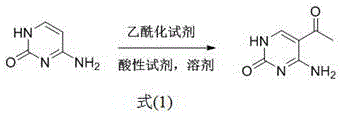
Furthermore, the choice of solvent plays a critical role in modulating the reactivity and solubility of the intermediates throughout the reaction coordinate. The patent explores a wide range of polar and non-polar media, including chloroform, nitrobenzene, and acetonitrile, demonstrating that the reaction is robust across different chemical environments provided the acid-to-substrate ratio is maintained. The mechanism involves the formation of a transient sigma-complex where the acylium ion attacks the C-5 position, followed by the restoration of aromaticity through the loss of a proton. This mechanistic clarity allows for precise control over impurity formation, ensuring that the final product profile is clean and amenable to standard purification techniques like silica gel chromatography or crystallization. For process chemists, this level of mechanistic control translates directly into reproducible batch quality and reduced risk of campaign failures during technology transfer.
How to Synthesize 5-Acetylcytosine Efficiently
Implementing this synthesis requires careful attention to the stoichiometry of the acid catalyst and the order of reagent addition to maximize the yield while minimizing thermal hazards. The general protocol involves dissolving cytosine in a selected solvent, followed by the slow addition of the Lewis acid to ensure complete complexation before introducing the acetylating agent. Detailed operational parameters, including specific temperature ramps and workup procedures involving neutralization and extraction, are critical for isolating the product in high purity.
- Dissolve cytosine in a suitable organic solvent such as chloroform or nitrobenzene under stirring.
- Add 3-5 equivalents of a Lewis acid catalyst (e.g., aluminum trichloride) to activate the system and protect the amino group.
- Introduce the acetylating reagent (acetyl chloride or acetic anhydride) and heat the mixture to reflux to complete the acylation.
Commercial Advantages for Procurement and Supply Chain Teams
For procurement managers and supply chain directors, the transition to this cytosine-based methodology offers profound strategic benefits that extend far beyond simple chemistry. The most immediate impact is the drastic simplification of the supply chain, as the reliance on unstable, specialty raw materials like cyanoacetone is completely eliminated in favor of stable, globally sourced cytosine. This shift significantly mitigates the risk of raw material shortages and price volatility, ensuring a more predictable and continuous flow of intermediates for downstream API production. Moreover, the reduction from a three-step process to a single-step operation inherently lowers the capital expenditure required for manufacturing infrastructure, as fewer reactors and separation units are needed to achieve the same output volume. This operational efficiency translates into substantial cost savings that can be passed down the value chain, enhancing the competitiveness of the final antitumor medications in the global marketplace.
- Cost Reduction in Manufacturing: The elimination of two entire synthetic steps removes the associated costs of reagents, solvents, and labor for those specific stages, while the high conversion rate minimizes raw material waste. By avoiding the use of expensive and deteriorating starting materials, the overall cost of goods sold is significantly optimized, allowing for more aggressive pricing strategies in tender negotiations. Additionally, the simplified purification process reduces the consumption of chromatography media and recycling solvents, further driving down the variable costs per kilogram of produced intermediate.
- Enhanced Supply Chain Reliability: Sourcing cytosine is far less risky than procuring specialized precursors, as it is a bulk commodity produced by numerous manufacturers worldwide. This diversification of the supply base ensures that production schedules are not held hostage by the capacity constraints of a single niche supplier. The robustness of the reaction conditions also means that the process is less sensitive to minor variations in raw material quality, reducing the frequency of batch rejections and ensuring consistent delivery timelines to pharmaceutical clients.
- Scalability and Environmental Compliance: The one-pot nature of the reaction facilitates easier scale-up from pilot plant to commercial tonnage, as there are fewer intermediate isolation steps that typically act as bottlenecks in scaling operations. From an environmental perspective, the reduction in total solvent usage and waste generation aligns with increasingly stringent green chemistry regulations, lowering the costs associated with waste disposal and environmental compliance auditing. This sustainability profile enhances the corporate reputation of manufacturers adopting this technology and future-proofs their operations against tightening regulatory frameworks.
Frequently Asked Questions (FAQ)
The following questions address common technical and commercial inquiries regarding the implementation of this patented technology, derived directly from the experimental data and claims within the document. Understanding these details is crucial for assessing the feasibility of integrating this route into existing manufacturing portfolios.
Q: Why is the new cytosine-based route superior to the traditional cyanoacetone method?
A: The traditional method relies on unstable cyanoacetone and requires three distinct reaction steps with a total yield below 10%, whereas the new patent utilizes stable, inexpensive cytosine in a single step with significantly higher conversion rates.
Q: How does the process prevent N-acylation side reactions on the amino group?
A: The process employs a large excess of Lewis acid or strong acid reagents, which protonate the amino group on the cytosine ring, effectively deactivating it towards nucleophilic attack and directing the acylation exclusively to the C-5 position.
Q: What are the primary cost drivers eliminated in this new manufacturing process?
A: By reducing the synthesis from three steps to one, the process eliminates the costs associated with multiple isolation and purification stages, while replacing expensive, deteriorating raw materials with commodity-grade cytosine.
Partnering with NINGBO INNO PHARMCHEM: Your Reliable 5-Acetylcytosine Supplier
At NINGBO INNO PHARMCHEM, we recognize the transformative potential of the synthetic route described in CN110698414B and possess the technical expertise to bring this innovation to life on a global scale. Our team has extensive experience scaling diverse pathways from 100 kgs to 100 MT/annual commercial production, ensuring that the transition from laboratory bench to industrial reactor is seamless and efficient. We maintain stringent purity specifications and operate rigorous QC labs equipped with state-of-the-art analytical instrumentation to guarantee that every batch of 5-acetylcytosine meets the exacting standards required for oncology drug synthesis. Our commitment to quality assurance ensures that our clients receive intermediates that are fully characterized and ready for immediate use in their GMP manufacturing processes.
We invite forward-thinking pharmaceutical companies to collaborate with us to leverage this cost-effective and robust synthesis technology. By partnering with our technical procurement team, you can request a Customized Cost-Saving Analysis tailored to your specific volume requirements and timeline constraints. We encourage you to reach out today to obtain specific COA data and comprehensive route feasibility assessments that demonstrate how our optimized manufacturing capabilities can enhance your supply chain resilience and reduce your overall production costs.