
Advanced Continuous Manufacturing of Pentamethyl Dipropylene Triamine for High-Performance Polyurethane Foams
Advanced Continuous Manufacturing of Pentamethyl Dipropylene Triamine for High-Performance Polyurethane Foams
The global demand for high-performance polyurethane foams in automotive, construction, and furniture sectors necessitates robust and efficient supply chains for specialized catalysts. Patent CN110437102B introduces a groundbreaking methodology for the preparation of pentamethyl dipropylene triamine, a critical balanced foaming catalyst known for enhancing open-cell structures and reducing foam fragility. This technical disclosure outlines a continuous, three-step synthesis route that leverages fixed-bed reactor technology to overcome the inherent limitations of traditional batch processes. By shifting from intermittent operations to a seamless continuous flow system, this innovation addresses key pain points regarding product selectivity, equipment corrosion, and operational safety. For R&D directors and procurement specialists, understanding this shift is vital, as it represents a move towards more sustainable and cost-effective polyurethane catalyst manufacturing that aligns with modern industrial safety standards and environmental regulations.
The Limitations of Conventional Methods vs. The Novel Approach
The Limitations of Conventional Methods
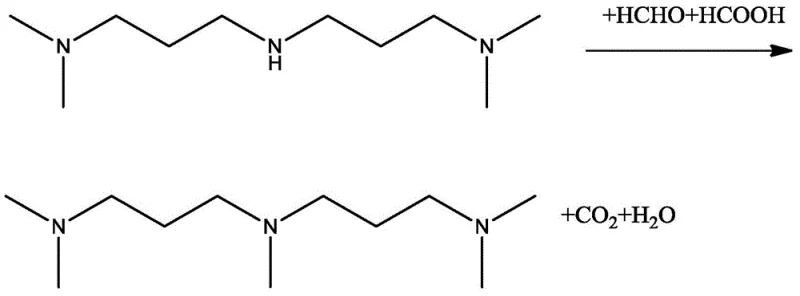
Historically, the production of pentamethyl dipropylene triamine has been plagued by inefficient synthetic routes that compromise both economic viability and operational safety. One prominent legacy method, often referred to as the Liang-Chang route, relies on the use of tetramethyl dipropylene triamine as a starting material, which is inherently expensive and limits scalability. Furthermore, this process necessitates the use of formic acid, a corrosive agent that imposes stringent material requirements on reaction vessels, leading to increased capital expenditure for equipment maintenance and replacement. As illustrated in the reaction scheme below, the reliance on such harsh conditions often results in lower product yields, typically hovering around 78%, which directly impacts the cost of goods sold and creates significant waste disposal challenges for specialty chemical manufacturers.
Another reported pathway involves a multi-step sequence starting from methylamine and acrylonitrile, proceeding through dicyan intermediates. While the raw materials are cheaper, this route suffers from severe selectivity issues during the hydrogenation phase. The formation of complex byproducts such as amino nitriles, diimines, and piperazine substances drastically reduces the selectivity of the desired N-(3-aminopropyl)-N-methylpropane-1,3-diamine to merely 85%. Consequently, the final product yield drops to approximately 67%, and the lack of intermediate separation steps complicates purification. Moreover, the use of methylamine introduces significant odor and environmental hazards, while the intermittent batch nature of the process increases labor intensity and the probability of safety accidents due to manual handling and stirring mechanisms.
The Novel Approach
In stark contrast to these legacy methods, the novel approach detailed in the patent utilizes a streamlined three-step continuous process that begins with the Michael addition of 3-dimethylaminopropylamine and acrylonitrile. This initial step is conducted under solvent-free conditions with precise temperature control, ensuring high selectivity for the mono-addition product, 3-[[3-(dimethylamino)propyl]amino]propionitrile. The subsequent steps involve continuous hydrogenation and reductive methylation within fixed-bed reactors, eliminating the need for mechanical stirring and allowing for precise control over residence time and reaction parameters. This transition to continuous processing not only enhances intrinsic safety by removing moving parts in contact with catalysts but also facilitates the recycling of unreacted starting materials, thereby optimizing atom economy and reducing raw material costs for reliable polyurethane catalyst suppliers.

Mechanistic Insights into Continuous Fixed-Bed Catalysis
The core of this technological advancement lies in the sophisticated design of the catalytic systems employed in the second and third stages of the synthesis. In the hydrogenation step, the process utilizes a Raney-type catalyst, specifically Raney cobalt, within a fixed-bed reactor operating at elevated pressures and temperatures. This setup allows for the efficient conversion of the nitrile group to a primary amine without the formation of excessive secondary amine byproducts, a common issue in batch hydrogenations. The continuous flow ensures that the reactant concentration profile remains optimal throughout the catalyst bed, minimizing side reactions and maximizing the throughput of the intermediate N'-(3-aminopropyl)-N,N-dimethyl-1,3-propanediamine. This level of control is unattainable in traditional batch reactors where concentration gradients and heat transfer limitations often lead to inconsistent product quality.
The final methylation step represents a significant leap in catalyst engineering, employing a specially formulated supported palladium-based catalyst. This catalyst is not merely palladium on alumina; it is intricately modified with zinc and rhenium promoters and a niobium-silicon treated support. The inclusion of rhenium enhances the hydrogen absorption capacity of the active centers, accelerating the hydrogenation speed and reducing the retention time of raw materials at high temperatures, which suppresses byproduct formation. Simultaneously, the zinc promoter improves the dispersion and thermal stability of the palladium particles. Crucially, the support is modified with silicon and niobium oxides to create a hydrophobic environment that inhibits the hydration of the alumina carrier caused by the aqueous formaldehyde feed. This structural integrity ensures prolonged catalyst life and consistent activity, which is essential for the commercial scale-up of complex polymer additives.

How to Synthesize Pentamethyl Dipropylene Triamine Efficiently
The synthesis protocol described in the patent provides a clear roadmap for transitioning from laboratory-scale batch reactions to industrial-scale continuous production. The process is designed to be modular, allowing for the independent optimization of the Michael addition, hydrogenation, and methylation stages. By adhering to the specific molar ratios, temperature gradients, and space velocities outlined in the technical disclosure, manufacturers can achieve product purities exceeding 99% with minimal downstream purification requirements. The integration of vacuum rectification for the intermediate further ensures that only high-purity feed enters the hydrogenation stage, protecting the sensitive catalysts from poisoning. For a detailed breakdown of the operational parameters and step-by-step execution guide, please refer to the standardized synthesis protocol below.
- Perform a solvent-free Michael addition reaction between 3-dimethylaminopropylamine and acrylonitrile at controlled temperatures to generate the nitrile intermediate with high selectivity.
- Conduct a continuous hydrogenation of the nitrile intermediate in a fixed-bed reactor using a Raney cobalt catalyst to form the diamine precursor.
- Execute a reductive methylation reaction in a second fixed-bed reactor using formaldehyde and hydrogen over a modified supported palladium catalyst to yield the final triamine product.
Commercial Advantages for Procurement and Supply Chain Teams
For procurement managers and supply chain directors, the adoption of this continuous manufacturing technology translates into tangible strategic advantages beyond mere technical specifications. The shift away from expensive and corrosive raw materials like formic acid and tetramethyl dipropylene triamine towards bulk commodities like acrylonitrile and 3-dimethylaminopropylamine fundamentally alters the cost structure of the final product. This raw material substitution, combined with the high selectivity of the continuous process, eliminates the need for complex and costly waste treatment associated with corrosive effluents. Furthermore, the continuous nature of the fixed-bed reactors allows for 24/7 operation with minimal human intervention, drastically reducing labor costs and the variability associated with batch-to-batch production. This reliability is paramount for maintaining a steady supply of high-purity pentamethyl dipropylene triamine to downstream foam manufacturers who operate on tight just-in-time schedules.
- Cost Reduction in Manufacturing: The elimination of expensive starting materials and the reduction of byproduct formation significantly lower the variable cost per kilogram of the final catalyst. By avoiding the use of formic acid, the process also removes the capital and operational expenses related to corrosion-resistant equipment and neutralization of acidic waste streams. The ability to recycle unreacted amines from the first step back into the process further enhances material efficiency, ensuring that every dollar spent on raw materials contributes maximally to the final yield. This economic efficiency allows suppliers to offer more competitive pricing without compromising on margin, providing a distinct advantage in cost reduction in foam additive manufacturing.
- Enhanced Supply Chain Reliability: Continuous processing inherently offers greater predictability and stability compared to batch operations. The fixed-bed reactor system is less prone to the mechanical failures and safety incidents that often plague stirred tank reactors, particularly when handling hazardous gases like hydrogen and ammonia derivatives. This robustness ensures a consistent output rate, allowing supply chain planners to forecast availability with high confidence. Additionally, the use of stable, long-life catalysts reduces the frequency of shutdowns for catalyst changeovers, minimizing production interruptions and ensuring a uninterrupted flow of goods to customers who rely on consistent quality for their own production lines.
- Scalability and Environmental Compliance: The modular nature of the fixed-bed reactor design facilitates straightforward scale-up from pilot plants to full commercial production without the nonlinear challenges often encountered in scaling batch processes. From an environmental perspective, the solvent-free initial step and the closed-loop nature of the continuous system significantly reduce volatile organic compound (VOC) emissions and liquid waste generation. The absence of heavy metal contamination in the final product, thanks to the fixed-bed configuration where the catalyst remains contained, simplifies regulatory compliance and reduces the burden on quality control laboratories. This alignment with green chemistry principles positions the manufacturer favorably in markets with stringent environmental regulations.
Frequently Asked Questions (FAQ)
The following questions address common technical and commercial inquiries regarding the implementation and benefits of this novel synthesis route. These insights are derived directly from the patent specifications and are intended to clarify the operational advantages for potential partners and technical stakeholders. Understanding these nuances is critical for evaluating the feasibility of integrating this technology into existing production portfolios or for sourcing high-quality catalysts from external partners. The answers reflect a deep dive into the mechanistic and process engineering aspects that define the superiority of this method over conventional alternatives.
Q: What are the primary advantages of the continuous fixed-bed process over traditional batch methods for PMDPTA?
A: The continuous fixed-bed process offers superior safety by eliminating mechanical stirring friction on catalysts, ensures higher automation levels reducing labor intensity, and significantly extends catalyst service life through the use of modified supports that resist hydration and deactivation.
Q: How does the novel catalyst formulation improve reaction selectivity?
A: The supported palladium catalyst utilizes zinc and rhenium as promoters; rhenium enhances hydrogen absorption capacity accelerating reaction rates, while zinc improves dispersion and stability. Additionally, the niobium-modified alumina support effectively inhibits carrier hydration caused by aqueous formaldehyde.
Q: Is the raw material cost significantly lower compared to legacy synthesis routes?
A: Yes, the process utilizes bulk chemicals like 3-dimethylaminopropylamine and acrylonitrile instead of expensive tetramethyl dipropylene triamine, and the high conversion rates combined with recyclable unreacted amines drastically reduce overall material consumption costs.
Partnering with NINGBO INNO PHARMCHEM: Your Reliable Pentamethyl Dipropylene Triamine Supplier
At NINGBO INNO PHARMCHEM, we recognize the critical role that advanced catalytic processes play in driving the efficiency of the polyurethane industry. Our team of expert chemists and process engineers possesses extensive experience scaling diverse pathways from 100 kgs to 100 MT/annual commercial production, ensuring that the theoretical benefits of patents like CN110437102B are fully realized in practical, large-scale applications. We are committed to delivering products that meet stringent purity specifications through our rigorous QC labs, guaranteeing that every batch of pentamethyl dipropylene triamine performs consistently in your foam formulations. Our capability to adapt and optimize continuous flow technologies allows us to stay ahead of market demands, providing a secure and high-quality supply chain for our global clientele.
We invite you to collaborate with us to explore how this advanced synthesis route can optimize your procurement strategy and enhance your product performance. Our technical procurement team is ready to provide a Customized Cost-Saving Analysis tailored to your specific volume requirements and application needs. By partnering with us, you gain access to specific COA data and route feasibility assessments that demonstrate the tangible value of our manufacturing capabilities. Contact us today to discuss how we can support your growth with reliable, high-performance chemical solutions that drive innovation in your sector.
Engineering Bottleneck?
Can't scale up this synthesis? Upload your target structure or CAS, and our CDMO team will evaluate the industrial feasibility within 24 hours. Request Evaluation →