
Advanced Synthesis of Fluorene-Carbazole Derivatives for High-Efficiency OLED Manufacturing
Advanced Synthesis of Fluorene-Carbazole Derivatives for High-Efficiency OLED Manufacturing
The rapid evolution of the display industry has placed immense pressure on material scientists to develop organic semiconductors that combine high electroluminescent efficiency with exceptional thermal stability. Patent CN103588698A addresses a critical bottleneck in this sector by introducing a novel class of organic semiconductor materials based on a rigid fluorene-carbazole scaffold. These materials are specifically engineered to overcome the poor heat resistance and short operational lifetimes often associated with traditional blue-light fluorescent materials. By leveraging a robust Suzuki coupling strategy, the invention provides a scalable pathway to produce compounds that maintain planar conjugation, thereby ensuring superior carrier transmission performance. This technological breakthrough is pivotal for manufacturers seeking reliable OLED material supplier partnerships that can deliver consistent quality for next-generation lighting and display applications.
The Limitations of Conventional Methods vs. The Novel Approach
The Limitations of Conventional Methods
Historically, the synthesis of high-performance blue emitters has been plagued by significant technical hurdles that impede commercial viability. Conventional routes often rely on harsh reaction conditions that can degrade sensitive functional groups or result in complex mixtures of regioisomers, necessitating costly and time-consuming purification steps. Furthermore, many existing blue-light materials suffer from inadequate thermal stability, leading to premature device failure when subjected to the high temperatures required for vacuum deposition processes. The lack of efficient dark blue fluorescent materials with long working lives has remained a persistent challenge, limiting the color gamut and longevity of organic EL displays. These deficiencies not only increase the cost reduction in organic semiconductor manufacturing but also create supply chain vulnerabilities due to low production yields and inconsistent batch quality.
The Novel Approach
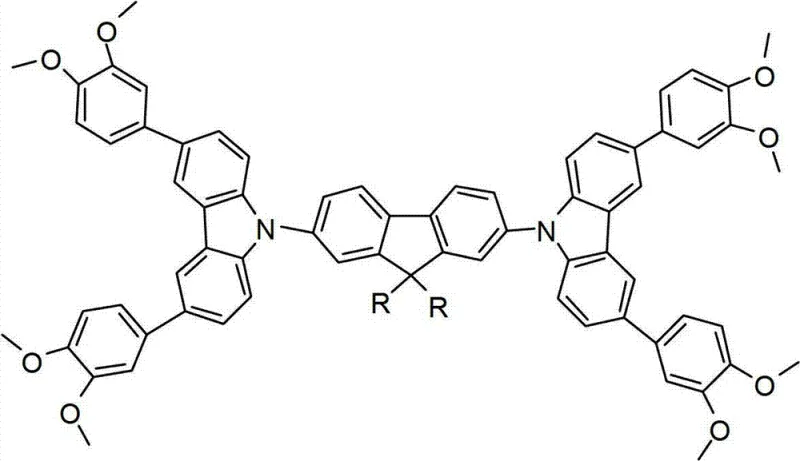
The methodology outlined in the patent represents a paradigm shift by utilizing a modular Suzuki coupling reaction to construct the core molecular architecture. This approach allows for the precise introduction of fluorenyl and carbazolyl groups, both of which are planar conjugating rigid groups known for their excellent carrier transmission properties. By selecting specific alkyl chains (R groups ranging from C1 to C6), the synthesis can be tuned to optimize solubility and film-forming properties without compromising the electronic performance of the rigid core. This flexibility enables the production of a family of materials, such as MOPCMF, MOPCPF, and MOPCHF, each tailored for specific processing requirements. The simplicity of operation and high production benefit make this novel approach exceptionally suitable for industrial production, offering a clear advantage over legacy synthetic routes.
Mechanistic Insights into Suzuki-Catalyzed Cross-Coupling
The core of this synthesis lies in the palladium-catalyzed cross-coupling between a halogenated carbazole-fluorene derivative and an arylboronic acid. The reaction mechanism proceeds through a classic catalytic cycle involving oxidative addition, transmetallation, and reductive elimination. Initially, the zero-valent palladium catalyst undergoes oxidative addition with the carbon-bromine bond of the carbazole-fluorene precursor, forming an organopalladium intermediate. This step is crucial as it activates the sterically hindered aromatic ring for subsequent coupling. The presence of electron-donating methoxy groups on the boronic acid partner facilitates the transmetallation step, where the aryl group is transferred to the palladium center. Finally, reductive elimination releases the coupled product and regenerates the active catalyst, allowing the cycle to continue. This mechanistic pathway ensures high selectivity and minimizes the formation of homocoupling byproducts, which is essential for achieving the high-purity organic semiconductor materials required for electronic applications.
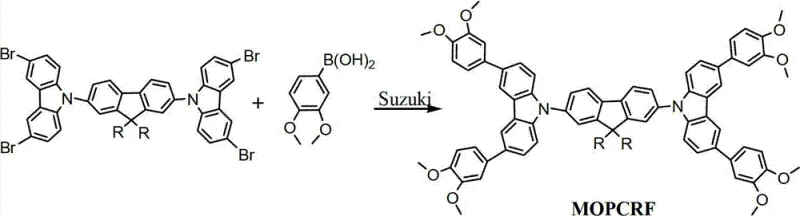
Impurity control is inherently built into this mechanistic design through the use of mild reaction conditions and specific catalyst systems. The patent specifies the use of catalysts such as tetrakis triphenylphosphine palladium or tris(dibenzylideneacetone)dipalladium, which are known for their high activity and tolerance to various functional groups. By maintaining an oxygen-free environment, typically achieved through nitrogen or argon purging, the deactivation of the palladium catalyst is prevented, ensuring consistent reaction kinetics throughout the 24 to 48-hour duration. The choice of base, such as soluble carbonate salts like potassium carbonate or cesium carbonate, further aids in suppressing side reactions. The resulting crude product can be effectively purified via silica gel column chromatography, yielding materials with the structural integrity necessary for stable electroluminescence. This rigorous control over the reaction environment directly translates to a cleaner impurity profile, reducing the burden on downstream purification processes.
How to Synthesize MOPCMF Efficiently
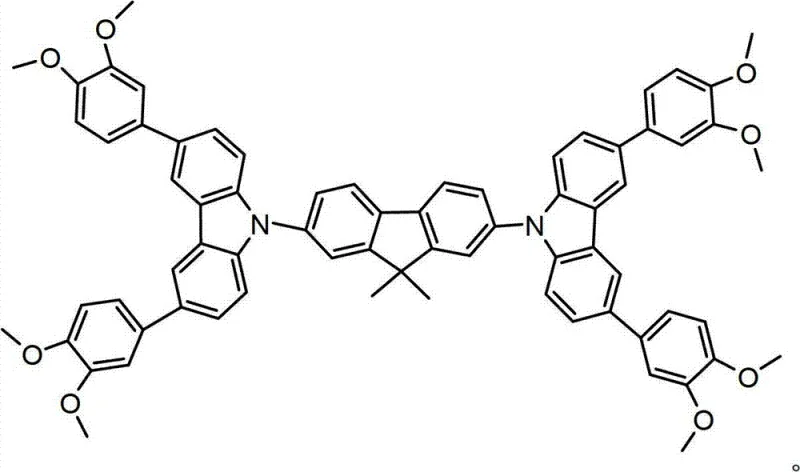
The synthesis of specific derivatives like 9-(7-(3,6-bis(3,4-dimethoxyphenyl)-9H-carbazol-9-yl)-9,9-dimethyl-9H-fluoren-2-yl)-3,6-bis(3,4-dimethoxyphenyl)-9H-carbazole, abbreviated as MOPCMF, exemplifies the practical application of this technology. The process begins with the preparation of the key intermediates: a dibromo-substituted carbazole-fluorene core and 3,4-dimethoxyphenylboronic acid. These precursors are mixed in a specific molar ratio, typically favoring an excess of the boronic acid to drive the reaction to completion. The detailed standardized synthesis steps below outline the precise conditions required to achieve the reported yields of up to 77% for this specific methyl-substituted variant. Understanding these parameters is critical for any facility aiming for the commercial scale-up of complex fluorene-carbazole derivatives.
- Prepare reactants: Mix bromo-substituted carbazole-fluorene derivative (Compound A) and dimethoxyphenylboronic acid (Compound B) in a molar ratio of 1:4 to 1:8 under oxygen-free conditions.
- Add catalyst and base: Introduce an organic palladium catalyst (e.g., tetrakis triphenylphosphine palladium) and a basic solution (e.g., 2mol/L K2CO3 or Na2CO3) in an organic solvent like THF or toluene.
- Reaction and Purification: Heat the mixture to 75-120°C for 24-48 hours. After completion, extract with dichloromethane, wash, dry, and purify via silica gel column chromatography.
Commercial Advantages for Procurement and Supply Chain Teams
For procurement managers and supply chain directors, the adoption of this synthetic route offers tangible strategic benefits that extend beyond mere technical performance. The reliance on widely available starting materials, such as substituted boronic acids and brominated aromatics, mitigates the risk of raw material shortages that often plague specialty chemical supply chains. Furthermore, the reaction conditions—operating between 75°C and 120°C—are well within the capabilities of standard industrial reactors, eliminating the need for specialized high-pressure or cryogenic equipment. This accessibility significantly lowers the barrier to entry for manufacturing partners and ensures a more resilient supply network capable of meeting fluctuating market demands for high-purity OLED intermediates.
- Cost Reduction in Manufacturing: The economic viability of this process is driven by the high atom economy of the Suzuki coupling and the elimination of expensive transition metal removal steps often required in other cross-coupling methodologies. By utilizing efficient palladium catalysts at relatively low loadings (0.05 to 0.1 molar ratio relative to the substrate), the overall cost of goods sold is substantially optimized. Additionally, the high yields reported (ranging from 77% to 86%) mean less waste generation and lower raw material consumption per kilogram of final product. This efficiency translates into significant cost savings that can be passed down the value chain, making the final OLED devices more competitive in the marketplace without sacrificing quality.
- Enhanced Supply Chain Reliability: The modular nature of the synthesis allows for flexible production scheduling and inventory management. Since the R group on the fluorene bridge can be easily varied (methyl, propyl, hexyl) by simply changing the dialkyl fluorenone precursor, manufacturers can produce a portfolio of materials using the same core infrastructure. This versatility reduces the lead time for high-purity OLED intermediates because production lines do not need to be completely retooled for different product variants. The robustness of the reaction also ensures consistent batch-to-batch reproducibility, a critical factor for long-term supply agreements with major display panel manufacturers who require absolute consistency in material performance.
- Scalability and Environmental Compliance: Scaling this process from laboratory to commercial tonnage is facilitated by the use of common organic solvents like tetrahydrofuran, toluene, and glycol dimethyl ether, which have well-established recovery and recycling protocols. The absence of extremely hazardous reagents simplifies waste treatment and aligns with increasingly stringent environmental regulations governing chemical manufacturing. The ability to operate at atmospheric pressure with inert gas protection rather than high-pressure hydrogenation or other dangerous unit operations enhances plant safety profiles. Consequently, this methodology supports sustainable growth and the commercial scale-up of complex polymer additives and small molecule semiconductors with a reduced environmental footprint.
Frequently Asked Questions (FAQ)
The following questions address common technical and commercial inquiries regarding the implementation of this organic semiconductor technology. These answers are derived directly from the experimental data and specifications provided in the patent documentation, ensuring accuracy for R&D and procurement evaluation. Understanding these details is essential for assessing the feasibility of integrating these materials into your current product development pipelines.
Q: What is the thermal stability of the synthesized organic semiconductor materials?
A: According to the patent data, the materials exhibit excellent thermal stability with decomposition temperatures (5% weight loss) exceeding 414°C, making them highly suitable for vacuum evaporation processes in OLED device fabrication.
Q: What is the primary application of these fluorene-carbazole derivatives?
A: These materials are designed specifically for use in organic electroluminescent devices (OLEDs), particularly as blue-light emitting layers, addressing the historical lack of efficient and thermally stable blue fluorescent materials.
Q: What yields can be expected from this Suzuki coupling process?
A: The patent reports high production efficiency with isolated yields ranging from 77% to 86% across different alkyl substitutions (methyl, propyl, hexyl), demonstrating the robustness of the synthetic route.
Partnering with NINGBO INNO PHARMCHEM: Your Reliable MOPCMF Supplier
At NINGBO INNO PHARMCHEM, we recognize the critical role that advanced organic semiconductors play in the future of display technology. Our team possesses extensive experience scaling diverse pathways from 100 kgs to 100 MT/annual commercial production, ensuring that your transition from laboratory discovery to mass market deployment is seamless. We are committed to delivering materials that meet stringent purity specifications, supported by our rigorous QC labs equipped with state-of-the-art analytical instrumentation. Whether you require the methyl-substituted MOPCMF or its higher solubility hexyl analogues, our manufacturing capabilities are designed to support the demanding requirements of the optoelectronic industry.
We invite you to engage with our technical procurement team to discuss how our synthesis capabilities can align with your project goals. By requesting a Customized Cost-Saving Analysis, you can gain deeper insights into how our optimized processes can reduce your overall material costs. We encourage potential partners to contact us directly to obtain specific COA data and route feasibility assessments tailored to your unique application needs, ensuring a partnership built on transparency and technical excellence.