
Optimizing Fipronil Precursor Production: A Technical Breakdown of High-Purity 2,6-Dichloro-p-trifluoromethylaniline Manufacturing
Optimizing Fipronil Precursor Production: A Technical Breakdown of High-Purity 2,6-Dichloro-p-trifluoromethylaniline Manufacturing
The global demand for high-efficacy phenylpyrazole insecticides, particularly Fipronil, has placed immense pressure on the supply chains of their critical precursors. Patent CN100519510C introduces a transformative methodology for the preparation of 2,6-dihalo-p-trifluoromethylaniline, specifically targeting the production of 2,6-dichloro-p-trifluoromethylaniline with unprecedented purity and operational safety. This technical insight report analyzes the strategic value of this patented process for R&D directors and procurement leaders seeking a reliable agrochemical intermediate supplier. By shifting away from hazardous hydrofluoric acid media to a controlled polar aprotic solvent system, this innovation addresses long-standing bottlenecks in cost reduction in pesticide manufacturing. The ability to produce intermediates that bypass extensive purification steps represents a paradigm shift in process chemistry, ensuring that downstream synthesis lines remain uninterrupted by quality failures or supply delays.
The Limitations of Conventional Methods vs. The Novel Approach
The Limitations of Conventional Methods
Historically, the synthesis of 2,6-dichloro-p-trifluoromethylaniline has been fraught with significant chemical and engineering challenges that compromise both yield and safety profiles. Prior art, such as the methods disclosed in patent applications WO00/35851 and FR2810665, often relied on harsh reaction environments, including the use of hydrofluoric acid as a solvent medium for chlorinating aniline precursors. These conventional approaches frequently resulted in the formation of undesirable by-products, specifically condensation polymers and heavy polychlorides, which are notoriously difficult to separate from the target molecule. The presence of these impurities renders the intermediate unusable for the sensitive coupling reactions required in phenylpyrazole insecticide production without undergoing rigorous and costly purification protocols. Furthermore, the reliance on hydrofluoric acid introduces severe corrosion risks to reactor vessels and necessitates specialized, expensive containment infrastructure, thereby inflating capital expenditure and operational overheads for manufacturing facilities attempting commercial scale-up of complex fluorinated anilines.
The Novel Approach
In stark contrast to these legacy methods, the process defined in CN100519510C utilizes a remarkably elegant solution involving the direct reaction of p-trifluoromethylaniline with elemental halogen in a polar aprotic solvent. 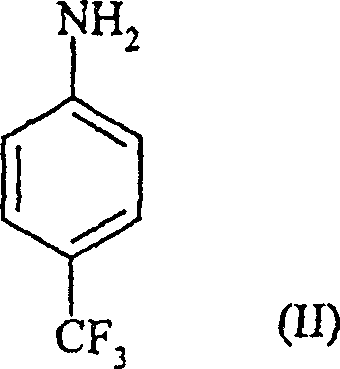 The core innovation lies in the simultaneous addition of the substrate and the halogenating agent into a solvent such as chlorobenzene at elevated temperatures ranging from 100°C to 300°C. This specific protocol effectively suppresses the formation of the aforementioned polymeric impurities, yielding a product of sufficient purity to be fed directly into subsequent synthesis steps. By eliminating the need for intermediate isolation and purification, this novel approach drastically simplifies the production workflow. The selection of chlorobenzene as the preferred solvent not only provides an optimal reaction medium for solubility and heat transfer but also aligns with standard industrial solvent recovery systems, facilitating a more sustainable and economically viable manufacturing cycle for high-purity phenylpyrazole precursors.
Mechanistic Insights into Electrophilic Aromatic Substitution
The chemical transformation described in this patent is a classic yet highly optimized example of electrophilic aromatic substitution, where the electronic properties of the trifluoromethyl group play a pivotal role in directing regioselectivity. The trifluoromethyl (-CF3) group is a strong electron-withdrawing substituent that deactivates the benzene ring towards electrophilic attack, necessitating the use of elevated temperatures and specific solvent conditions to drive the reaction to completion. However, its meta-directing nature is crucial here; while the amino group is strongly ortho/para directing, the specific reaction conditions and the steric environment favor substitution at the 2 and 6 positions relative to the amino group, flanking the -CF3 group. The precise control of the molar ratio of halogen to substrate, maintained between 1.9 and 2.5, ensures that the reaction proceeds past the monochlorinated stage to the desired dichlorinated product without significant over-chlorination or ring degradation. This stoichiometric precision is vital for minimizing the generation of waste and maximizing atom economy, a key consideration for modern green chemistry initiatives in the agrochemical sector.
Furthermore, the mechanism involves the generation of gaseous hydrogen chloride as a by-product, which must be managed carefully to prevent the formation of amine hydrochloride salts that could precipitate and clog reactor lines. The patent specifies the use of a sodium hydroxide trap to absorb the evolved HCl gas, maintaining a neutral to slightly basic environment that keeps the amine functionality available for reaction. The micro-mixing efficiency provided by high-shear stirring is another critical mechanistic factor; it ensures that the local concentration of chlorine does not become excessive at the point of entry, which could otherwise lead to localized hot spots and the formation of tar-like polychlorinated by-products. This attention to fluid dynamics and mass transfer underscores the robustness of the process, making it highly reproducible across different scales of operation and ensuring consistent batch-to-batch quality for reducing lead time for high-purity agrochemical intermediates.
How to Synthesize 2,6-Dichloro-p-trifluoromethylaniline Efficiently
The operational procedure outlined in the patent provides a clear roadmap for implementing this synthesis on an industrial scale, emphasizing safety and process control. The method begins with the preparation of a solvent heel, typically pure chlorobenzene, which is heated to a precise temperature window of 105°C to 115°C within a nitrogen-purged, jacketed reactor. The simultaneous feeding of the p-trifluoromethylaniline solution and chlorine gas requires sophisticated flow control systems to maintain the strict molar ratios and thermal conditions necessary for high selectivity. Detailed standardized synthesis steps follow below, outlining the exact parameters for scaling this reaction from pilot to commercial volumes.
- Charge a jacketed reactor with pure chlorobenzene and heat to 110°C under nitrogen atmosphere.
- Simultaneously feed a 70% solution of p-trifluoromethylaniline in chlorobenzene and chlorine gas at controlled flow rates to maintain temperature.
- Monitor residual starting material, distill off solvent under vacuum, and cool the crude product for storage or direct downstream use.
Commercial Advantages for Procurement and Supply Chain Teams
For procurement managers and supply chain directors, the adoption of this patented process offers tangible strategic benefits that extend far beyond simple chemical yield improvements. The elimination of hydrofluoric acid from the process stream fundamentally alters the risk profile of the manufacturing operation, removing the need for specialized corrosion-resistant alloys and hazardous material handling protocols. This shift translates directly into lower capital intensity and reduced insurance premiums, contributing to a more stable and predictable cost structure for the final intermediate. Moreover, the ability to produce material with greater than 98% purity without intermediate purification steps significantly compresses the production cycle time. This efficiency gain allows manufacturers to respond more agilely to market fluctuations in demand for Fipronil and related insecticides, ensuring a continuous supply of critical raw materials even during periods of global supply chain stress.
- Cost Reduction in Manufacturing: The economic impact of this process is driven primarily by the simplification of the downstream processing train. By avoiding the formation of condensation polymers and heavy polychlorides, the need for energy-intensive distillation columns or complex crystallization steps to remove these impurities is effectively eliminated. This reduction in unit operations leads to substantial savings in utility consumption, including steam for heating and cooling water for condensation. Additionally, the recovery and recycling of the chlorobenzene solvent further enhance the overall process economics, creating a closed-loop system that minimizes raw material waste. The avoidance of expensive HF-resistant equipment also represents a significant long-term capital saving, allowing for the utilization of standard glass-lined or stainless steel reactors that are more readily available and easier to maintain.
- Enhanced Supply Chain Reliability: Supply chain resilience is bolstered by the use of commodity chemicals as primary reagents. Chlorine gas and chlorobenzene are widely available bulk chemicals with established global supply networks, reducing the risk of raw material shortages that can plague specialty chemical manufacturing. The robustness of the reaction conditions, which tolerate slight variations in temperature and feed rates without catastrophic loss of quality, ensures high first-pass yield rates. This reliability minimizes the occurrence of off-spec batches that would otherwise require rework or disposal, thereby stabilizing inventory levels and delivery schedules. For global buyers, this means a dependable source of high-purity phenylpyrazole precursors that can be integrated seamlessly into their own production timelines without the fear of unexpected delays caused by quality failures.
- Scalability and Environmental Compliance: From an environmental, health, and safety (EHS) perspective, this process offers a markedly superior profile compared to traditional HF-based methods. The absence of hydrofluoric acid eliminates the risk of acute toxicity exposure and the generation of fluoride-containing wastewater, which is costly and difficult to treat. The primary waste stream consists of hydrochloric acid, which can be easily neutralized or potentially valorized as a by-product. The scalability of the process is demonstrated by the patent examples, which describe operations in 20 cubic meter reactors, indicating readiness for multi-ton production campaigns. This scalability ensures that the process can meet the growing global demand for agrochemicals while adhering to increasingly stringent environmental regulations regarding hazardous waste disposal and emissions control.
Frequently Asked Questions (FAQ)
The following questions address common technical and commercial inquiries regarding the implementation and benefits of this synthesis route. These answers are derived directly from the experimental data and claims presented in the patent documentation, providing a factual basis for decision-making.
Q: Why is the chlorobenzene solvent system superior to hydrofluoric acid media for this halogenation?
A: The chlorobenzene system eliminates the severe corrosion risks and hazardous waste disposal issues associated with hydrofluoric acid, while simultaneously preventing the formation of condensation polymers that plague older methods.
Q: What purity levels can be achieved with this patented halogenation process?
A: The process consistently yields 2,6-dichloro-p-trifluoromethylaniline with purity exceeding 98%, with residual starting material below 0.05% and monochloro derivatives below 0.09%.
Q: Is additional purification required before using this intermediate for Fipronil synthesis?
A: No, the high selectivity of the reaction ensures the product is sufficiently pure to be used directly in the subsequent synthesis of phenylpyrazole insecticide compounds without intermediate purification steps.
Partnering with NINGBO INNO PHARMCHEM: Your Reliable 2,6-Dichloro-p-trifluoromethylaniline Supplier
At NINGBO INNO PHARMCHEM, we recognize that the integrity of your final agrochemical product depends entirely on the quality of its building blocks. Our technical team has extensively analyzed the pathway described in CN100519510C and possesses the expertise to execute this halogenation with precision. We bring extensive experience scaling diverse pathways from 100 kgs to 100 MT/annual commercial production, ensuring that the transition from lab-scale optimization to full-scale manufacturing is seamless. Our facility is equipped with stringent purity specifications and rigorous QC labs capable of detecting trace impurities down to the ppm level, guaranteeing that every batch of 2,6-dichloro-p-trifluoromethylaniline meets the exacting standards required for Fipronil synthesis.
We invite you to collaborate with us to leverage this advanced technology for your supply chain. Contact our technical procurement team today to request a Customized Cost-Saving Analysis tailored to your specific volume requirements. We are prepared to provide specific COA data from our pilot runs and comprehensive route feasibility assessments to demonstrate how partnering with us can optimize your production costs and secure your supply of this critical intermediate.