
Scalable Biocatalytic Production of High-Purity Chiral Alcohol for Pharmaceutical Applications
Scalable Biocatalytic Production of High-Purity Chiral Alcohol for Pharmaceutical Applications
The pharmaceutical industry is constantly seeking more efficient and sustainable pathways for synthesizing complex chiral intermediates, particularly for blockbuster drugs like Aprepitant. A pivotal advancement in this domain is documented in patent CN102382780A, which discloses a novel strain of Microbacterium oxydans (CCTCC M 2010179) capable of highly enantioselective reduction. This biological catalyst offers a transformative alternative to traditional chemical synthesis, enabling the production of optically pure (R)-1-[3,5-bis(trifluoromethyl)phenyl]ethanol with exceptional efficiency. By leveraging the intrinsic metabolic machinery of this specific bacterial strain, manufacturers can bypass the harsh conditions and toxic reagents associated with conventional methods. This report analyzes the technical merits and commercial implications of this biocatalytic route, providing critical insights for R&D directors and procurement strategists looking to optimize their supply chains for high-value API intermediates.
The Limitations of Conventional Methods vs. The Novel Approach
The Limitations of Conventional Methods
Historically, the synthesis of chiral alcohols like the key intermediate for Aprepitant has relied heavily on transition metal-catalyzed asymmetric hydrogenation. While methods developed by major pharmaceutical entities using Ruthenium complexes and chiral ligands can achieve high yields, they present significant downstream processing challenges. The presence of heavy metal residues necessitates rigorous and costly purification steps to meet strict regulatory limits for pharmaceutical ingredients. Furthermore, the chiral ligands required for these reactions are often expensive, sensitive to air and moisture, and difficult to recycle, driving up the overall cost of goods sold. Additionally, chemical reduction often requires high pressure and temperature, posing safety risks and increasing energy consumption, which contradicts the growing industry mandate for greener manufacturing processes.
The Novel Approach
In stark contrast, the biocatalytic method utilizing Microbacterium oxydans C3 operates under remarkably mild conditions, typically between 27°C and 33°C, at atmospheric pressure. This whole-cell catalytic system eliminates the need for precious metal catalysts entirely, thereby removing the risk of heavy metal contamination and the associated purification burden. The patent highlights that this biological route achieves conversion efficiencies and enantioselectivity that rival or exceed chemical methods, with reported ee values consistently exceeding 99%. By employing a whole-cell system, the process inherently includes a self-regenerating cofactor system, which simplifies the reaction setup and reduces the reliance on expensive external additives. This shift from chemocatalysis to biocatalysis represents a paradigm shift towards more sustainable and cost-effective manufacturing for complex fluorinated intermediates.
Mechanistic Insights into Microbacterium oxydans-Catalyzed Asymmetric Reduction
The core of this technological breakthrough lies in the specific carbonyl reductase enzymes housed within the Microbacterium oxydans C3 strain. Unlike many other microorganisms that follow Prelog's rule to produce the (S)-enantiomer, this unique strain exhibits anti-Prelog selectivity, directly yielding the desired (R)-configuration alcohol from the prochiral ketone substrate. The reaction mechanism involves the transfer of a hydride ion from the reduced cofactor (NADPH or NADH) to the carbonyl carbon of 3,5-bis(trifluoromethyl)acetophenone. Crucially, the whole-cell system facilitates in-situ cofactor regeneration. The patent describes the addition of inexpensive co-substrates such as isopropanol or glucose, which serve as hydrogen donors to recycle the oxidized cofactors back to their active reduced state. This internal recycling loop ensures that the catalytic cycle continues efficiently without the need for stoichiometric amounts of expensive cofactors, a common bottleneck in isolated enzyme systems.
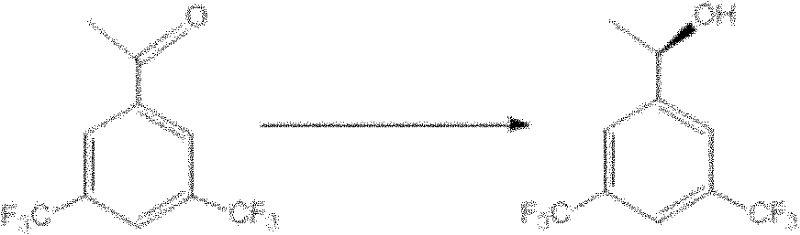
Beyond the primary reduction mechanism, the cellular environment of Microbacterium oxydans plays a vital role in impurity control. The specificity of the microbial enzymes ensures that side reactions, such as the reduction of other functional groups or the formation of racemic byproducts, are minimized. The patent data indicates that even at higher substrate concentrations, the system maintains high stereoselectivity, suggesting that the enzyme active sites are highly discriminating against the formation of the unwanted (S)-enantiomer. This high fidelity is essential for pharmaceutical applications where impurity profiles must be tightly controlled to ensure patient safety. The ability to achieve >99% ee directly from the biotransformation step significantly simplifies the downstream purification process, potentially allowing for direct crystallization or simple extraction rather than complex chiral chromatography.
How to Synthesize (R)-1-[3,5-bis(trifluoromethyl)phenyl]ethanol Efficiently
Implementing this biocatalytic process involves a streamlined workflow that integrates seamlessly into existing fermentation infrastructure. The process begins with the cultivation of the seed culture in a defined medium containing glucose, peptone, and yeast extract to ensure robust cell growth. Once the cells reach the logarithmic growth phase, the substrate 3,5-bis(trifluoromethyl)acetophenone is introduced into the system. The reaction can be performed using either growing cells or resting cells suspended in a buffer solution, offering flexibility depending on the specific production constraints. The addition of a co-substrate like isopropanol or glucose is critical to drive the equilibrium towards product formation by regenerating the necessary reducing equivalents. Following the biotransformation period, which typically ranges from 24 to 88 hours depending on substrate loading, the product is recovered via solvent extraction, yielding a high-purity chiral alcohol ready for further processing.
- Cultivate Microbacterium oxydans C3 in a nutrient-rich medium containing glucose and peptone at 27-33°C for 24-48 hours to achieve optimal cell density.
- Perform whole-cell biotransformation by adding 3,5-bis(trifluoromethyl)acetophenone substrate and a coenzyme recycling system (isopropanol/glucose) to the culture or resting cells.
- Extract the final product using ethyl acetate and purify to obtain the target chiral alcohol with >99% enantiomeric excess.
Commercial Advantages for Procurement and Supply Chain Teams
For procurement managers and supply chain heads, the adoption of this biocatalytic route offers compelling strategic advantages beyond mere technical feasibility. The elimination of heavy metal catalysts translates directly into significant cost reductions by removing the need for expensive metal scavengers and extensive analytical testing for residual metals. Furthermore, the raw materials required for this process—such as glucose and isopropanol—are commodity chemicals with stable pricing and abundant global availability, mitigating the supply chain risks associated with specialized chiral ligands or rare earth metals. The mild reaction conditions also imply lower energy consumption and reduced wear on reactor equipment, contributing to a lower total cost of ownership for the manufacturing facility. These factors combined create a more resilient and economically attractive supply chain for critical pharmaceutical intermediates.
- Cost Reduction in Manufacturing: The transition to a whole-cell biocatalytic system fundamentally alters the cost structure of producing this chiral intermediate. By avoiding the use of precious metal catalysts like Ruthenium and complex chiral ligands, the direct material costs are drastically lowered. Additionally, the self-regenerating cofactor system within the bacterial cells removes the necessity for purchasing expensive external cofactors, which are often a major cost driver in enzymatic processes. The simplified downstream processing, resulting from high selectivity and the absence of metal residues, further reduces operational expenditures related to purification and waste treatment, leading to substantial overall cost savings.
- Enhanced Supply Chain Reliability: Relying on a fermentation-based process enhances supply chain security by diversifying the source of raw materials away from geographically concentrated mining or specialized chemical synthesis hubs. The bacterial strain can be preserved and propagated indefinitely, ensuring a consistent and renewable source of the biocatalyst. This biological "factory" is less susceptible to the market volatility that often affects the pricing and availability of transition metals and synthetic ligands. Moreover, the robustness of the Microbacterium oxydans strain allows for flexible production scheduling, enabling manufacturers to respond more agilely to fluctuations in market demand for the final API.
- Scalability and Environmental Compliance: From an environmental and regulatory standpoint, this biocatalytic process aligns perfectly with green chemistry principles. The aqueous nature of the reaction medium and the biodegradability of the biological components simplify waste management and reduce the environmental footprint of the manufacturing site. Scaling up from laboratory to industrial production is straightforward, as it utilizes standard stirred-tank reactors common in the fermentation industry. The absence of toxic heavy metals and corrosive reagents minimizes the generation of hazardous waste, facilitating easier compliance with increasingly stringent environmental regulations and reducing the costs associated with waste disposal and environmental monitoring.
Frequently Asked Questions (FAQ)
The following questions address common technical and commercial inquiries regarding the implementation of this biocatalytic technology. These answers are derived directly from the experimental data and specifications outlined in the patent literature, providing a reliable foundation for decision-making. Understanding these details is crucial for evaluating the feasibility of integrating this route into your existing manufacturing portfolio. We encourage technical teams to review these points closely to assess the alignment with their specific quality and capacity requirements.
Q: What is the enantiomeric purity achievable with this biocatalytic method?
A: According to patent CN102382780A, the Microbacterium oxydans C3 strain consistently produces (R)-1-[3,5-bis(trifluoromethyl)phenyl]ethanol with an enantiomeric excess (ee) value greater than 99%, meeting the stringent requirements for chiral drug synthesis.
Q: Why is whole-cell catalysis preferred over isolated enzymes for this reaction?
A: Whole-cell catalysis utilizes the microorganism's intrinsic coenzyme regeneration systems, eliminating the need for expensive external cofactors like NADPH. This approach significantly lowers production costs and enhances enzyme stability compared to using isolated enzymes.
Q: Is this biocatalytic process suitable for large-scale industrial manufacturing?
A: Yes, the process utilizes standard fermentation techniques with mild reaction conditions (27-33°C) and readily available substrates. The robustness of the bacterial strain allows for easy scale-up from laboratory shaker flasks to industrial fermenters without complex equipment modifications.
Partnering with NINGBO INNO PHARMCHEM: Your Reliable (R)-1-[3,5-bis(trifluoromethyl)phenyl]ethanol Supplier
At NINGBO INNO PHARMCHEM, we recognize the critical importance of securing a stable and high-quality supply of chiral intermediates for the global pharmaceutical market. Our expertise in biocatalysis and process development positions us as an ideal partner for scaling this innovative Microbacterium oxydans-mediated pathway. We possess extensive experience scaling diverse pathways from 100 kgs to 100 MT/annual commercial production, ensuring that we can meet your volume requirements without compromising on quality. Our state-of-the-art facilities are equipped with rigorous QC labs and adhere to stringent purity specifications, guaranteeing that every batch of (R)-1-[3,5-bis(trifluoromethyl)phenyl]ethanol meets the highest industry standards for enantiomeric excess and chemical purity.
We invite you to collaborate with us to leverage this advanced biocatalytic technology for your next project. Our technical team is prepared to provide a Customized Cost-Saving Analysis tailored to your specific production needs, demonstrating how this green chemistry approach can optimize your bottom line. Please contact our technical procurement team today to request specific COA data and route feasibility assessments. Let us help you secure a competitive advantage through superior process technology and reliable supply chain execution.