
Advanced Synthesis of Camphorate-Based Platinum II Complexes for Oncology Applications
The pharmaceutical landscape for oncology treatments is constantly evolving, driven by the urgent need for agents that balance potent efficacy with manageable toxicity profiles. Patent CN1203080C, published in May 2005, introduces a significant advancement in this domain by disclosing a novel class of platinum (II) coordination compounds utilizing camphoric acid radicals as ligands. Unlike traditional cisplatin derivatives that often suffer from severe nephrotoxicity and poor water solubility, these new complexes leverage the unique steric and electronic properties of the camphorate anion. The invention details the preparation methods and demonstrates the in vitro inhibitory effects of these compounds against human leukemia, ovarian, liver, and lung cancer cells. For R&D directors and procurement specialists seeking a reliable pharmaceutical intermediate supplier, understanding the structural nuances of these camphorate-based complexes is critical for developing next-generation anticancer formulations that offer improved therapeutic indices.
The Limitations of Conventional Methods vs. The Novel Approach
The Limitations of Conventional Methods
Historically, the development of platinum-based anticancer drugs has been hindered by the inherent trade-off between stability and reactivity. In classical cisplatin analogues, the nature of the anionic leaving group dictates the drug's behavior in vivo. If an unstable leaving group is employed, the compound tends to exhibit heightened toxicity due to premature hydrolysis and non-specific binding to healthy tissues. Conversely, if the leaving group is too inert, the compound fails to activate within the tumor microenvironment, rendering it therapeutically ineffective. Furthermore, many second-generation platinum drugs, while improving upon cisplatin, still face challenges regarding water solubility, which complicates formulation and administration. The reliance on simple dicarboxylic acids like oxalate or malonate has provided some relief, yet there remains a persistent demand for ligands that can fine-tune the hydrolysis rate more precisely to minimize systemic side effects while maximizing tumor uptake.
The Novel Approach
The methodology outlined in CN1203080C presents a transformative solution by incorporating camphoric acid radicals as the complex anion. This approach effectively addresses the solubility and toxicity issues plaguing earlier generations of platinum drugs. The bulky, chiral structure of the camphorate group modulates the kinetics of ligand exchange, ensuring that the platinum center remains stable during circulation but becomes active upon reaching the target site. The patent explicitly highlights that these novel platinum (II) coordination compounds possess low toxicity and good water solubility, making them superior candidates for clinical development. By reacting camphorate radicals with platinum amine complex cations, the inventors have created a versatile platform capable of generating multiple stereoisomers, including DL racemates and specific optical isomers like (1R, 3S)-(+)-camphorate. This structural diversity allows for the optimization of pharmacokinetic properties, offering a distinct competitive advantage in the cost reduction in API manufacturing by potentially reducing the dosage required for therapeutic effect.
Mechanistic Insights into Camphorate Ligand Exchange Synthesis
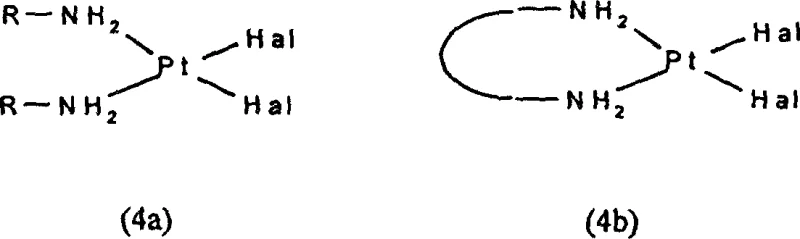
The synthesis of these divalent platinum complexes relies on a sophisticated yet robust ligand exchange mechanism. The process begins with the formation of a precursor containing dihalide ions coordinated to a diamine ligand, typically derived from potassium tetrachloroplatinate. As illustrated in the structural representations below, these precursors serve as the foundational scaffold for the final active pharmaceutical ingredient. The critical step involves the removal of the halide ions (Cl-, Br-, or I-) to create a coordinatively unsaturated intermediate that is highly receptive to the incoming camphorate ligand. This is achieved through the use of silver ions, which precipitate the halides as insoluble silver salts, driving the equilibrium forward. The subsequent reaction with monovalent alkali metal camphorates or ammonium camphorates results in the formation of the desired cis-(camphorate)·diamine platinum (II) compound. This two-step sequence ensures high regioselectivity and minimizes the formation of trans-isomers, which are often inactive.
Furthermore, the control of impurities is paramount in the production of high-purity platinum complexes. The patent specifies that the reaction must be conducted under nitrogen protection and shielded from light at elevated temperatures, typically around 60°C. These conditions prevent the oxidation of the platinum center and the degradation of the sensitive amine ligands. The use of silver-mediated halide abstraction is particularly advantageous because it avoids the introduction of extraneous metal contaminants that are difficult to remove later. The resulting intermediates react cleanly with the camphorate source, whether it be a sodium salt generated in situ from camphoric acid and sodium hydroxide, or a pre-formed silver camphorate. This mechanistic precision ensures that the final product meets the stringent purity specifications required for oncology applications, thereby facilitating the commercial scale-up of complex organometallics without compromising on quality or safety standards.
How to Synthesize Camphorate Platinum Complexes Efficiently
The synthetic pathway described in the patent offers a clear roadmap for producing these valuable intermediates. The process is characterized by its operational simplicity and the use of readily available starting materials. The initial step involves coordinating the diamine ligand to the platinum center, followed by the crucial silver-mediated halide exchange. Detailed standardized synthesis steps are provided in the guide below, outlining the precise stoichiometry and reaction conditions necessary to achieve optimal yields ranging from 37% to 64% as demonstrated in the experimental examples. This protocol is designed to be adaptable for various diamine ligands, including 1,2-trans-cyclohexanediamine and substituted dioxolane derivatives, allowing manufacturers to produce a library of analogues for structure-activity relationship studies.
- Preparation of Dihalodiamine Platinum Precursors: React potassium tetrachloroplatinate with specific diamine ligands to form the dihalogen-diamine coordinated platinum compound represented by formulas 4a and 4b.
- Halide Removal via Silver Mediation: Treat the precursor with silver ions (e.g., silver nitrate) in aqueous solution under nitrogen protection at 60°C to remove halide ions, forming a reactive aquo-intermediate.
- Ligand Exchange with Camphorate: React the intermediate with alkali metal camphorates or directly use silver camphorate to introduce the camphorate ligand, yielding the final cis-(camphorate)·diamine platinum(II) complex.
Commercial Advantages for Procurement and Supply Chain Teams
For procurement managers and supply chain heads, the adoption of this camphorate-based synthesis route offers substantial strategic benefits beyond mere chemical novelty. The primary advantage lies in the simplification of the purification process. Traditional platinum drug synthesis often requires extensive chromatography or recrystallization steps to remove unreacted starting materials and toxic metal impurities. However, the silver-mediated precipitation method described in this patent inherently separates the halide byproducts as insoluble silver salts, which can be easily filtered off using diatomaceous earth. This streamlined workflow significantly reduces the number of unit operations required, leading to a drastic simplification of the manufacturing process and associated cost savings.
- Cost Reduction in Manufacturing: The elimination of expensive transition metal catalysts and the use of aqueous reaction media contribute to a leaner cost structure. By avoiding organic solvents in the key ligand exchange step, the process reduces both material costs and the expenses associated with solvent recovery and waste disposal. The ability to use crude camphoric acid derivatives without extensive pre-purification further enhances the economic viability of this route. Consequently, manufacturers can achieve significant cost optimization in the production of these high-value intermediates, making them more accessible for generic drug development.
- Enhanced Supply Chain Reliability: The raw materials required for this synthesis, such as potassium tetrachloroplatinate, silver nitrate, and camphoric acid, are commercially available from multiple global suppliers. This diversification of the supply base mitigates the risk of shortages that often plague specialized reagent markets. Moreover, the reaction conditions are mild (60°C) and do not require high-pressure equipment or cryogenic cooling, meaning that production can be easily transferred between different manufacturing sites without significant capital investment. This flexibility ensures reducing lead time for high-purity intermediates and guarantees a continuous supply for downstream drug formulation.
- Scalability and Environmental Compliance: From an environmental perspective, the process is favorable due to its reduced solvent footprint. The use of water as the primary reaction medium aligns with green chemistry principles, minimizing the generation of hazardous volatile organic compounds (VOCs). The solid byproducts, primarily silver halides, can be recovered and recycled, adding an additional layer of sustainability to the operation. The robustness of the reaction allows for seamless scaling from laboratory benchtop quantities to multi-ton annual production capacities, ensuring that the supply chain can meet the demands of large-scale clinical trials and commercial launch without bottlenecks.
Frequently Asked Questions (FAQ)
The following questions address common technical and commercial inquiries regarding the production and application of these camphorate platinum complexes. The answers are derived directly from the technical specifications and experimental data provided in patent CN1203080C, ensuring accuracy and relevance for industry professionals.
Q: What is the primary advantage of using camphorate as a ligand in platinum complexes?
A: According to patent CN1203080C, using camphorate as a leaving group significantly improves water solubility and reduces toxicity compared to traditional chloride ligands, while maintaining potent antitumor activity against leukemia, ovarian, liver, and lung cancer cells.
Q: How does the stereochemistry of the camphorate ligand affect the compound?
A: The patent specifies that the camphorate radical can be a DL racemate, D-type optical isomer [(1R, 3S)-(+)-camphorate], or L-type optical isomer [(1S, 3R)-(-)-camphorate], allowing for the creation of diverse stereoisomers with potentially varied biological profiles.
Q: Is this synthesis route scalable for commercial production?
A: Yes, the described method utilizes standard aqueous reactions at moderate temperatures (60°C) and common reagents like silver nitrate and sodium hydroxide, making it highly amenable to commercial scale-up without requiring extreme pressure or cryogenic conditions.
Partnering with NINGBO INNO PHARMCHEM: Your Reliable Camphorate Platinum Complex Supplier
At NINGBO INNO PHARMCHEM, we recognize the transformative potential of the camphorate-based platinum technology disclosed in CN1203080C. As a leading CDMO partner, we possess the technical expertise to translate these patented methodologies into commercial reality. Our facilities are equipped to handle the nuanced requirements of organometallic synthesis, including light-sensitive reactions and silver-mediated processes. We bring extensive experience scaling diverse pathways from 100 kgs to 100 MT/annual commercial production, ensuring that your project moves smoothly from pilot scale to full-scale manufacturing. Our commitment to quality is underscored by our stringent purity specifications and rigorous QC labs, which utilize advanced analytical techniques such as HPLC, ICP-MS, and NMR to verify the identity and purity of every batch.
We invite you to collaborate with us to leverage this innovative chemistry for your oncology pipeline. Our team is ready to provide a Customized Cost-Saving Analysis tailored to your specific volume requirements and target market. Please contact our technical procurement team today to request specific COA data and route feasibility assessments. By partnering with us, you gain access to a secure, scalable, and cost-effective supply chain for high-performance platinum intermediates, positioning your organization at the forefront of anticancer drug development.