
Advanced Synthesis of 5-Amino-2,4-Diiodo-1,3-Phthalic Acid for Contrast Agent Quality Control
Introduction to High-Purity Impurity Standards for Iodinated Contrast Agents
The global demand for non-ionic iodine contrast agents, such as Iohexol, Iopamidol, and Ioversol, continues to drive rigorous quality standards in pharmaceutical manufacturing. These vital diagnostic tools rely heavily on 5-amino-2,4,6-triiodo-1,3-phthalic acid as their fundamental chemical scaffold. However, ensuring the safety and efficacy of these agents requires precise control over related substances, particularly incomplete iodination byproducts. Patent CN112778151A introduces a breakthrough methodology for the preparation of 5-amino-2,4-diiodo-1,3-phthalic acid, a critical impurity that has historically been difficult to synthesize and isolate. This innovation addresses a significant gap in the supply of certified reference materials, enabling more accurate quantitative analysis and stricter quality control for contrast agent producers worldwide.
Traditionally, obtaining this specific diiodo isomer involved complex separation from reaction mother liquors, a process plagued by low recovery rates and purity challenges. The new approach detailed in the patent utilizes a selective catalytic deiodination strategy, transforming the readily available triiodo precursor into the desired diiodo standard with exceptional efficiency. By establishing a dedicated synthetic route rather than relying on incidental byproduct isolation, manufacturers can now secure a consistent supply of high-purity standards essential for regulatory compliance. This shift not only enhances analytical precision but also streamlines the overall quality assurance workflow for major pharmaceutical entities producing X-ray imaging solutions.
The Limitations of Conventional Methods vs. The Novel Approach
The Limitations of Conventional Methods
In the conventional production of 5-amino-2,4,6-triiodo-1,3-phthalic acid, the iodination reaction proceeds stepwise, inevitably generating trace amounts of under-iodinated species. Among these, 5-amino-2,4-diiodo-1,3-phthalic acid is the predominant incomplete iodination byproduct, yet isolating it in sufficient quantity and purity for analytical use has proven exceptionally difficult. The primary challenge lies in the similar physicochemical properties between the triiodo parent and the diiodo impurity, which complicates separation techniques like crystallization or chromatography. Furthermore, relying on extraction from reaction waste streams results in unpredictable yields and inconsistent batch-to-batch quality, creating bottlenecks for quality control laboratories that require reliable reference standards for HPLC calibration.
The Novel Approach
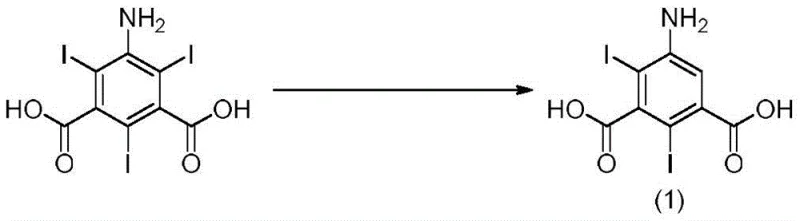
The novel approach presented in the patent circumvents these isolation difficulties by employing a targeted synthetic transformation. Instead of scavenging for the impurity, the method intentionally converts the abundant triiodo starting material into the diiodo target through a controlled reductive deiodination. This strategy leverages the structural similarity between the precursor and the product to ensure high conversion efficiency while utilizing specific catalytic conditions to prevent over-reduction to the monoiodo or non-iodinated species. By shifting the paradigm from separation to synthesis, the process guarantees a robust supply of the impurity standard, significantly reducing the lead time for method validation and ensuring that contrast agent manufacturers can meet stringent pharmacopeial requirements with confidence.
Mechanistic Insights into Pd/C-Catalyzed Selective Deiodination
The core of this innovative synthesis lies in the precise application of palladium-on-carbon (Pd/C) catalysis combined with a mild hydroboration reducing agent. The reaction mechanism involves the adsorption of the triiodo substrate onto the palladium surface, where the carbon-iodine bond at the specific position is activated for cleavage. Under carefully controlled alkaline conditions and low temperatures ranging from 1°C to 5°C, the hydride species generated from the borohydride reagent selectively attacks the activated iodine center. This delicate balance of reaction parameters is crucial; it ensures that only one iodine atom is removed from the aromatic ring, preserving the remaining two iodine atoms that define the specific impurity profile required for analysis. The use of an inorganic base, such as sodium hydroxide, facilitates the solubility of the acidic substrate in the aqueous medium, promoting efficient contact with the heterogeneous catalyst.
Impurity control in this mechanism is achieved through the kinetic regulation of the reduction potential. By maintaining the reaction temperature strictly between 1°C and 5°C and controlling the dropwise addition rate of the reducing agent, the process minimizes the risk of further deiodination which would lead to unwanted monoiodo byproducts. The subsequent workup involves a careful quenching step to destroy excess reducing agent, followed by acidification to precipitate the product. The final purification via recrystallization from a methanol-water system exploits the solubility differences to remove any residual triiodo starting material or trace monoiodo species. This multi-stage purification ensures that the final 5-amino-2,4-diiodo-1,3-phthalic acid achieves an HPLC purity exceeding 97%, making it suitable for use as a primary reference standard in high-stakes pharmaceutical testing.
How to Synthesize 5-Amino-2,4-Diiodo-1,3-Phthalic Acid Efficiently
The synthesis of this critical intermediate requires strict adherence to temperature controls and reagent stoichiometry to maximize selectivity. The process begins with the dissolution of the triiodo precursor in deionized water with an inorganic base, followed by the introduction of the Pd/C catalyst. The reduction is initiated by the slow addition of a sodium borohydride solution, maintaining the system at cryogenic temperatures to prevent side reactions. After the reaction reaches completion, the catalyst is filtered off, and the product is isolated through pH-controlled crystallization. For detailed operational parameters, stoichiometric ratios, and specific safety protocols regarding the handling of borohydrides and palladium catalysts, please refer to the standardized synthesis guide below.
- Dissolve 5-amino-2,4,6-triiodo-1,3-phthalic acid in aqueous base and cool to 1-5°C.
- Add Pd/C catalyst and dropwise introduce sodium borohydride solution while maintaining low temperature.
- Quench, acidify to pH 1-2 for crystallization, and recrystallize from methanol/water to obtain high-purity product.
Commercial Advantages for Procurement and Supply Chain Teams
For procurement managers and supply chain directors in the pharmaceutical sector, the adoption of this dedicated synthesis route offers substantial strategic benefits beyond mere technical feasibility. The ability to produce 5-amino-2,4-diiodo-1,3-phthalic acid on demand eliminates the dependency on unpredictable extraction from waste streams, thereby stabilizing the supply chain for critical quality control materials. This reliability is paramount for maintaining continuous production schedules of contrast agents, where delays in impurity standard availability can halt entire batches of finished goods. Furthermore, the use of commodity chemicals like sodium borohydride and palladium carbon, combined with an aqueous solvent system, significantly reduces the raw material costs associated with producing these high-value reference standards compared to complex multi-step organic syntheses.
- Cost Reduction in Manufacturing: The streamlined single-step conversion from a commercially available triiodo precursor drastically simplifies the production workflow. By eliminating the need for extensive chromatographic separations or multiple synthetic steps to build the aromatic core from scratch, the overall processing time and resource consumption are significantly lowered. This efficiency translates directly into reduced operational expenditures, allowing for more competitive pricing of the final impurity standards without compromising on the rigorous purity specifications demanded by regulatory bodies.
- Enhanced Supply Chain Reliability: Sourcing high-purity impurity standards has historically been a bottleneck due to the lack of specialized suppliers. This robust synthetic method enables domestic and international chemical manufacturers to establish a consistent in-house production capability. By securing a stable source of 5-amino-2,4-diiodo-1,3-phthalic acid, pharmaceutical companies can mitigate the risks associated with external supply disruptions, ensuring that their quality control laboratories always have the necessary materials to validate the safety of their contrast agent products.
- Scalability and Environmental Compliance: The process operates in an aqueous environment with mild reaction conditions, avoiding the use of hazardous organic solvents typically associated with traditional iodination or dehalogenation reactions. This green chemistry approach not only simplifies waste treatment and reduces environmental impact but also facilitates easier scale-up from laboratory to commercial production volumes. The straightforward workup involving filtration and crystallization is inherently scalable, supporting the transition from gram-scale research to kilogram or ton-scale manufacturing required for global supply.
Frequently Asked Questions (FAQ)
The following questions address common technical and commercial inquiries regarding the production and application of 5-amino-2,4-diiodo-1,3-phthalic acid. These insights are derived directly from the patented technology and are intended to assist R&D and procurement teams in evaluating the feasibility of integrating this material into their quality control frameworks. Understanding the specific advantages of this synthetic route is essential for making informed decisions about supplier partnerships and long-term sourcing strategies.
Q: Why is 5-amino-2,4-diiodo-1,3-phthalic acid critical for contrast agent manufacturing?
A: It serves as a key related substance and impurity standard for qualifying 5-amino-2,4,6-triiodo-1,3-phthalic acid, the core scaffold for non-ionic iodine contrast agents like Iohexol and Iopamidol.
Q: What is the advantage of the selective deiodination method over isolation from mother liquor?
A: Isolation from mother liquor is difficult due to solubility issues and low concentration. Direct synthesis via selective reduction offers higher yield, better purity (>97%), and a reliable supply of the reference standard.
Q: Can this process be scaled for commercial reference standard production?
A: Yes, the process uses common reagents (Pd/C, NaBH4) in an aqueous system with mild temperatures (1-5°C), making it highly scalable and safe for industrial production of high-purity intermediates.
Partnering with NINGBO INNO PHARMCHEM: Your Reliable 5-Amino-2,4-Diiodo-1,3-Phthalic Acid Supplier
As the pharmaceutical industry continues to advance, the need for high-quality intermediates and reference standards becomes increasingly critical. NINGBO INNO PHARMCHEM stands at the forefront of this evolution, leveraging deep technical expertise to deliver complex molecules with unmatched precision. Our team possesses extensive experience scaling diverse pathways from 100 kgs to 100 MT/annual commercial production, ensuring that we can meet the fluctuating demands of the global market. With our stringent purity specifications and rigorous QC labs, we guarantee that every batch of 5-amino-2,4-diiodo-1,3-phthalic acid meets the highest international standards, providing our partners with the confidence they need to bring life-saving diagnostic agents to market.
We invite you to collaborate with us to optimize your supply chain and enhance your product quality. Contact our technical procurement team today to request a Customized Cost-Saving Analysis tailored to your specific volume requirements. We are ready to provide specific COA data and comprehensive route feasibility assessments to demonstrate how our advanced manufacturing capabilities can support your long-term business goals. Let us be your trusted partner in navigating the complexities of fine chemical synthesis and supply.