
Scalable Synthesis of (S)-2-Hydroxy-3-O-Methylpropanoic Acid for Cosmetic and Pharma Applications
The pharmaceutical and cosmetic industries are constantly seeking robust, scalable, and environmentally benign pathways for the production of high-value chiral intermediates. A recent technological breakthrough, documented in patent CN113968781A, introduces a highly efficient synthesis method for (S)-2-hydroxy-3-o-methylpropanoic acid, a critical building block known for its moisturizing and skin-smoothing properties in cosmetic formulations. This innovation addresses the longstanding challenges associated with traditional synthetic routes, specifically the reliance on toxic reagents and the difficulties inherent in large-scale purification. By leveraging a diazotization strategy starting from readily available chiral amino acid derivatives, this method offers a compelling alternative for manufacturers aiming to enhance their supply chain resilience while adhering to stricter safety standards.
The Limitations of Conventional Methods vs. The Novel Approach
The Limitations of Conventional Methods
Historically, the synthesis of alpha-hydroxy acids like (S)-2-hydroxy-3-o-methylpropanoic acid has been plagued by significant safety and operational hurdles that hinder commercial viability. Conventional routes typically involve the use of highly toxic cyanide reagents to construct the necessary carbon framework, creating severe environmental liabilities and requiring specialized containment infrastructure that drives up capital expenditure. Furthermore, these traditional processes often yield racemic mixtures, necessitating a subsequent enzymatic resolution step using nitrilases to isolate the desired enantiomer, which adds complexity and cost to the manufacturing workflow. The final purification in these legacy methods almost invariably relies on column chromatography, a technique that is notoriously difficult to translate from the laboratory bench to multi-ton industrial production due to low throughput and excessive solvent consumption.
The Novel Approach
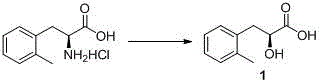
In stark contrast, the methodology disclosed in the patent utilizes a chiral pool strategy that bypasses the need for toxic cyanide and complex enzymatic resolutions entirely. The process initiates with 2-methyl-L-phenylalanine hydrochloride, a stable and accessible chiral precursor, which undergoes a direct diazotization reaction to install the hydroxyl functionality while preserving the stereochemical integrity of the molecule. This streamlined approach not only eliminates the handling of hazardous materials but also simplifies the downstream processing significantly, replacing energy-intensive column chromatography with a straightforward slurry purification. The result is a synthesis route that is inherently safer, more cost-effective, and perfectly suited for the rigorous demands of commercial-scale manufacturing.
Mechanistic Insights into Diazotization of Chiral Amino Acids
The core chemical transformation in this novel synthesis is the diazotization of the primary amine group on the 2-methyl-L-phenylalanine backbone, a reaction that proceeds with remarkable stereoselectivity under the specified conditions. In the presence of sodium nitrite and dilute sulfuric acid within a 1,4-dioxane and water solvent system, the amine is converted into a diazonium intermediate, which subsequently undergoes hydrolysis to yield the corresponding alpha-hydroxy acid. The choice of solvent mixture is critical, as it ensures the solubility of the organic substrate while providing the aqueous environment necessary for the hydrolysis step, facilitating a smooth conversion that maintains the (S)-configuration of the chiral center throughout the process. This retention of configuration is vital for the biological activity of the final product, particularly when utilized in bioactive polypeptides or high-end cosmetic applications where enantiomeric purity dictates efficacy.
From an impurity control perspective, this mechanism offers distinct advantages over radical-based or cyanide-mediated pathways which often generate complex byproduct profiles. The reaction conditions are mild enough to prevent racemization or degradation of the sensitive alpha-hydroxy acid motif, yet robust enough to drive the reaction to high conversion rates, as evidenced by the reported yields. The subsequent workup involves a liquid-liquid extraction followed by a targeted slurry purification, which effectively removes inorganic salts and minor organic impurities without the need for silica gel. This mechanistic simplicity translates directly into a cleaner crude profile, reducing the burden on quality control laboratories and ensuring a consistent supply of high-purity material for downstream formulation.
How to Synthesize (S)-2-Hydroxy-3-O-Methylpropanoic Acid Efficiently
The operational protocol for this synthesis is designed to be user-friendly and adaptable to standard reactor configurations found in most fine chemical facilities. The process begins by dissolving the chiral starting material in the biphasic solvent system, followed by the controlled addition of the nitrite source to manage the exotherm associated with diazotization. Once the reaction is complete, the isolation strategy focuses on maximizing recovery through extraction and crystallization-like slurry techniques rather than distillation or chromatography. For a comprehensive, step-by-step guide including exact stoichiometric ratios and safety precautions, please refer to the standardized synthesis instructions below.
- Dissolve 2-methyl-L-phenylalanine hydrochloride in a mixed solvent of 1,4-dioxane and 1M dilute sulfuric acid.
- Add an aqueous solution of sodium nitrite dropwise under cooling, then stir at room temperature overnight to complete the diazotization.
- Extract the reaction mixture with ethyl acetate, concentrate, and purify the crude product by slurrying with petroleum ether and ethyl acetate.
Commercial Advantages for Procurement and Supply Chain Teams
For procurement managers and supply chain directors, the adoption of this synthetic route represents a strategic opportunity to optimize both cost structures and operational reliability. By shifting away from enzymatic processes and toxic reagents, manufacturers can significantly reduce the overhead costs associated with waste disposal, regulatory compliance, and specialized raw material sourcing. The elimination of column chromatography is particularly impactful, as it removes a major bottleneck in production throughput, allowing for faster batch turnover and reduced cycle times. This efficiency gain directly contributes to a more agile supply chain capable of responding rapidly to market fluctuations in the cosmetic and pharmaceutical sectors.
- Cost Reduction in Manufacturing: The economic benefits of this process are driven primarily by the substitution of expensive biocatalysts and hazardous reagents with commodity chemicals like sodium nitrite and sulfuric acid. Removing the enzymatic resolution step not only saves on the cost of the enzyme itself but also eliminates the associated buffer systems and incubation times, leading to substantial savings in utility and labor costs. Furthermore, the switch to slurry purification drastically cuts down on the volume of high-purity solvents required, lowering both material costs and the expenses related to solvent recovery and recycling systems.
- Enhanced Supply Chain Reliability: Relying on a chiral pool starting material that can be produced via established Negishi coupling reactions ensures a stable and predictable supply of the key precursor. Unlike enzymatic processes which can suffer from batch-to-batch variability or supply constraints on specialized biocatalysts, this chemical synthesis utilizes robust, shelf-stable reagents that are readily available from multiple global suppliers. This diversification of the supply base mitigates the risk of production stoppages and ensures continuous availability of the final intermediate for critical downstream applications.
- Scalability and Environmental Compliance: The simplicity of the reaction setup and workup makes this process exceptionally easy to scale from pilot plant to multi-ton commercial production without the need for specialized equipment. The absence of toxic cyanide reagents simplifies environmental permitting and reduces the liability associated with handling hazardous materials, aligning perfectly with modern green chemistry initiatives. Additionally, the reduced solvent load and simplified waste stream facilitate easier treatment and disposal, helping manufacturers meet increasingly stringent environmental regulations while maintaining high production volumes.
Frequently Asked Questions (FAQ)
The following questions address common technical and commercial inquiries regarding the implementation of this synthesis method, derived directly from the patent specifications and industry best practices. These insights are intended to assist technical teams in evaluating the feasibility of integrating this route into their existing manufacturing portfolios. Understanding these details is crucial for making informed decisions about process adoption and supplier qualification.
Q: Why is this new synthesis method safer than traditional routes?
A: Traditional methods often rely on toxic cyanide reagents to form the carbon skeleton, posing significant safety and environmental hazards. This novel approach utilizes a diazotization reaction on a chiral amino acid derivative, completely eliminating the need for hazardous cyanide sources and expensive enzymatic resolution steps.
Q: How does the purification process differ from conventional chromatography?
A: Conventional synthesis of alpha-hydroxy acids frequently requires column chromatography to separate enantiomers or remove impurities, which is costly and difficult to scale. This patent describes a simple slurry purification using petroleum ether and ethyl acetate, which is highly amenable to industrial-scale production and significantly reduces solvent consumption.
Q: Is the stereochemistry preserved during the reaction?
A: Yes, the process utilizes 2-methyl-L-phenylalanine hydrochloride as a chiral pool starting material. The diazotization conditions are optimized to ensure the configuration remains unchanged, directly yielding the desired (S)-enantiomer without the need for resolution.
Partnering with NINGBO INNO PHARMCHEM: Your Reliable (S)-2-Hydroxy-3-O-Methylpropanoic Acid Supplier
At NINGBO INNO PHARMCHEM, we recognize the critical importance of adopting advanced synthetic methodologies to maintain a competitive edge in the global market for fine chemical intermediates. Our team possesses extensive experience scaling diverse pathways from 100 kgs to 100 MT/annual commercial production, ensuring that the transition from laboratory innovation to industrial reality is seamless and efficient. We are committed to delivering products that meet stringent purity specifications through our rigorous QC labs, guaranteeing that every batch of (S)-2-hydroxy-3-o-methylpropanoic acid performs consistently in your final formulations.
We invite you to collaborate with us to leverage this cutting-edge technology for your specific application needs. Please contact our technical procurement team to request a Customized Cost-Saving Analysis tailored to your volume requirements. We are ready to provide specific COA data and route feasibility assessments to demonstrate how our optimized manufacturing capabilities can drive value and reliability for your supply chain.