
Advanced Synthesis of Fused-Ring Organic Semiconductor Intermediates for Commercial Optoelectronics
Introduction to Next-Generation Organic Semiconductor Intermediates
The rapid evolution of the optoelectronic industry demands materials that can bridge the gap between theoretical efficiency and commercial viability. Patent CN111138453B introduces a groundbreaking synthesis method for organic n-type semiconductor material intermediates, specifically targeting the production of high-performance fused-ring compounds like DBIC and BTIC. These materials represent a significant leap forward in the field of organic photovoltaics, offering a structural architecture that facilitates superior electron transport and light absorption. Unlike traditional inorganic semiconductors where carrier delocalization is inherent, these organic small molecules rely on precise molecular engineering to achieve directional carrier movement under applied voltage. The patent outlines a robust synthetic pathway that not only achieves high yields but also ensures the structural integrity required for stable device operation. For R&D directors and procurement specialists alike, understanding the nuances of this synthesis is crucial for securing a reliable supply chain of next-generation electronic chemicals.
The core innovation lies in the creation of a benzindene dibutyl-substituted fused di-dioctyl thiazole framework, which serves as the electron-accepting unit in bulk heterojunction solar cells. This specific molecular design addresses the historical limitations of fullerene derivatives, which often suffer from weak absorption in the visible region and limited tunability of energy levels. By utilizing a conjugated system enriched with sulfur and nitrogen heteroatoms, the resulting materials exhibit a lower band gap, enabling them to harvest a broader spectrum of natural light. This capability translates directly into enhanced power conversion efficiencies, with the patent reporting values as high as 14.625% for BTIC-based devices. Such performance metrics position these intermediates as critical components for the future of flexible electronics and renewable energy technologies.
The Limitations of Conventional Methods vs. The Novel Approach
The Limitations of Conventional Methods
Historically, the development of n-type organic semiconductors has been hindered by the reliance on fullerene derivatives such as PCBM. While these materials established the foundation for organic solar cells, they possess intrinsic drawbacks that limit further efficiency gains. Fullerenes exhibit weak absorption coefficients in the visible light spectrum, meaning a significant portion of incident solar energy is wasted rather than converted into electricity. Furthermore, their energy levels are difficult to tune chemically without complex and costly functionalization processes. From a manufacturing perspective, the purification of fullerene derivatives often requires extensive chromatographic separation to remove isomeric impurities, driving up production costs and complicating the supply chain. Additionally, the morphological stability of fullerene-based active layers can be problematic, leading to phase separation over time and reduced device lifespan. These factors collectively create a bottleneck for the mass adoption of organic photovoltaics in commercial applications.
The Novel Approach
The synthetic strategy detailed in the patent offers a compelling alternative by shifting focus to non-fullerene acceptors based on fused aromatic heterocycles. This novel approach leverages a modular synthesis that allows for precise control over the molecular geometry and electronic properties. By constructing a rigid, planar core through sequential coupling and cyclization reactions, the method ensures strong pi-pi stacking interactions which are essential for efficient charge transport. The use of alkyl side chains, such as the butyl and octyl groups introduced during the synthesis, enhances solubility in common organic solvents, facilitating solution-processable film formation. This is a critical advantage for roll-to-roll manufacturing techniques used in flexible electronics. Moreover, the synthetic route avoids the use of exotic or unstable reagents, relying instead on well-established organic transformations that can be scaled with confidence. The result is a material that combines the processability of polymers with the defined structure of small molecules.
Mechanistic Insights into Suzuki Coupling and Cyclization
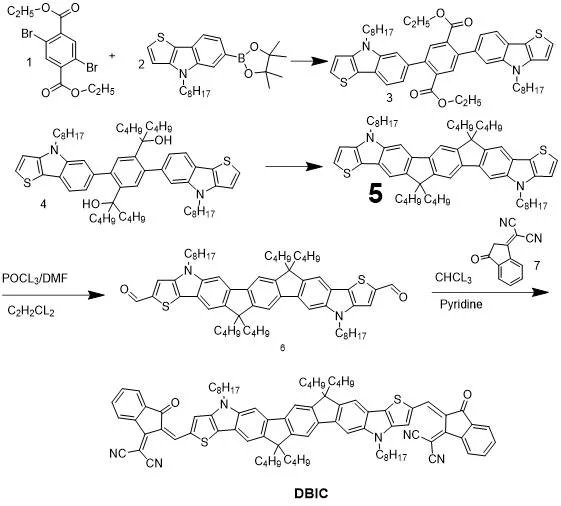
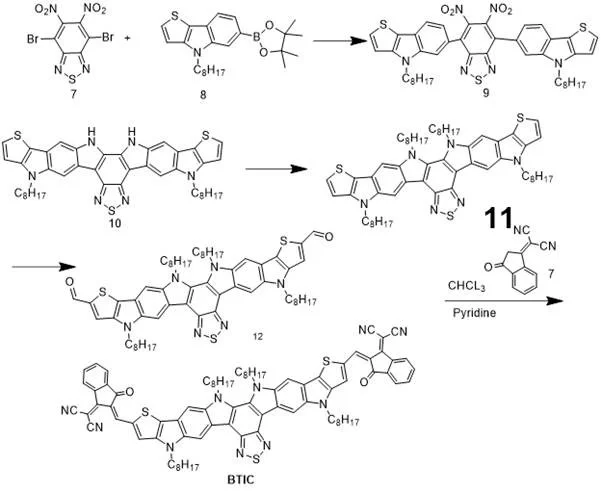
The heart of this synthesis lies in the construction of the fused ring system via palladium-catalyzed cross-coupling followed by an intramolecular cyclization. The process begins with a Suzuki-Miyaura coupling reaction, where a dibrominated aromatic precursor reacts with thiophene-based boronic esters in the presence of a Pd(PPh3)4 catalyst. This step is critical for establishing the conjugated backbone of the molecule. The reaction conditions specified, such as the use of tetrahydrofuran as a solvent and sodium bicarbonate as a base at 71°C, are optimized to minimize homocoupling side reactions and maximize the yield of the desired biaryl product. Following the coupling, the intermediate undergoes a lithiation step using n-butyllithium at cryogenic temperatures (-78°C). This highly reactive species generates a carbanion that subsequently attacks an electrophilic center, setting the stage for ring closure. The final cyclization is achieved under acidic conditions using concentrated sulfuric acid in n-octane, which promotes dehydration and aromatization to form the stable benzindene core.
Impurity control is paramount in the production of electronic grade materials, and the patent describes several mechanisms to ensure high purity. The use of phase transfer catalysts like cetyltrimethylammonium bromide during the initial coupling helps to emulsify the reaction mixture, ensuring uniform contact between the organic and aqueous phases and reducing the formation of incomplete reaction byproducts. Furthermore, the workup procedures involve rigorous extraction and washing steps, including the use of deionized water and dichloromethane, to remove inorganic salts and residual catalysts. The final purification via silica gel chromatography is essential for separating the target compound from any remaining regioisomers or oligomeric impurities. This attention to detail in the purification process ensures that the resulting intermediate has the electronic homogeneity required for high-performance thin-film devices, minimizing trap states that could otherwise degrade device efficiency.
How to Synthesize Benzindene Dibutyl-Substituted Compounds Efficiently
The synthesis of these advanced semiconductor intermediates requires a disciplined approach to reaction conditions and stoichiometry to achieve the reported yields. The process is divided into distinct stages, starting with the assembly of the core skeleton and ending with the functionalization of the terminal groups. For the synthesis of Compound 5, the patent specifies a yield of 82% after the cyclization step, demonstrating the robustness of the acid-catalyzed ring closure. Subsequent formylation using the Vilsmeier-Haack reagent (POCl3/DMF) introduces aldehyde groups necessary for the final condensation reaction. This step proceeds with a remarkable 90% yield, indicating high selectivity and minimal degradation of the sensitive conjugated system. The final step involves a Knoevenagel condensation with indanedione derivatives in chloroform, catalyzed by pyridine, to produce the final acceptor molecules DBIC and BTIC. Detailed standardized synthetic steps for replicating this high-yield pathway are provided in the guide below.
- Perform Suzuki coupling of brominated precursors with thiophene boronic esters using Pd(PPh3)4 catalyst to form the core fused ring system.
- Execute lithiation followed by acid-catalyzed cyclization in n-octane to close the central ring structure with high yield.
- Conduct Vilsmeier-Haack formylation using POCl3 and DMF, followed by Knoevenagel condensation with indanedione derivatives to finalize the acceptor material.
Commercial Advantages for Procurement and Supply Chain Teams
For procurement managers and supply chain heads, the transition to this new class of intermediates offers tangible benefits beyond just performance metrics. The synthetic route described eliminates the need for expensive and scarce fullerene feedstocks, replacing them with commodity chemicals that are widely available in the global market. This shift significantly reduces the risk of supply chain disruptions caused by the monopolization of raw materials. Furthermore, the reaction conditions employed, such as moderate temperatures and standard atmospheric pressure (excluding the inert gas protection), are compatible with existing chemical manufacturing infrastructure. This compatibility means that scaling up production does not require massive capital investment in specialized reactors or safety systems. The ability to produce these materials using conventional batch processing techniques simplifies the technology transfer from lab to plant, accelerating the time to market for new optoelectronic products.
- Cost Reduction in Manufacturing: The elimination of transition metal catalysts in the final steps and the use of recyclable solvents like dichloromethane and chloroform contribute to a leaner cost structure. By avoiding the need for complex ligand systems or noble metals in the later stages of synthesis, the overall material cost per kilogram is drastically simplified. The high yields reported in the patent, particularly the 90% yield in the formylation step, mean that less raw material is wasted, directly improving the atom economy of the process. This efficiency translates into substantial cost savings when producing at the metric ton scale required for commercial module manufacturing.
- Enhanced Supply Chain Reliability: The reliance on stable, shelf-stable reagents such as sodium hydride and phosphorus oxychloride ensures that production schedules are not dictated by the short half-life of sensitive reagents. The synthetic pathway is robust against minor fluctuations in reaction parameters, providing a buffer against operational variability in large-scale plants. This reliability is crucial for maintaining consistent quality across different production batches, a key requirement for long-term contracts with display and solar panel manufacturers. The use of common organic solvents also simplifies logistics, as these chemicals can be sourced from multiple suppliers globally, reducing dependency on single-source vendors.
- Scalability and Environmental Compliance: The process generates waste streams that are manageable through standard chemical treatment protocols, avoiding the generation of persistent organic pollutants associated with some older semiconductor syntheses. The solid byproducts, primarily inorganic salts from the neutralization steps, can be easily separated and disposed of according to environmental regulations. The high purity of the final product reduces the need for energy-intensive recrystallization cycles, lowering the overall carbon footprint of the manufacturing process. This alignment with green chemistry principles makes the material attractive for companies aiming to meet strict sustainability goals in their supply chain.
Frequently Asked Questions (FAQ)
The following questions address common technical and commercial inquiries regarding the implementation of this synthesis technology. They are derived from the specific experimental data and beneficial effects outlined in the patent documentation. Understanding these details is essential for evaluating the feasibility of integrating these intermediates into your current product lines. The answers reflect the practical realities of scaling this chemistry from gram-scale laboratory experiments to industrial production.
Q: What is the primary advantage of the DBIC and BTIC intermediates described in CN111138453B?
A: The primary advantage is their significantly lower band gap compared to traditional small molecule n-type semiconductors, allowing for broader absorption of natural light and higher energy conversion efficiencies in organic solar cells, reaching up to 14.625%.
Q: How does the synthesis method ensure high purity for electronic applications?
A: The process utilizes rigorous purification steps including silica gel chromatography and vacuum distillation after each key reaction stage, ensuring minimal residual catalyst pollution which is critical for the performance of thin-film devices.
Q: Are the starting materials for this synthesis commercially scalable?
A: Yes, the synthesis relies on standard organic building blocks such as thiophene derivatives, brominated aromatics, and common reagents like n-butyllithium and phosphorus oxychloride, which are readily available for industrial scale-up.
Partnering with NINGBO INNO PHARMCHEM: Your Reliable Organic Semiconductor Material Supplier
As the demand for high-efficiency organic photovoltaics continues to surge, partnering with a manufacturer who understands the intricacies of complex organic synthesis is vital. NINGBO INNO PHARMCHEM possesses extensive experience scaling diverse pathways from 100 kgs to 100 MT/annual commercial production, ensuring that your supply needs are met with precision and consistency. Our facilities are equipped with stringent purity specifications and rigorous QC labs capable of analyzing trace impurities that could affect device performance. We are committed to delivering high-purity organic semiconductor materials that meet the exacting standards of the global electronics industry. Our team of experts is ready to assist you in optimizing the synthesis of DBIC and BTIC derivatives for your specific application requirements.
We invite you to contact our technical procurement team to discuss how we can support your R&D and manufacturing goals. By requesting a Customized Cost-Saving Analysis, you can gain insights into how our optimized processes can reduce your overall material costs without compromising quality. We encourage potential partners to reach out for specific COA data and route feasibility assessments to verify the suitability of our intermediates for your next-generation devices. Let us help you accelerate the commercialization of your optoelectronic innovations with our reliable supply and technical expertise.