
Advanced Synthesis of Fipronil Sulfonamide Derivatives for Next-Generation Insecticides
Advanced Synthesis of Fipronil Sulfonamide Derivatives for Next-Generation Insecticides
The global agrochemical industry is constantly seeking novel active ingredients that balance potent pest control with improved environmental safety profiles. Patent CN101921231A introduces a significant advancement in this domain by disclosing a series of fipronil sulfonamide derivatives and their efficient preparation methods. This technology addresses the critical need for modifying the fipronil scaffold to mitigate its adverse effects on non-target organisms such as bees and aquatic species, while preserving its efficacy against hemipteran and lepidopteran pests. The core innovation lies in the strategic introduction of sulfonyl groups onto the nitrogen atom of the pyrazole ring's 5-position amino group. This structural modification creates a new class of compounds, designated as Formula III, which represents a promising avenue for developing next-generation insecticides with reduced ecological footprints. For R&D directors and procurement specialists in the agrochemical sector, understanding the synthetic accessibility and scalability of these derivatives is paramount for securing a reliable supply chain of high-performance crop protection agents.
The Limitations of Conventional Methods vs. The Novel Approach
The Limitations of Conventional Methods
Historically, the modification of the fipronil skeleton has presented substantial synthetic challenges, often requiring harsh reaction conditions or multi-step sequences that compromise overall yield and purity. Traditional approaches to functionalizing the pyrazole ring frequently involve complex protection and deprotection strategies to selectively target specific positions without affecting the sensitive trifluoromethylsulfinyl moiety or the cyano group. These conventional pathways often suffer from low atom economy and generate significant amounts of hazardous waste, which poses both economic and environmental burdens for large-scale manufacturing. Furthermore, the instability of certain intermediates under acidic or highly basic conditions can lead to decomposition, resulting in difficult-to-remove impurities that complicate downstream purification processes. Such inefficiencies not only drive up the cost of goods sold but also extend the lead time for bringing new active ingredients to market, creating bottlenecks for agrochemical companies aiming to innovate rapidly.
The Novel Approach
In stark contrast, the methodology described in patent CN101921231A offers a streamlined and robust route to accessing these valuable sulfonamide derivatives. The process utilizes arylsulfonyl chlorides as direct sulfonylating agents, reacting them with the fipronil intermediate in the presence of a base under mild ice-bath conditions. This direct functionalization strategy eliminates the need for cumbersome protecting groups, thereby simplifying the operational workflow significantly. The reaction proceeds efficiently at temperatures ranging from 0°C to 100°C, depending on the specific reactivity of the sulfonyl chloride employed, allowing for precise control over the reaction kinetics. By leveraging this straightforward nucleophilic substitution, manufacturers can achieve high conversion rates with minimal byproduct formation. This novel approach not only enhances the feasibility of producing diverse libraries of fipronil analogs for biological screening but also establishes a solid foundation for the commercial scale-up of complex agrochemical intermediates with consistent quality.
Mechanistic Insights into Base-Mediated Sulfonylation
The chemical transformation at the heart of this patent involves a classic nucleophilic substitution mechanism where the primary amino group at the 5-position of the pyrazole ring acts as the nucleophile. In the presence of a suitable base, such as sodium hydride or potassium hydroxide, the lone pair of electrons on the nitrogen atom is activated through deprotonation, increasing its nucleophilicity. This activated amine then attacks the electrophilic sulfur atom of the arylsulfonyl chloride reagent. The electron-withdrawing nature of the chlorine atom on the sulfonyl group facilitates the departure of the chloride ion as a leaving group, resulting in the formation of the stable sulfonamide bond. This mechanism is particularly advantageous because it tolerates a wide variety of substituents on the aryl ring of the sulfonyl chloride, enabling the synthesis of a broad spectrum of derivatives with tailored physicochemical properties.
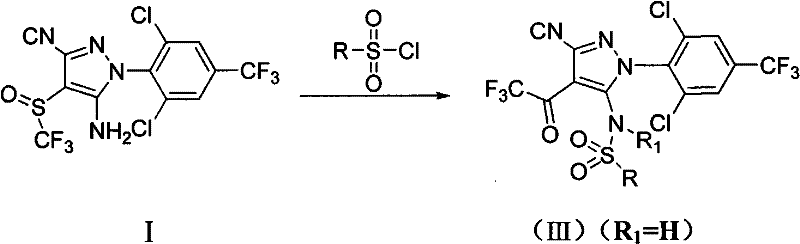
Furthermore, the reaction conditions are meticulously optimized to prevent side reactions that could degrade the sensitive fipronil core. The use of solvents like ethyl acetate, DMF, or tetrahydrofuran ensures adequate solubility of both the organic substrate and the inorganic base, promoting homogeneous reaction kinetics. The control of temperature, specifically initiating the reaction under ice-bath conditions, is crucial for managing the exothermic nature of the neutralization between the base and the amine, as well as the subsequent sulfonylation step. This careful thermal management minimizes the risk of thermal decomposition of the trifluoromethylsulfinyl group, which is known to be susceptible to reduction or oxidation under extreme conditions. Consequently, the process yields products with high structural integrity, as evidenced by the sharp melting points and clean NMR spectra reported in the experimental examples, ensuring that the final agrochemical intermediate meets stringent purity specifications required for regulatory approval.
How to Synthesize Fipronil Sulfonamide Derivatives Efficiently
The synthesis protocol outlined in the patent provides a clear roadmap for laboratory and pilot-scale production of these high-value intermediates. The procedure begins with the dissolution of the fipronil precursor in a polar aprotic or moderately polar solvent, followed by the controlled addition of a stoichiometric amount of base. Once the amine is activated, the arylsulfonyl chloride is introduced slowly to maintain reaction control. The mixture is then allowed to warm to room temperature to drive the reaction to completion. Following the reaction, a simple aqueous workup involving washing with water removes inorganic salts and excess reagents, while the organic layer is dried and concentrated. Final purification is typically achieved through column chromatography using standard eluent systems like petroleum ether and ethyl acetate.
- Dissolve fipronil intermediate in a suitable organic solvent such as ethyl acetate or DMF under cooling conditions.
- Add a strong base like sodium hydride to deprotonate the amino group, followed by the dropwise addition of arylsulfonyl chloride.
- Allow the reaction to proceed to room temperature, then perform aqueous workup and purification via column chromatography to isolate the high-purity derivative.
Commercial Advantages for Procurement and Supply Chain Teams
For procurement managers and supply chain heads, the adoption of this synthetic route offers compelling economic and logistical benefits that directly impact the bottom line. The simplicity of the reaction design translates into reduced operational complexity, meaning that existing manufacturing infrastructure can often be utilized without the need for specialized high-pressure or cryogenic equipment. This adaptability significantly lowers the barrier to entry for contract manufacturing organizations and internal production teams alike. Moreover, the high yields reported, reaching up to 95% in specific embodiments, imply a drastic reduction in raw material waste and solvent consumption per kilogram of product produced. This efficiency is a key driver for cost reduction in agrochemical intermediate manufacturing, allowing companies to remain competitive in a price-sensitive market while maintaining healthy profit margins.
- Cost Reduction in Manufacturing: The elimination of multi-step protection and deprotection sequences drastically reduces the consumption of reagents and solvents, leading to substantial cost savings. By utilizing readily available arylsulfonyl chlorides and common inorganic bases, the raw material costs are kept low, and the reliance on exotic or expensive catalysts is completely removed. The high atom economy of the direct sulfonylation reaction ensures that the majority of the input mass is converted into the desired product, minimizing the costs associated with waste disposal and environmental compliance. Additionally, the simplified workup procedure reduces labor hours and energy consumption required for distillation and purification, further enhancing the overall economic viability of the process.
- Enhanced Supply Chain Reliability: The starting materials for this synthesis, including fipronil intermediates and various substituted benzenesulfonyl chlorides, are commercially available from multiple global suppliers, mitigating the risk of single-source dependency. This abundance of raw materials ensures a stable supply chain capable of withstanding market fluctuations or geopolitical disruptions. The robustness of the reaction conditions, which tolerate a range of temperatures and solvents, adds another layer of reliability, as production can continue even if specific grades of solvents are temporarily unavailable. This flexibility allows supply chain managers to optimize inventory levels and reduce lead times for high-purity agrochemical intermediates, ensuring timely delivery to formulation plants.
- Scalability and Environmental Compliance: The process is inherently scalable, moving seamlessly from gram-scale laboratory experiments to multi-ton commercial production without significant re-engineering. The mild reaction conditions minimize the generation of hazardous byproducts, aligning with increasingly strict global environmental regulations regarding chemical manufacturing. The use of ethyl acetate, a relatively green solvent compared to chlorinated alternatives, further supports sustainability goals. By adopting this cleaner synthesis route, companies can reduce their environmental footprint and avoid potential regulatory fines, positioning themselves as responsible leaders in the sustainable agrochemical industry.
Frequently Asked Questions (FAQ)
The following questions address common technical and commercial inquiries regarding the production and application of these fipronil sulfonamide derivatives. The answers are derived directly from the technical specifications and experimental data provided in the patent literature, ensuring accuracy and relevance for industry professionals. Understanding these details is essential for making informed decisions about integrating this technology into your product development pipeline.
Q: What are the primary advantages of this sulfonylation method over traditional modifications?
A: This method offers significantly simplified operation with high yields exceeding 80%, avoiding complex multi-step protection strategies often required in pyrazole modifications.
Q: Which bases are compatible with this synthesis protocol?
A: The patent specifies a wide range of compatible bases including potassium hydroxide, sodium bicarbonate, sodium carbonate, sodium hydroxide, and sodium hydride, providing flexibility for scale-up.
Q: How does this derivative address the environmental concerns of standard fipronil?
A: By modifying the 5-position amino group with various sulfonyl groups, the resulting derivatives aim to maintain insecticidal potency while reducing toxicity to non-target organisms like bees and aquatic life.
Partnering with NINGBO INNO PHARMCHEM: Your Reliable Fipronil Sulfonamide Supplier
At NINGBO INNO PHARMCHEM, we recognize the transformative potential of the synthetic routes disclosed in patent CN101921231A for the future of insecticide development. As a premier CDMO partner, we possess extensive experience scaling diverse pathways from 100 kgs to 100 MT/annual commercial production, ensuring that your transition from benchtop discovery to market-ready product is seamless. Our state-of-the-art facilities are equipped with rigorous QC labs capable of meeting stringent purity specifications, guaranteeing that every batch of fipronil sulfonamide intermediate we deliver adheres to the highest quality standards required by global regulatory bodies. We are committed to supporting your R&D efforts with the technical expertise needed to optimize these sulfonylation reactions for maximum efficiency and yield.
We invite you to collaborate with us to leverage this advanced chemistry for your next-generation agrochemical products. Our team is ready to provide a Customized Cost-Saving Analysis tailored to your specific production volumes and quality requirements. Please contact our technical procurement team today to request specific COA data and comprehensive route feasibility assessments. Let us help you secure a competitive advantage in the global market with our reliable supply of high-performance agrochemical intermediates.