
Advanced Diphenyl Sulfide Oxime Esters for High-Performance Display Manufacturing
The rapid evolution of the display industry, particularly the shift towards high-definition Liquid Crystal Displays (LCDs) and Organic Light-Emitting Diodes (OLEDs), has placed unprecedented demands on the performance of photosensitive materials. Patent CN102492060A introduces a groundbreaking class of diphenyl sulfide oxime ester photoinitiators that directly address the critical limitations of existing technologies. This innovation represents a significant leap forward in the field of electronic chemical manufacturing, offering a robust solution for the production of color filters and photoresists. The core technical breakthrough lies in the unique chemical structure which combines high photosensitivity with exceptional resistance to yellowing, a persistent challenge in the fabrication of large-screen displays. For R&D Directors and Supply Chain Heads, this patent data signals a viable pathway to enhance product quality while streamlining the manufacturing process. As a reliable photoinitiator supplier, understanding the nuances of this technology is essential for maintaining competitiveness in the high-end display market.
The Limitations of Conventional Methods vs. The Novel Approach
The Limitations of Conventional Methods
Traditional photoinitiators, such as benzophenones and earlier generations of oxime esters like OXE-02, have long served the industry but are increasingly becoming bottlenecks for next-generation display technologies. The primary deficiency of these conventional compounds is their tendency to induce yellowing in the cured film, which severely compromises the color purity and contrast ratio of the final display panel. Furthermore, many existing initiators suffer from poor solubility in standard organic solvents, leading to precipitation issues during the coating process and resulting in defects such as pinholes or uneven film thickness. These physical limitations not only degrade the optical performance of the device but also necessitate complex purification steps and stringent process controls, thereby inflating production costs. For procurement managers, the reliance on these older chemistries often translates to higher waste generation and lower overall yield, creating significant inefficiencies in the supply chain.
The Novel Approach
The novel approach detailed in the patent data utilizes a diphenyl sulfide backbone integrated with an oxime ester functional group, creating a molecule that fundamentally overcomes the drawbacks of its predecessors. This new chemical architecture ensures that the resulting photosensitive composition remains colorless after curing, thereby meeting the rigorous standards required for high-definition color filters. Additionally, the modified structure significantly enhances solubility in common solvents like propylene glycol methyl ether acetate (PGMEA) and cyclohexanone, allowing for more uniform dispersion within the resin matrix. This improvement in physical properties directly translates to cost reduction in electronic chemical manufacturing by reducing the need for exotic co-solvents and minimizing defect rates during the coating and exposure stages. The superior photosensitivity also means that lower exposure doses are required, which can drastically increase throughput in high-volume production environments.
Mechanistic Insights into Diphenyl Sulfide Oxime Ester Photoinitiation
The exceptional performance of this photoinitiator can be attributed to the specific electronic and steric properties of the diphenyl sulfide oxime ester structure. The presence of the sulfur atom within the diphenyl sulfide moiety plays a crucial role in stabilizing the radical species generated upon UV exposure, facilitating efficient polymerization of the acrylic resin matrix. Unlike carbazole-based initiators which possess extended conjugated systems that absorb visible light and cause yellowing, the diphenyl sulfide structure maintains a high degree of transparency in the visible spectrum while retaining strong absorption in the UV range. This selective absorption profile is vital for ensuring that the photoinitiator activates rapidly under standard exposure sources without imparting unwanted color to the final product. The structural flexibility provided by the variable R1 and Ar groups further allows for fine-tuning of the solubility and reactivity parameters to match specific formulation requirements.
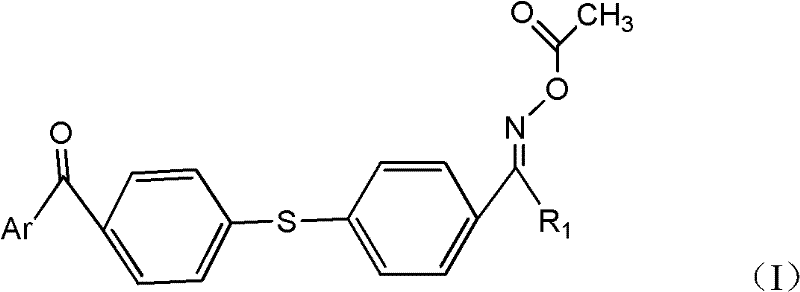
Controlling the impurity profile during the synthesis of such complex molecules is paramount for ensuring consistent performance in downstream applications. The synthetic route described in the patent employs a stepwise approach that allows for the isolation and purification of intermediates, thereby preventing the carryover of unreacted starting materials or side products into the final photoinitiator. The use of aluminum trichloride in the initial acylation step is carefully managed to ensure complete conversion, while the subsequent oximation and esterification steps are optimized to minimize the formation of isomeric byproducts. This rigorous control over the reaction pathway ensures that the final product meets stringent purity specifications, which is critical for preventing defects in the delicate layers of an OLED or LCD panel. For quality assurance teams, this level of process control provides the confidence needed to qualify the material for high-volume commercial production.
How to Synthesize Diphenyl Sulfide Oxime Ester Efficiently
The synthesis of this high-performance photoinitiator follows a logical three-step sequence that is well-suited for industrial scale-up. The process begins with the acylation of diphenyl sulfide, followed by the conversion of the resulting ketone to an oxime, and concludes with an esterification reaction to form the final active ester. Each step utilizes readily available reagents and standard reaction conditions, making the overall pathway accessible for manufacturers with existing fine chemical infrastructure. The ability to isolate stable intermediates at each stage provides multiple checkpoints for quality control, ensuring that any deviations can be corrected before proceeding to the next step. This modular approach to synthesis is a key factor in the commercial viability of the technology, as it allows for flexible production scheduling and efficient resource allocation.
- Perform Friedel-Crafts acylation on diphenyl sulfide using aluminum trichloride to generate the ketone intermediate.
- Conduct an oximation reaction with hydroxylamine hydrochloride to convert the ketone intermediate into a ketoxime.
- Finalize the synthesis via esterification with acetic anhydride to yield the target diphenyl sulfide oxime ester photoinitiator.

Commercial Advantages for Procurement and Supply Chain Teams
From a commercial perspective, the adoption of this diphenyl sulfide oxime ester technology offers substantial benefits for procurement and supply chain operations. The enhanced solubility and stability of the material reduce the complexity of logistics and storage, as the product is less prone to degradation or precipitation during transit. Furthermore, the high efficiency of the photoinitiator means that less material is required per unit of production, leading to significant inventory savings over time. For supply chain heads, the robustness of the synthetic route ensures a reliable supply of high-purity photoinitiators, mitigating the risk of production stoppages due to material shortages. The elimination of yellowing issues also reduces the rate of customer returns and complaints, protecting the brand reputation of the display manufacturer.
- Cost Reduction in Manufacturing: The streamlined synthesis pathway eliminates the need for expensive and specialized catalysts often required for alternative high-sensitivity initiators. By utilizing standard reagents like acetic anhydride and hydroxylamine hydrochloride, the overall cost of goods sold is significantly optimized. Additionally, the high conversion rates and ease of purification reduce the volume of waste solvents and byproducts that must be treated and disposed of, further lowering operational expenses. This qualitative improvement in process efficiency translates directly to a more competitive pricing structure for the final electronic chemical product.
- Enhanced Supply Chain Reliability: The starting materials for this synthesis, such as diphenyl sulfide and various acyl chlorides, are commodity chemicals with established global supply chains. This abundance of raw materials ensures that production can be scaled up rapidly to meet surges in demand without being constrained by niche precursor availability. The stability of the intermediates also allows for the strategic stocking of semi-finished goods, providing a buffer against potential disruptions in the supply of final reagents. This resilience is critical for maintaining continuous production schedules in the fast-paced consumer electronics market.
- Scalability and Environmental Compliance: The reaction conditions described in the patent are mild and do not require extreme temperatures or pressures, making the process inherently safer and easier to scale from pilot plant to full commercial production. The absence of heavy metal catalysts in the final steps simplifies the environmental compliance profile, reducing the regulatory burden associated with waste management. This alignment with green chemistry principles not only lowers compliance costs but also enhances the sustainability credentials of the manufacturing facility, which is increasingly important for corporate social responsibility reporting.
Frequently Asked Questions (FAQ)
The following questions address common technical and commercial inquiries regarding the implementation of this photoinitiator technology. These answers are derived directly from the patent data and are intended to provide clarity for decision-makers evaluating the feasibility of adoption. Understanding these details is crucial for assessing the fit of this material within existing formulation workflows and supply chain strategies. The responses highlight the practical advantages and operational considerations that define the value proposition of this innovation.
Q: How does this photoinitiator compare to OXE-02 regarding yellowing?
A: Unlike OXE-02 and carbazole-based initiators which exhibit significant yellowing, the diphenyl sulfide oxime ester structure ensures a colorless film, critical for high-definition color filters.
Q: What is the solubility profile in standard industry solvents?
A: The compound demonstrates superior solubility in PGMEA and cyclohexanone compared to conventional initiators, facilitating easier formulation and processing.
Q: Is this synthesis route suitable for large-scale production?
A: Yes, the three-step process utilizes commercially available starting materials and standard reaction conditions, making it highly scalable for industrial manufacturing.
Partnering with NINGBO INNO PHARMCHEM: Your Reliable Diphenyl Sulfide Oxime Ester Supplier
At NINGBO INNO PHARMCHEM, we recognize the critical role that advanced photoinitiators play in the success of next-generation display technologies. Our team possesses extensive experience scaling diverse pathways from 100 kgs to 100 MT/annual commercial production, ensuring that your transition from R&D to mass manufacturing is seamless and efficient. We are committed to delivering materials that meet stringent purity specifications and are validated through our rigorous QC labs to guarantee consistent performance in your applications. By leveraging our deep technical expertise, we can help you optimize your formulations to fully realize the benefits of the diphenyl sulfide oxime ester chemistry described in patent CN102492060A.
We invite you to engage with our technical procurement team to discuss how this innovative photoinitiator can drive value for your organization. We are prepared to provide a Customized Cost-Saving Analysis that quantifies the potential efficiencies in your specific production context. Please contact us to request specific COA data and route feasibility assessments tailored to your project requirements. Our goal is to be your long-term partner in achieving superior product quality and operational excellence in the competitive electronic materials market.
Engineering Bottleneck?
Can't scale up this synthesis? Upload your target structure or CAS, and our CDMO team will evaluate the industrial feasibility within 24 hours. Request Evaluation →