
Advanced Synthetic Route for 3,4-Dichloro-2-Nitrobenzoic Acid: Scalable Manufacturing for Global Pharma
The pharmaceutical and fine chemical industries constantly seek robust, scalable pathways for complex aromatic building blocks, and the recent disclosure in patent CN111943854A presents a significant advancement in the synthesis of 3,4-dichloro-2-nitrobenzoic acid. This specific benzoic acid derivative serves as a critical scaffold in the construction of various active pharmaceutical ingredients (APIs) and agrochemical agents, where precise substitution patterns on the aromatic ring are mandatory for biological activity. The patented methodology addresses long-standing challenges in regioselective functionalization by employing a logical, four-step sequence that transforms a readily available aniline precursor into the target carboxylic acid with exceptional efficiency. By leveraging well-established organic transformations such as electrophilic chlorination, diazotization-iodination, and nitrile hydrolysis, this route eliminates the need for exotic reagents or cryogenic conditions that often plague alternative syntheses. For R&D directors and process chemists, this represents a viable strategy to secure a stable supply of high-purity intermediates, while procurement teams will appreciate the reliance on commodity chemicals that mitigate supply chain volatility. The following analysis dissects the technical merits of this invention, highlighting its potential to redefine cost structures and manufacturing reliability for downstream users.
The Limitations of Conventional Methods vs. The Novel Approach
The Limitations of Conventional Methods
Historically, the synthesis of polysubstituted benzoic acids bearing both electron-withdrawing nitro groups and halogen substituents has been fraught with difficulties regarding regiocontrol and yield optimization. Traditional approaches often rely on direct oxidation of methyl-substituted precursors, which can suffer from over-oxidation issues or require harsh conditions that compromise sensitive functional groups like nitro or halo substituents. Furthermore, introducing chlorine atoms at specific positions on a nitro-aniline framework frequently necessitates the use of elemental chlorine gas, which poses significant safety hazards and requires specialized corrosion-resistant equipment, thereby inflating capital expenditure. Other literature methods may involve multiple protection and deprotection steps to manage the reactivity of the amino group, leading to longer synthetic sequences, increased waste generation, and lower overall atom economy. These inefficiencies translate directly into higher manufacturing costs and extended lead times, creating bottlenecks for companies aiming to bring new drug candidates to market rapidly. The lack of a streamlined, industrially viable process has often forced manufacturers to accept lower purities or pay premiums for custom synthesis, highlighting the urgent need for the innovative approach detailed in the patent data.
The Novel Approach
The synthetic strategy outlined in CN111943854A offers a refreshing departure from these cumbersome legacy methods by utilizing a concise, linear progression that maximizes material throughput. The process initiates with the selective chlorination of a nitro-chloroaniline derivative using N-chlorosuccinimide (NCS), a solid reagent that provides superior handling safety and reaction control compared to gaseous chlorine. This is followed by a clever sequence where the amino group is converted into an iodine atom via a diazonium intermediate, effectively acting as a placeholder that is subsequently displaced by a cyano group using cuprous cyanide. The final step involves the hydrolysis of this nitrile functionality to the desired carboxylic acid under acidic conditions. This route is particularly elegant because it builds complexity systematically, ensuring that each functional group is installed in an order that respects the electronic properties of the aromatic ring. 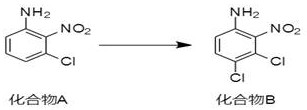 The visual representation of the initial transformation underscores the precision of this method, where the second chlorine atom is introduced ortho to the existing substituents without affecting the nitro group. By avoiding precious metal catalysts and utilizing robust copper-mediated reactions, this novel approach significantly lowers the barrier to entry for commercial scale-up, making it an attractive option for reliable pharmaceutical intermediate supplier networks seeking to optimize their portfolios.
Mechanistic Insights into Copper-Mediated Functionalization and Hydrolysis
A deep dive into the reaction mechanism reveals why this specific sequence achieves such high fidelity in product formation. The initial chlorination step relies on the electrophilic nature of N-chlorosuccinimide activated by the solvent system, likely DMF, which facilitates the generation of the chloronium ion equivalent. The amino group on the starting material acts as a strong activating group, directing the incoming electrophile to the position ortho to itself, which is also para to the existing chlorine, thus establishing the 3,4-dichloro pattern essential for the final target. Following this, the conversion of the amine to the iodide (Compound C) proceeds through a classic Sandmeyer-type mechanism involving the formation of a diazonium salt in situ using tert-butyl nitrite. The presence of cuprous iodide is critical here, as it mediates the radical substitution of the diazonium group, a transformation that is far more reliable than attempting direct nucleophilic aromatic substitution on the chloro-nitro system at this stage. This iodine atom then serves as an excellent leaving group for the subsequent Rosenmund-von Braun reaction with cuprous cyanide. The high temperature required for this cyanation step (150-155°C) ensures sufficient energy to overcome the activation barrier for the nucleophilic attack by the cyanide ion, displacing the iodide to form the nitrile (Compound D). Finally, the hydrolysis of the nitrile to the carboxylic acid is driven by the strong acidic environment provided by 70% sulfuric acid at elevated temperatures, which protonates the nitrogen of the nitrile group, making the carbon susceptible to nucleophilic attack by water molecules, eventually yielding the stable carboxylate after workup.
From an impurity control perspective, the choice of reagents and conditions plays a pivotal role in maintaining the integrity of the final product. The use of NCS instead of Cl2 minimizes the formation of polychlorinated byproducts that are difficult to separate. Similarly, the specific stoichiometry of cuprous iodide and tert-butyl nitrite is optimized to ensure complete consumption of the amine, preventing the carryover of unreacted starting material which could complicate downstream purification. The patent data indicates that purification via silica gel column chromatography was used in the examples to achieve purities above 98%, suggesting that while the reaction is clean, careful isolation is still part of the quality assurance protocol. For industrial applications, this implies that crystallization strategies would need to be developed to replace chromatography, but the high intrinsic selectivity of the chemical steps provides a solid foundation for such process development. The rigorous control of temperature during the exothermic diazotization and the high-temperature cyanation steps further prevents thermal degradation of the sensitive nitro-aromatic core, ensuring that the impurity profile remains manageable and consistent with stringent purity specifications required for API synthesis.
How to Synthesize 3,4-Dichloro-2-Nitrobenzoic Acid Efficiently
Implementing this synthesis requires strict adherence to the specified reaction parameters to replicate the high yields and purity reported in the patent. The process is divided into four distinct operational stages, beginning with the low-temperature mixing of the starting aniline in DMF followed by the controlled addition of NCS. Operators must monitor the reaction progress closely, typically using TLC, to ensure complete conversion before quenching and extracting the intermediate. The subsequent iodination step demands careful temperature management, starting cold for the diazotization and then ramping up for the substitution, while the cyanation step requires robust heating equipment capable of sustaining 150°C safely.
- Perform electrophilic chlorination of the starting aniline derivative using N-chlorosuccinimide (NCS) in DMF to introduce the second chlorine atom.
- Execute a Sandmeyer-type iodination using tert-butyl nitrite and cuprous iodide to convert the amino group into an iodo substituent.
- Conduct a Rosenmund-von Braun cyanation with cuprous cyanide followed by acidic hydrolysis to yield the final carboxylic acid product.
Commercial Advantages for Procurement and Supply Chain Teams
For procurement managers and supply chain heads, the adoption of this synthetic route offers tangible benefits that extend beyond mere chemical elegance. The primary advantage lies in the substantial cost savings derived from the use of commodity reagents. By replacing hazardous gases and expensive noble metal catalysts with solid, shelf-stable reagents like NCS and copper salts, the process drastically simplifies inventory management and reduces the need for specialized containment infrastructure. This shift not only lowers the direct cost of goods sold (COGS) but also mitigates the risks associated with transporting and storing dangerous chemicals, leading to lower insurance and compliance costs. Furthermore, the shortness of the synthetic route—only four steps from a commercially available starting material—means fewer unit operations, less solvent consumption, and reduced labor hours per kilogram of product. These efficiencies compound to create a significantly more competitive pricing structure for the final 3,4-dichloro-2-nitrobenzoic acid, allowing downstream manufacturers to improve their margins or pass savings on to customers.
- Cost Reduction in Manufacturing: The elimination of precious metal catalysts such as palladium or platinum, which are often required in cross-coupling alternatives, removes a major variable cost driver from the production budget. Copper salts are orders of magnitude cheaper and can often be recovered or disposed of with less environmental impact than heavy noble metals. Additionally, the high atom economy of the chlorination and hydrolysis steps ensures that a greater proportion of the raw material mass ends up in the final product, reducing waste disposal fees. The operational simplicity also translates to lower energy consumption per batch, as the reaction times are optimized and do not require prolonged reflux or cryogenic cooling beyond the initial stages. Collectively, these factors contribute to a leaner manufacturing model that is resilient against fluctuations in raw material pricing.
- Enhanced Supply Chain Reliability: Sourcing reliability is paramount for continuous API production, and this route excels by utilizing reagents that are widely available from multiple global suppliers. N-chlorosuccinimide, cuprous iodide, and sulfuric acid are bulk chemicals with mature supply chains, unlike specialized ligands or custom-synthesized intermediates that might have single-source dependencies. This diversification of the supply base reduces the risk of production stoppages due to vendor shortages or logistical delays. Moreover, the stability of the intermediates allows for potential campaign manufacturing, where batches of Compound B or C can be stockpiled if necessary, providing a buffer against demand spikes. For supply chain planners, this flexibility is invaluable for maintaining just-in-time delivery schedules to pharmaceutical clients without compromising on quality or lead time.
- Scalability and Environmental Compliance: Scaling chemical processes from the bench to the plant often reveals hidden pitfalls, but the robust nature of this chemistry suggests a smooth transition to commercial volumes. The reactions do not generate excessive gas evolution or highly unstable intermediates that would require complex engineering controls. From an environmental standpoint, the avoidance of chlorinating gases reduces the burden on scrubber systems, and the use of standard organic solvents like DMF and acetonitrile allows for established recovery and recycling protocols. While the cyanation step requires careful handling due to the toxicity of cyanide, industrial protocols for managing cuprous cyanide are well-established, ensuring that the process can meet rigorous environmental, health, and safety (EHS) standards. This compliance readiness accelerates regulatory approval for the manufacturing site, ensuring uninterrupted supply for the long term.
Frequently Asked Questions (FAQ)
Understanding the nuances of this new synthetic method is crucial for stakeholders evaluating its integration into their supply chains. The following questions address common concerns regarding technical feasibility, quality control, and commercial viability based on the patent disclosures.
Q: What are the key advantages of this synthetic route for 3,4-dichloro-2-nitrobenzoic acid?
A: The patented method offers a short reaction sequence with easily available raw materials. It utilizes standard reagents like NCS and copper salts, avoiding expensive precious metal catalysts, which simplifies purification and reduces overall production costs.
Q: How is high purity achieved in the final product?
A: The process employs specific temperature controls and solvent systems (DMF, acetonitrile) that favor the desired regioisomers. The final hydrolysis step under controlled acidic conditions ensures complete conversion of the nitrile group while minimizing side reactions, resulting in purity levels exceeding 99%.
Q: Is this process suitable for large-scale industrial production?
A: Yes, the reaction conditions are designed for operational simplicity and easy control. The use of common solvents and robust inorganic reagents makes the transition from laboratory scale to multi-ton commercial production feasible without significant engineering bottlenecks.
Partnering with NINGBO INNO PHARMCHEM: Your Reliable 3,4-Dichloro-2-Nitrobenzoic Acid Supplier
At NINGBO INNO PHARMCHEM, we recognize that the successful commercialization of complex pharmaceutical intermediates requires more than just a patent; it demands engineering excellence and unwavering commitment to quality. Our team of expert process chemists has extensively evaluated the route described in CN111943854A and possesses the extensive experience scaling diverse pathways from 100 kgs to 100 MT/annual commercial production. We understand the critical nature of maintaining stringent purity specifications for nitro-aromatic compounds, and our rigorous QC labs are equipped to detect and quantify trace impurities that could affect downstream coupling reactions. By partnering with us, you gain access to a supply chain that is not only cost-effective but also technically robust, ensuring that your API development timelines are met without compromise.
We invite procurement leaders and R&D directors to engage with us for a Customized Cost-Saving Analysis tailored to your specific volume requirements. Our technical procurement team is ready to provide specific COA data and route feasibility assessments to demonstrate how our optimized manufacturing of 3,4-dichloro-2-nitrobenzoic acid can enhance your project's economics. Whether you require kilogram quantities for clinical trials or metric tons for commercial launch, NINGBO INNO PHARMCHEM stands ready to be your strategic partner in fine chemical synthesis.
Engineering Bottleneck?
Can't scale up this synthesis? Upload your target structure or CAS, and our CDMO team will evaluate the industrial feasibility within 24 hours. Request Evaluation →