
Advanced Synthesis of Steroidal Piperidone Derivatives for High-Efficiency Pest Control Applications
Advanced Synthesis of Steroidal Piperidone Derivatives for High-Efficiency Pest Control Applications
The agricultural sector is constantly seeking novel chemical entities to combat the growing resistance of piercing-sucking pests such as aphids and mites. Patent CN113831386A introduces a groundbreaking class of steroidal piperidone derivatives that exhibit potent insecticidal activity. These compounds, characterized by a fused steroid backbone linked to a nitrogen-containing heterocyclic ring, represent a significant advancement in agrochemical intermediate design. The general structures, depicted as formula (1) and formula (2), allow for extensive structural diversification at the R-group position, enabling fine-tuning of biological efficacy. 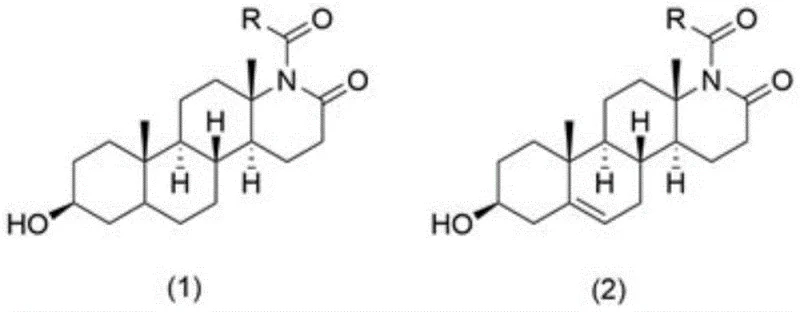 As a reliable agrochemical intermediate supplier, understanding the robust synthesis of these molecules is critical for securing the supply chain of next-generation crop protection agents.
The Limitations of Conventional Methods vs. The Novel Approach
The Limitations of Conventional Methods
Traditional synthesis of piperidone-containing heterocycles often relies on multi-step cyclization reactions that suffer from poor atom economy and harsh reaction conditions. Conventional routes frequently require expensive transition metal catalysts to establish the necessary stereochemistry, leading to significant cost inflation and complex waste streams containing heavy metals. Furthermore, the separation of diastereomers in non-steroidal scaffolds can be notoriously difficult, often necessitating preparative HPLC which is impractical for commercial scale-up. These inefficiencies create bottlenecks in cost reduction in agrochemical manufacturing, making it challenging to produce high volumes of active ingredients at a competitive price point for farmers.
The Novel Approach
The methodology disclosed in the patent overcomes these hurdles by utilizing dehydroepiandrosterone (DHEA) as a foundational building block. This strategy capitalizes on the inherent chirality of the steroid nucleus, effectively bypassing the need for asymmetric catalysis. The synthetic route is designed for high yield and operational simplicity, with products that precipitate easily from reaction mixtures as white solids. This ease of separation drastically simplifies downstream processing, reducing solvent consumption and energy usage. By integrating the heterocyclic ring directly onto the robust steroid framework, the process ensures structural integrity and consistent quality, which is paramount for commercial scale-up of complex heterocycles intended for large-scale agricultural application.
Mechanistic Insights into Beckmann Rearrangement and Acylation
The core of this synthetic innovation lies in the strategic expansion of the steroid D-ring. The process begins with the protection of the C3-hydroxyl group, followed by oximation of the C17-ketone. The pivotal step involves a Beckmann rearrangement mediated by thionyl chloride, which induces a skeletal rearrangement to form the six-membered lactam ring characteristic of the piperidone moiety. This transformation is highly efficient and proceeds under mild conditions, preserving the sensitive stereochemical centers of the steroid backbone. For derivatives requiring a saturated B-ring, a subsequent catalytic hydrogenation step using Pb/C is employed, demonstrating excellent chemoselectivity without affecting other functional groups.
Following the construction of the core scaffold, the final diversification is achieved through N-acylation.  The reaction of the secondary amine intermediates (compounds 3 or 5) with various substituted benzoyl chlorides introduces the necessary lipophilic and electronic properties for biological activity.
 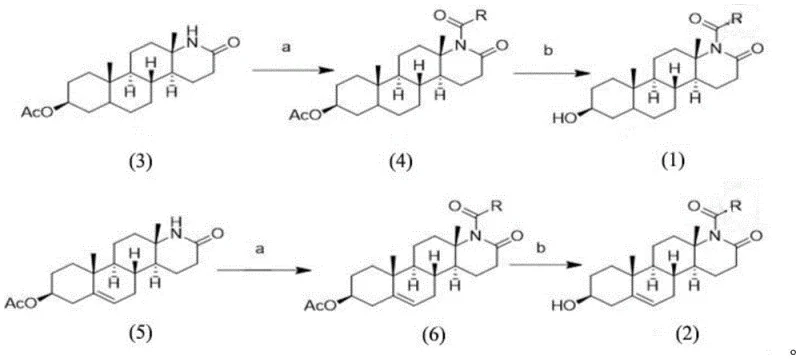 This step is facilitated by base catalysis in dichloromethane, ensuring rapid conversion. The mechanism allows for the incorporation of diverse substituents such as halogens, trifluoromethyl groups, and nitro groups, enabling the generation of a focused library of high-purity steroidal piperidone analogues tailored for specific pest resistance profiles.
How to Synthesize Steroidal Piperidone Derivatives Efficiently
The synthesis protocol outlined in the patent provides a clear roadmap for producing these valuable intermediates. It starts with readily available DHEA and proceeds through protection, oximation, rearrangement, and final acylation. The detailed standardized synthesis steps see the guide below, which outlines the specific reagents, temperatures, and workup procedures required to achieve the reported high yields and purity levels suitable for industrial production.
- Protect the hydroxyl group of dehydroepiandrosterone using acetic anhydride, then react with hydroxylamine hydrochloride to form the oxime intermediate.
- Perform Beckmann rearrangement using thionyl chloride to expand the ring into a piperidone lactam structure.
- Optionally hydrogenate the double bond using Pb/C catalyst, followed by acylation with substituted benzoyl chlorides to finalize the derivative.
Commercial Advantages for Procurement and Supply Chain Teams
From a procurement perspective, this synthetic route offers substantial advantages driven by raw material availability and process efficiency. The reliance on dehydroepiandrosterone, a commodity steroid, ensures a stable and predictable supply chain, mitigating the risks associated with scarce or volatile specialty chemicals. The elimination of precious metal catalysts and complex purification steps translates directly into lower operational expenditures. Additionally, the robustness of the reaction conditions allows for flexibility in manufacturing locations, enhancing supply chain resilience against regional disruptions.
- Cost Reduction in Manufacturing: The process eliminates the need for expensive chiral catalysts and complex chromatographic separations. By leveraging the natural chirality of the starting material and utilizing precipitation for purification, the manufacturing footprint is significantly reduced. This streamlined approach minimizes solvent waste and energy consumption, leading to substantial cost savings in the overall production budget without compromising the quality of the final agrochemical intermediate.
- Enhanced Supply Chain Reliability: Utilizing DHEA as a feedstock connects the production of these derivatives to the well-established steroid supply chain. This ensures consistent availability of raw materials and reduces lead times for high-purity steroidal piperidone derivatives. The simplicity of the synthetic steps also means that production can be easily scaled or shifted between facilities, providing a buffer against supply shocks and ensuring continuous delivery to formulation partners.
- Scalability and Environmental Compliance: The reaction conditions are mild, often proceeding at room temperature or under reflux in common solvents like ethanol and dichloromethane. This facilitates easy scale-up from laboratory to pilot and commercial plants. Furthermore, the absence of heavy metal residues simplifies waste treatment and environmental compliance, aligning with increasingly stringent global regulations on chemical manufacturing and supporting sustainable agricultural practices.
Frequently Asked Questions (FAQ)
The following questions address common technical and commercial inquiries regarding the production and application of these steroidal piperidone derivatives. The answers are derived directly from the patent specifications and biological data, providing clarity on the feasibility and potential of this technology for integration into existing agrochemical portfolios.
Q: What is the primary advantage of using dehydroepiandrosterone as a starting material?
A: Using dehydroepiandrosterone leverages a naturally abundant chiral pool, eliminating the need for complex asymmetric synthesis steps and significantly reducing raw material costs while ensuring high stereochemical purity.
Q: How does this synthesis method improve product isolation?
A: The process utilizes precipitation and filtration techniques with common solvent systems like petroleum ether and ethyl acetate, allowing for easy separation of the white solid products without requiring complex chromatography.
Q: What pests are these derivatives effective against?
A: Biological assays confirm strong toxicity against piercing-sucking insects including aphids, spider mites, rice planthoppers, and whiteflies, offering a broad-spectrum solution for crop protection.
Partnering with NINGBO INNO PHARMCHEM: Your Reliable Steroidal Piperidone Derivative Supplier
NINGBO INNO PHARMCHEM stands at the forefront of custom synthesis, possessing extensive experience scaling diverse pathways from 100 kgs to 100 MT/annual commercial production. Our technical team is adept at optimizing the Beckmann rearrangement and acylation steps described in patent CN113831386A to meet stringent purity specifications required for regulatory approval. With rigorous QC labs and a commitment to process safety, we ensure that every batch of steroidal piperidone intermediate meets the highest standards of quality and consistency.
We invite procurement leaders and R&D directors to collaborate with us on a Customized Cost-Saving Analysis for your specific project needs. By partnering with our technical procurement team, you can access specific COA data and route feasibility assessments that will accelerate your development timeline. Contact us today to discuss how we can support your supply chain with reliable, high-quality agrochemical intermediates.
Engineering Bottleneck?
Can't scale up this synthesis? Upload your target structure or CAS, and our CDMO team will evaluate the industrial feasibility within 24 hours. Request Evaluation →