
Advancing Aromatic Primary Amine Production with Recyclable Aqueous Copper Catalysis
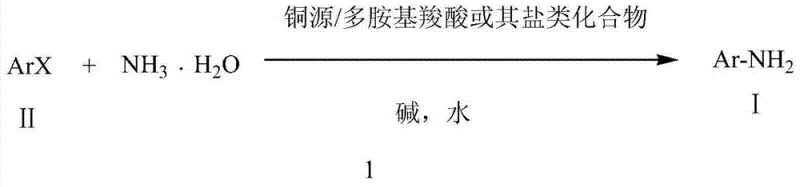
The chemical industry is currently witnessing a paradigm shift towards greener, more sustainable synthetic methodologies, particularly in the production of high-value intermediates. Patent CN103739417A introduces a groundbreaking method for synthesizing aromatic primary amines within a circulating water phase system, addressing critical inefficiencies found in traditional protocols. This innovation utilizes aryl halides and ammonia water as primary feedstocks, leveraging water as the exclusive solvent medium to drive the transformation. By employing a copper source catalyst in conjunction with polyaminocarboxylic acid ligands and inorganic bases, the process achieves high selectivity for primary amines while mitigating the formation of undesirable secondary and tertiary amine by-products. The significance of this technology lies not only in its chemical efficacy but also in its alignment with global sustainability goals, offering a robust pathway for the commercial scale-up of complex pharmaceutical intermediates. For R&D directors and procurement specialists alike, this patent represents a tangible opportunity to optimize supply chains through reduced environmental impact and simplified downstream processing.
The Limitations of Conventional Methods vs. The Novel Approach
The Limitations of Conventional Methods
Historically, the synthesis of aromatic primary amines via the coupling of aryl halides and ammonia has been plagued by significant technical and economic hurdles. Traditional methods predominantly rely on volatile organic solvents, which necessitate complex recovery systems and pose substantial safety risks due to flammability and toxicity. Furthermore, conventional catalytic systems often require expensive and structurally complex ligands, such as specialized phosphines, which are sensitive to air and moisture, thereby complicating storage and handling. A major chemical challenge in these legacy processes is the competitive reaction between the generated primary amine and the remaining aryl halide, leading to extensive over-alkylation and the production of secondary or tertiary amines. This lack of selectivity drastically reduces the yield of the desired primary amine, forcing manufacturers to invest in energy-intensive purification steps to remove these impurities. Additionally, many existing aqueous methods reported in literature require non-commercially available catalysts or large quantities of phase transfer catalysts, which further escalates the cost of goods sold and generates significant chemical waste.
The Novel Approach
In stark contrast to these legacy issues, the methodology disclosed in patent CN103739417A offers a streamlined, environmentally benign alternative that fundamentally reimagines the reaction medium. By utilizing water as the sole solvent, the process eliminates the need for hazardous organic volatiles and expensive phase transfer catalysts, creating a safer working environment and reducing waste disposal costs. The core of this innovation is the use of readily available polyaminocarboxylic acids, such as EDTA or DTPA, as ligands, which effectively coordinate with copper sources to form a highly active and stable catalytic species. This system allows for the direct use of inexpensive ammonia water as the nitrogen source, avoiding the handling difficulties associated with gaseous ammonia. Crucially, the patent highlights the recyclability of the entire catalytic system, including the water solvent, which can be circulated for multiple runs without significant loss of activity. This circular approach not only lowers the raw material consumption but also simplifies the isolation of the final product, making it an ideal candidate for cost reduction in pharmaceutical intermediate manufacturing.
Mechanistic Insights into Copper-Catalyzed C-N Coupling in Aqueous Media
The success of this aqueous transformation relies on the precise orchestration of the copper catalytic cycle within a polar protic environment. Mechanistically, the reaction is believed to proceed through a classic oxidative addition-reductive elimination pathway, facilitated by the polyaminocarboxylic acid ligand. The ligand plays a dual role: it stabilizes the copper center against aggregation into inactive metallic copper particles and modulates the electronic properties of the metal to favor the activation of the aryl halide bond. In the presence of a strong inorganic base, such as potassium hydroxide or cesium carbonate, the ammonia molecule is activated to form a nucleophilic amido-copper species. This species then undergoes transmetallation or direct attack on the oxidative addition complex. The unique solvation properties of water assist in stabilizing the ionic intermediates and transition states, potentially lowering the activation energy barrier compared to non-polar organic solvents. Furthermore, the high concentration of ammonia water (used in a molar ratio of 1:5 to 1:20 relative to the substrate) ensures that the kinetics favor the formation of the primary amine over subsequent alkylation reactions, effectively suppressing the generation of diarylamine impurities.
From an impurity control perspective, this system offers distinct advantages for maintaining high product purity, a critical metric for any reliable aromatic primary amine supplier. The use of water-soluble ligands and inorganic bases means that upon completion of the reaction, the catalyst and excess reagents largely remain in the aqueous phase. This facilitates a clean separation where the organic product can be extracted using a minimal amount of organic solvent, leaving the bulk of the catalytic residues behind. The patent data indicates that this method tolerates a wide range of functional groups, including nitro, acetyl, and carboxyl groups, without significant side reactions, suggesting a high degree of chemoselectivity. For example, substrates like 4-bromoanisole and 3-bromopyridine are converted efficiently, demonstrating that the catalytic system is robust enough to handle both electron-rich and electron-deficient aromatics as well as heterocycles. This broad tolerance minimizes the need for protecting group strategies, further shortening the synthetic route and reducing the overall impurity load in the final API intermediate.
How to Synthesize Aromatic Primary Amines Efficiently
Implementing this synthesis route requires careful attention to the stoichiometric ratios and thermal conditions outlined in the patent to ensure optimal conversion and yield. The process is designed to be operationally simple, requiring standard laboratory or plant equipment capable of handling pressurized aqueous reactions at elevated temperatures. The following guide summarizes the critical operational parameters derived from the experimental examples, serving as a foundational reference for process engineers looking to adapt this technology for larger-scale production. For a comprehensive, step-by-step Standard Operating Procedure (SOP) tailored to your specific facility capabilities, please refer to the detailed technical documentation provided below.
- Combine copper source catalyst, polyaminocarboxylic acid ligand, aryl halide substrate, inorganic base, and ammonia water in a reaction vessel with water as the solvent.
- Seal the reaction tube and heat the mixture using a standard hot bath method at temperatures ranging from 60°C to 130°C for a duration of 2 to 36 hours.
- Upon completion, separate the reaction mixture, extract with ethyl acetate, wash, dry, and purify via silica gel column chromatography to isolate the aromatic primary amine.
Commercial Advantages for Procurement and Supply Chain Teams
For procurement managers and supply chain heads, the adoption of this aqueous copper-catalyzed technology presents a compelling value proposition centered on cost efficiency and supply resilience. The shift from organic solvents to water dramatically reduces the expenditure on solvent purchase, recovery, and hazardous waste treatment, which are often hidden cost drivers in fine chemical manufacturing. Moreover, the reliance on commodity chemicals like copper salts, EDTA, and ammonia water ensures that the supply chain is not vulnerable to the volatility associated with specialized, single-source ligands. This stability allows for more accurate long-term forecasting and inventory management, reducing the risk of production stoppages due to raw material shortages. The simplicity of the workup procedure also translates to faster batch turnover times, enhancing overall plant throughput without the need for capital-intensive new equipment.
- Cost Reduction in Manufacturing: The elimination of expensive phase transfer catalysts and complex phosphine ligands results in a direct decrease in raw material costs. Since the catalyst and solvent system are recyclable, the effective cost per kilogram of product decreases significantly over multiple batches. The use of water as a solvent also removes the need for expensive solvent drying and purification steps required for moisture-sensitive organic reactions. Furthermore, the high selectivity for primary amines reduces the loss of valuable starting materials to by-products, improving the overall atom economy of the process. These factors combine to create a leaner manufacturing model that maximizes margin potential in competitive markets.
- Enhanced Supply Chain Reliability: The raw materials required for this synthesis, including various aryl halides and inorganic bases, are widely available from multiple global suppliers, mitigating the risk of single-source dependency. The robustness of the catalytic system means that minor variations in reagent quality are less likely to cause batch failures compared to more sensitive palladium-catalyzed systems. This reliability ensures consistent delivery schedules to downstream customers, fostering stronger long-term partnerships. Additionally, the ability to recycle the aqueous phase reduces the volume of fresh water required, insulating the production site from local water scarcity issues or regulatory restrictions on water usage.
- Scalability and Environmental Compliance: Scaling this reaction from gram to ton scale is facilitated by the use of water, which has superior heat capacity and thermal conductivity compared to organic solvents, allowing for better temperature control in large reactors. This inherent safety feature reduces the risk of thermal runaways, a common concern in exothermic coupling reactions. From a regulatory standpoint, the reduction in volatile organic compound (VOC) emissions aligns with increasingly stringent environmental regulations, simplifying the permitting process for new production lines. The minimal generation of hazardous waste also lowers the compliance burden and associated disposal fees, contributing to a more sustainable corporate footprint.
Frequently Asked Questions (FAQ)
The following questions address common technical inquiries regarding the implementation and scope of this patented technology. These answers are derived directly from the experimental data and claims within patent CN103739417A, providing clarity on the practical application of the method. Understanding these nuances is essential for technical teams evaluating the feasibility of integrating this process into their existing manufacturing workflows.
Q: What ligands are utilized in this aqueous copper-catalyzed amination process?
A: The process employs commercially available polyaminocarboxylic acids or their salts, such as ethylenediaminetetraacetic acid (EDTA), diethylenetriaminepentaacetic acid (DTPA), or ethylenediamine-N,N'-diacetic acid, which act as effective ligands to stabilize the copper catalyst.
Q: Is the catalytic system and solvent recyclable in this method?
A: Yes, a key advantage of patent CN103739417A is that the catalyst, ligand, and the water solvent can be recycled and reused, significantly enhancing the environmental friendliness and economic viability of the process compared to traditional organic solvent methods.
Q: What is the substrate scope for this aromatic primary amine synthesis?
A: The method demonstrates a broad substrate scope, successfully converting various aryl iodides and bromides, including those with electron-donating or withdrawing groups like nitro, methoxy, and halogens, as well as heterocyclic substrates like pyridines.
Partnering with NINGBO INNO PHARMCHEM: Your Reliable Aromatic Primary Amines Supplier
The technological advancements detailed in patent CN103739417A underscore the immense potential of green chemistry to redefine the production of critical chemical building blocks. At NINGBO INNO PHARMCHEM, we possess the technical expertise and infrastructure to translate such innovative laboratory protocols into robust, industrial-scale realities. Our team has extensive experience scaling diverse pathways from 100 kgs to 100 MT/annual commercial production, ensuring that the transition from pilot plant to full-scale manufacturing is seamless and efficient. We maintain stringent purity specifications across all our product lines, supported by rigorous QC labs equipped with state-of-the-art analytical instrumentation to guarantee that every batch meets the exacting standards required by the global pharmaceutical and agrochemical industries.
We invite you to collaborate with us to optimize your supply chain and reduce your manufacturing costs through the adoption of this advanced synthetic route. Our technical procurement team is ready to provide a Customized Cost-Saving Analysis specific to your target molecules, demonstrating exactly how this aqueous copper-catalyzed method can improve your bottom line. We encourage you to contact us to request specific COA data for similar compounds and to discuss route feasibility assessments for your proprietary intermediates. Let us partner with you to drive innovation and efficiency in your chemical sourcing strategy.
Engineering Bottleneck?
Can't scale up this synthesis? Upload your target structure or CAS, and our CDMO team will evaluate the industrial feasibility within 24 hours. Request Evaluation →