
Advanced Enzymatic Deracemization for Commercial L-Glufosinate-Ammonium Manufacturing
The global agrochemical industry is currently witnessing a pivotal shift towards high-efficiency, chiral-pure herbicides, driven by the urgent need for sustainable and potent crop protection solutions. A groundbreaking technical disclosure found in patent CN112391438A introduces a sophisticated enzymatic deracemization process that fundamentally transforms the production landscape of L-glufosinate-ammonium. This innovation addresses the critical bottleneck of converting the inexpensive racemic DL-mixture into the physiologically active L-configuration with unprecedented efficiency. By leveraging a novel in-situ oxygen supply mechanism, this method overcomes the historical limitations of oxygen mass transfer in biocatalysis, enabling reaction concentrations that were previously unattainable. For R&D directors and procurement strategists, this patent represents a significant leap forward in process intensification, offering a pathway to reduce manufacturing complexity while simultaneously enhancing the optical purity of the final agrochemical intermediate. The implications for supply chain stability and cost structure in the herbicide sector are profound, marking a new era for reliable L-glufosinate-ammonium supplier capabilities.
The Limitations of Conventional Methods vs. The Novel Approach
The Limitations of Conventional Methods
Historically, the industrial synthesis of L-glufosinate-ammonium has been plagued by significant technical and economic hurdles that have hindered its widespread adoption as a replacement for glyphosate. Traditional chemical resolution methods are inherently inefficient, theoretically capping the yield at 50% while generating substantial waste from the unwanted D-isomer, which drives up the cost of goods sold significantly. Furthermore, prior enzymatic attempts often relied on physical aeration or air bubbling to supply the oxygen required for the D-amino acid oxidase (DAAO) catalyzed oxidation step. This approach creates severe operational challenges, including excessive foaming and the necessity for high-shear stirring, which physically damages the delicate enzyme structures and leads to rapid loss of catalytic activity. Additionally, older routes frequently depended on expensive palladium-carbon catalysts for reduction steps, introducing the risk of heavy metal contamination and necessitating costly purification protocols to meet stringent regulatory standards for agrochemical intermediates. These cumulative inefficiencies have kept production costs high, limiting the market penetration of this superior herbicide despite its environmental and efficacy advantages.
The Novel Approach
The patented methodology introduces a paradigm shift by replacing mechanical aeration with a chemically elegant in-situ oxygen generation system. By introducing hydrogen peroxide into the reaction matrix alongside catalase, the process generates dissolved oxygen directly within the aqueous phase exactly where the enzyme requires it. This eliminates the need for vigorous stirring and air sparging, thereby creating a mild reaction environment that preserves enzyme integrity and extends catalyst lifespan. The result is a robust one-pot system capable of handling substrate concentrations as high as 200 g/L, a dramatic improvement over the dilute conditions (20-50 mM) typical of prior art. This intensification allows for smaller reactor volumes to produce the same output, directly translating to reduced capital expenditure and lower energy consumption per kilogram of product. For a reliable agrochemical intermediate supplier, this technology offers a scalable, environmentally benign route that bypasses the use of precious metals and complex separation steps, ensuring a more resilient and cost-effective manufacturing pipeline for high-purity L-glufosinate-ammonium.
Mechanistic Insights into Enzymatic Deracemization and In-Situ Oxygen Supply
The core of this technological breakthrough lies in the synergistic coupling of three enzymatic activities within a single reaction vessel, creating a self-sustaining catalytic cycle that drives the conversion of the D-isomer to the L-configuration. The process initiates with D-amino acid oxidase (DAAO), which selectively oxidizes the D-glufosinate-ammonium substrate into an intermediate keto-acid (PPO), releasing ammonia and hydrogen peroxide as byproducts. In conventional systems, the accumulation of hydrogen peroxide would inhibit the oxidase, but here, catalase (CAT) immediately decomposes the peroxide into water and molecular oxygen. This generated oxygen is then instantly available to re-oxidize the DAAO cofactor, closing the first loop of the cycle without the need for external gas transfer. Simultaneously, the keto-acid intermediate is stereoselectively reduced by L-amino acid dehydrogenase (GluDH) using NADPH as a cofactor, yielding the desired L-glufosinate-ammonium product. A coenzyme regeneration system, typically involving glucose dehydrogenase, ensures a continuous supply of NADPH, making the process atom-economical and sustainable.
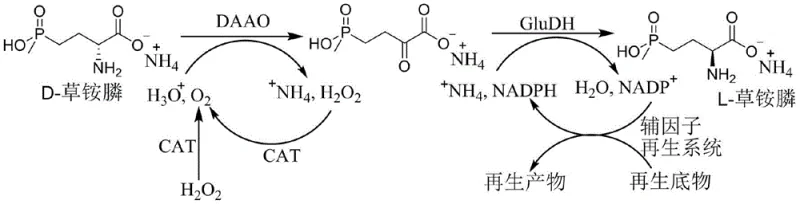
From a quality control perspective, this mechanism offers superior impurity management compared to chemical synthesis. Because the enzymes are highly specific, side reactions are minimized, resulting in a cleaner reaction profile that simplifies downstream isolation. The in-situ oxygen supply ensures that the rate-limiting oxidation step proceeds rapidly, preventing the accumulation of partially oxidized intermediates that could lead to byproduct formation. Furthermore, the mild pH and temperature conditions (pH 8.0, 30°C) prevent the degradation of the sensitive phosphonate moiety, which is prone to hydrolysis under harsh chemical conditions. For R&D teams focused on impurity profiles, this biocatalytic route provides a distinct advantage by inherently limiting the formation of structurally related impurities, thereby facilitating easier compliance with global regulatory specifications for herbicide active ingredients and ensuring consistent batch-to-batch quality.
How to Synthesize L-Glufosinate-Ammonium Efficiently
Implementing this synthesis route requires precise control over the biocatalytic environment to maximize the benefits of the in-situ oxygen supply system. The process begins by preparing a buffered aqueous solution containing the racemic DL-glufosinate-ammonium substrate at concentrations ranging from 30 to 300 g/L, adjusted to a pH of approximately 8.0. The enzymatic cocktail, comprising D-amino acid oxidase, catalase, and L-amino acid dehydrogenase, is introduced along with the necessary coenzymes and a regeneration substrate such as glucose. The critical operational parameter is the controlled addition of hydrogen peroxide, which must be dosed carefully to maintain a steady release of oxygen bubbles without accumulating toxic levels of peroxide that could inactivate the enzymes. Detailed standardized synthesis steps see the guide below.
- Prepare a reaction system with DL-glufosinate-ammonium substrate (30-300 g/L) in phosphate buffer at pH 8.0 and 30°C.
- Add D-amino acid oxidase (DAAO), Catalase (CAT), and L-amino acid dehydrogenase (GluDH) along with necessary coenzymes (NADP+/NADPH).
- Maintain reaction by dropwise adding hydrogen peroxide to generate in-situ oxygen, ensuring high conversion rates without foaming.
Commercial Advantages for Procurement and Supply Chain Teams
For procurement managers and supply chain heads, the adoption of this enzymatic deracemization technology offers compelling strategic advantages that extend beyond simple technical metrics. The elimination of precious metal catalysts like palladium-carbon removes a significant variable cost component and mitigates the supply risk associated with fluctuating metal prices. Moreover, the ability to run reactions at high substrate concentrations significantly improves space-time yield, meaning that existing manufacturing infrastructure can produce substantially more output without the need for capital-intensive plant expansion. This process intensification directly contributes to cost reduction in herbicide manufacturing by lowering energy consumption per unit and reducing the volume of wastewater generated, aligning with increasingly strict environmental compliance standards. The simplified downstream processing, resulting from higher selectivity and fewer byproducts, further shortens the production cycle time, enhancing overall supply chain responsiveness and reliability.
- Cost Reduction in Manufacturing: The transition from chemical resolution or metal-catalyzed reduction to a fully enzymatic process fundamentally alters the cost structure of L-glufosinate-ammonium production. By removing the need for expensive palladium catalysts and the associated recovery or disposal costs, the direct material costs are significantly lowered. Additionally, the theoretical 100% conversion of the racemic mixture into the active L-isomer doubles the effective yield from the raw material compared to traditional resolution methods, effectively halving the raw material cost burden per kilogram of active product. This dramatic improvement in atom economy, combined with the reduced need for complex purification steps to remove metal residues, results in substantial cost savings that can be passed down the supply chain or retained as margin.
- Enhanced Supply Chain Reliability: The robustness of the in-situ oxygen supply system enhances the reliability of the manufacturing process by reducing sensitivity to external aeration equipment failures. Since the oxygen is generated chemically within the solution, the process is less dependent on large-scale compressors or spargers, which are common points of failure in traditional fermentation or oxidation setups. This decentralization of the oxygen supply reduces maintenance downtime and ensures consistent production schedules. Furthermore, the use of commercially available enzymes and standard chemical reagents like hydrogen peroxide ensures that the raw material supply chain is diverse and resilient, minimizing the risk of production stoppages due to the scarcity of specialized catalysts or reagents.
- Scalability and Environmental Compliance: The mild reaction conditions and the absence of heavy metals make this process inherently easier to scale from pilot to commercial production without encountering the safety and environmental hurdles typical of high-pressure hydrogenation or harsh chemical oxidations. The reduction in foaming and enzyme inactivation allows for larger reactor sizes to be utilized effectively, facilitating the commercial scale-up of complex agrochemical intermediates. From an environmental perspective, the aqueous nature of the reaction and the biodegradable nature of the enzymatic catalysts reduce the ecological footprint of the manufacturing process. This aligns with global sustainability goals and simplifies the permitting process for new production facilities, ensuring long-term operational continuity in a regulatory environment that is increasingly hostile to traditional chemical synthesis methods.
Frequently Asked Questions (FAQ)
The following questions address common technical and commercial inquiries regarding the implementation of this enzymatic deracemization technology. These insights are derived directly from the experimental data and technical disclosures within the patent literature, providing a factual basis for evaluating the feasibility of this route for industrial adoption. Understanding these details is crucial for stakeholders assessing the transition from conventional chemical synthesis to this advanced biocatalytic platform.
Q: How does the in-situ oxygen supply improve enzyme stability compared to air bubbling?
A: Traditional air bubbling causes severe foaming and high-shear stirring which leads to enzyme inactivation. The patented in-situ oxygen supply via Catalase decomposition of hydrogen peroxide provides dissolved oxygen gently and uniformly, maintaining enzyme activity for longer periods and allowing for higher substrate concentrations.
Q: What is the expected optical purity (ee value) of the L-glufosinate-ammonium produced?
A: According to the patent data, this enzymatic deracemization process achieves an ee value of up to 100% in laboratory scales and maintains over 98.5% ee even at high substrate concentrations (200g/L), ensuring high-purity agrochemical intermediates suitable for premium herbicide formulations.
Q: Does this process eliminate the need for expensive metal catalysts?
A: Yes, unlike previous methods that relied on palladium-carbon catalysts for reduction steps, this biocatalytic route utilizes specific enzymes (DAAO and GluDH). This eliminates the cost of precious metals and the complex downstream processing required to remove heavy metal residues from the final product.
Partnering with NINGBO INNO PHARMCHEM: Your Reliable L-Glufosinate-Ammonium Supplier
At NINGBO INNO PHARMCHEM, we recognize the transformative potential of this enzymatic deracemization technology for the global agrochemical market. As a leading CDMO partner, we possess the extensive experience scaling diverse pathways from 100 kgs to 100 MT/annual commercial production, ensuring that innovative laboratory processes like this are successfully translated into robust industrial realities. Our state-of-the-art facilities are equipped with rigorous QC labs and stringent purity specifications, guaranteeing that every batch of L-glufosinate-ammonium meets the highest international standards for herbicide intermediates. We are committed to leveraging our technical expertise to optimize this biocatalytic route, ensuring maximum yield and purity while maintaining the cost efficiencies that make this process commercially viable for our partners.
We invite you to collaborate with us to explore how this advanced synthesis method can enhance your product portfolio and supply chain efficiency. Our technical procurement team is ready to provide a Customized Cost-Saving Analysis tailored to your specific volume requirements and quality standards. We encourage you to contact us to request specific COA data and route feasibility assessments, allowing you to make informed decisions about integrating this high-purity L-glufosinate-ammonium into your supply chain. Together, we can drive the next generation of sustainable and efficient agrochemical manufacturing.
Engineering Bottleneck?
Can't scale up this synthesis? Upload your target structure or CAS, and our CDMO team will evaluate the industrial feasibility within 24 hours. Request Evaluation →