
Scalable Metal-Free Synthesis of 3-Methylthio Benzofurans for Commercial API Production
The pharmaceutical and fine chemical industries are constantly seeking robust, scalable, and cost-effective methodologies for constructing complex heterocyclic scaffolds. Patent CN110746393A introduces a groundbreaking synthetic route for 3-methylthio-substituted benzofurans, a privileged structure found in numerous bioactive molecules and drug candidates. This technology represents a significant paradigm shift by eliminating the need for expensive and toxic transition metal catalysts, relying instead on a highly efficient electrophilic cyclization strategy using dimethyl sulfoxide (DMSO) and thionyl chloride (SOCl2). For R&D directors and procurement managers alike, this metal-free approach offers a compelling value proposition, addressing critical pain points regarding heavy metal residue limits in APIs and the high costs associated with noble metal catalysts. The process operates under remarkably mild conditions, typically at room temperature in toluene, ensuring high atom economy and operational simplicity that translates directly to commercial viability.
The Limitations of Conventional Methods vs. The Novel Approach
The Limitations of Conventional Methods
Traditionally, the construction of benzofuran cores, particularly those functionalized at the 3-position, has heavily relied on transition metal catalysis involving palladium, copper, or gold complexes. These conventional pathways often necessitate rigorous exclusion of moisture and oxygen, specialized ligands, and elevated temperatures, which collectively drive up operational expenditures and complicate process safety profiles. Furthermore, the presence of transition metals in the final active pharmaceutical ingredient (API) is strictly regulated, requiring additional downstream processing steps such as scavenging or extensive chromatography to meet residual metal specifications. These purification bottlenecks not only extend lead times for high-purity pharmaceutical intermediates but also result in substantial yield losses and increased waste generation, creating a significant burden on both the supply chain and environmental compliance teams.
The Novel Approach
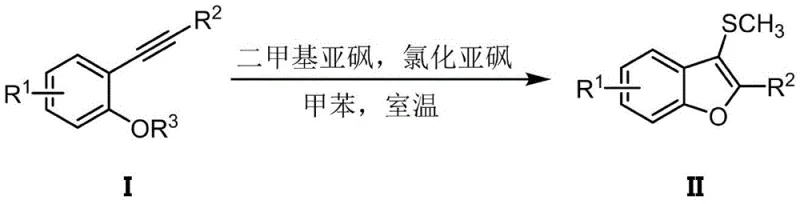
In stark contrast, the methodology disclosed in CN110746393A utilizes a simple yet powerful combination of DMSO and thionyl chloride to effect simultaneous cyclization and methylthiolation in a single pot. This innovative strategy bypasses the need for any metal catalyst, thereby inherently removing the risk of heavy metal contamination and the associated costly removal steps. The reaction proceeds smoothly at room temperature, drastically reducing energy consumption compared to thermal cyclization methods. By employing commercially available and inexpensive reagents like toluene and thionyl chloride, the process achieves high yields, often exceeding 80% for various substrates, demonstrating excellent functional group tolerance. This streamlined approach simplifies the manufacturing workflow, making it an ideal candidate for the commercial scale-up of complex pharmaceutical intermediates.
Mechanistic Insights into DMSO/SOCl2 Mediated Electrophilic Cyclization
The core of this transformation lies in the in situ generation of a highly reactive chlorodimethylsulfonium species formed by the interaction of dimethyl sulfoxide and thionyl chloride. This electrophilic sulfur species activates the alkyne moiety of the 2-alkynyl anisole or phenol substrate, initiating a cascade that leads to ring closure. The mechanism involves the nucleophilic attack of the oxygen atom on the activated alkyne, followed by the incorporation of the methylthio group from the sulfonium intermediate. This tandem process ensures high regioselectivity and efficiency, constructing the benzofuran skeleton and installing the valuable methylthio handle simultaneously. Understanding this mechanism is crucial for R&D teams as it highlights the versatility of the system, allowing for the modulation of electronic properties on the aromatic ring without compromising the reaction outcome.
From an impurity control perspective, the absence of metal catalysts significantly simplifies the impurity profile of the crude product. Traditional metal-catalyzed reactions often generate complex mixtures containing metal-ligand complexes, homocoupling byproducts, and dehalogenated species that are difficult to separate. In this metal-free protocol, the primary byproducts are gaseous (SO2 and HCl), which evolve from the reaction mixture, driving the equilibrium forward and leaving behind a cleaner organic phase. This inherent cleanliness facilitates easier isolation and purification, ensuring that the final high-purity OLED material or pharmaceutical intermediate meets stringent quality standards with minimal processing effort. The robustness of this mechanism across diverse substrates underscores its potential for broad application in medicinal chemistry campaigns.
How to Synthesize 3-Methylthio-Substituted Benzofurans Efficiently
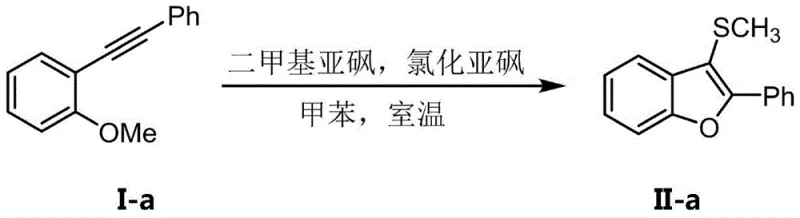
The practical implementation of this synthesis is straightforward and amenable to standard laboratory and plant equipment. The process begins by dissolving the specific 2-alkynyl anisole or phenol derivative along with dimethyl sulfoxide in a suitable volume of toluene. Thionyl chloride is then added dropwise to the stirred solution at room temperature, and the mixture is monitored via TLC until the starting material is fully consumed. Following the reaction, a standard aqueous workup involving extraction with ethyl acetate, washing with brine, and drying over anhydrous sodium sulfate yields the crude product, which can be purified by column chromatography. For detailed operational parameters, stoichiometry, and specific purification techniques tailored to your specific substrate, please refer to the standardized guide below.
- Dissolve the 2-alkynyl anisole or phenol substrate (Compound I) and dimethyl sulfoxide (DMSO) in toluene solvent.
- Add thionyl chloride (SOCl2) dropwise to the reaction mixture while maintaining room temperature conditions.
- Stir the reaction until TLC indicates complete consumption of the starting material, then proceed with aqueous workup and purification.
Commercial Advantages for Procurement and Supply Chain Teams
For procurement managers and supply chain heads, the adoption of this metal-free synthesis route offers transformative advantages in terms of cost structure and supply reliability. The elimination of precious metal catalysts such as palladium or gold removes a major variable cost component and mitigates the supply risk associated with fluctuating metal prices. Additionally, the mild reaction conditions reduce the energy load on manufacturing facilities, contributing to a lower carbon footprint and reduced utility costs. The simplicity of the workup procedure, driven by the evolution of gaseous byproducts, minimizes solvent usage and waste disposal fees, further enhancing the overall economic efficiency of the production process.
- Cost Reduction in Manufacturing: The most significant economic driver of this technology is the complete removal of transition metal catalysts from the bill of materials. In traditional processes, the cost of the catalyst itself, combined with the expensive scavengers required to remove trace metals to ppm levels, constitutes a substantial portion of the COGS. By utilizing inexpensive commodity chemicals like DMSO and thionyl chloride, the raw material costs are drastically simplified. Furthermore, the high yields reported in the patent examples indicate efficient conversion, minimizing the loss of valuable starting materials and maximizing the output per batch, which directly translates to substantial cost savings in large-scale manufacturing.
- Enhanced Supply Chain Reliability: Relying on commodity reagents rather than specialized catalytic systems enhances the resilience of the supply chain. Thionyl chloride and DMSO are produced in massive quantities globally, ensuring consistent availability and stable pricing, unlike niche ligands or noble metals which can be subject to geopolitical supply disruptions. This stability allows for more accurate long-term planning and inventory management. Moreover, the robustness of the reaction at room temperature reduces the risk of batch failures due to thermal runaway or equipment malfunction, ensuring a steady and reliable flow of high-purity pharmaceutical intermediates to downstream customers.
- Scalability and Environmental Compliance: The scalability of this process is exceptional due to its exothermic nature being manageable at room temperature and the lack of sensitive catalysts that might deactivate on scale-up. The generation of gaseous byproducts (SO2 and HCl) requires appropriate scrubbing systems, which are standard in modern chemical plants, but the overall waste stream is significantly cleaner than metal-heavy alternatives. This aligns perfectly with increasingly stringent environmental regulations, reducing the burden of hazardous waste treatment. The ability to scale from gram to multi-ton quantities without re-optimizing complex catalytic parameters makes this an ideal platform for the commercial scale-up of complex polymer additives or drug substances.
Frequently Asked Questions (FAQ)
The following questions address common technical and commercial inquiries regarding the implementation of this synthesis technology. These insights are derived directly from the experimental data and claims within the patent documentation, providing a clear understanding of the method's capabilities and limitations for potential partners and licensees.
Q: Does this synthesis method require transition metal catalysts?
A: No, the method described in patent CN110746393A is completely metal-free, utilizing dimethyl sulfoxide and thionyl chloride as the key reagents for cyclization and methylthio introduction.
Q: What are the typical reaction conditions for this benzofuran synthesis?
A: The reaction proceeds under mild conditions, specifically at room temperature (approximately 25°C) in toluene, which significantly reduces energy consumption compared to high-temperature protocols.
Q: Can this method be used to produce deuterated compounds?
A: Yes, by substituting standard dimethyl sulfoxide with deuterated dimethyl sulfoxide (DMSO-d6), the method effectively produces deuterated 3-methylthio-substituted benzofurans for isotopic labeling studies.
Partnering with NINGBO INNO PHARMCHEM: Your Reliable 3-Methylthio-Substituted Benzofurans Supplier
At NINGBO INNO PHARMCHEM, we recognize the strategic importance of efficient, metal-free synthetic routes in modern drug development. Our team of expert chemists has extensively evaluated the technology described in CN110746393A and is fully prepared to leverage this methodology for your custom synthesis needs. We possess extensive experience scaling diverse pathways from 100 kgs to 100 MT/annual commercial production, ensuring that the transition from lab bench to pilot plant is seamless. Our state-of-the-art facilities are equipped with rigorous QC labs capable of meeting stringent purity specifications, guaranteeing that every batch of 3-methylthio-substituted benzofurans delivered meets the highest industry standards for pharmaceutical applications.
We invite you to collaborate with us to optimize this pathway for your specific target molecules. By partnering with our technical procurement team, you can access a Customized Cost-Saving Analysis that quantifies the economic benefits of switching to this metal-free protocol for your specific project. We encourage you to contact us today to request specific COA data and route feasibility assessments, allowing us to demonstrate how our expertise can accelerate your timeline and reduce your overall manufacturing costs.