
Advanced Metal-Free Synthesis of 1,9a-Dihydropyrido[2,1-c][1,4]thiazine Derivatives for Commercial Scale-Up
The pharmaceutical industry continuously seeks robust and efficient pathways to construct complex heterocyclic scaffolds, particularly those containing sulfur and nitrogen atoms which are prevalent in bioactive molecules. A significant breakthrough in this domain is detailed in Chinese Patent CN111423457A, which discloses a novel and highly efficient preparation method for 1,9a-dihydropyrido[2,1-c][1,4]thiazine compounds. These fused heterocyclic systems are critical structural motifs found in various therapeutic agents exhibiting antihistamine and psychostabilizing properties. The patent highlights a transformative approach that bypasses the limitations of conventional multi-step syntheses by employing a direct condensation between sulfur-containing ylides and arylmethylsulfonyl chlorides. This methodology is particularly noteworthy for its operational simplicity, achieving high conversion rates in mere minutes under ambient conditions. For R&D directors and process chemists, this represents a paradigm shift towards greener, more atom-economical synthesis strategies that minimize waste and energy consumption while maximizing throughput. The ability to access these valuable scaffolds without the need for inert atmosphere protection or cryogenic cooling further underscores the practical utility of this invention for modern drug discovery pipelines.
The Limitations of Conventional Methods vs. The Novel Approach
The Limitations of Conventional Methods
Historically, the construction of thiazine skeletons has been fraught with synthetic challenges that hinder efficient large-scale production. Traditional methods, such as those reported by the Molina group involving intramolecular heteroconjugate additions, often rely on harsh reaction conditions and sensitive reagents like carbodiimides or isothiocyanates. These legacy processes frequently suffer from mediocre yields and are highly susceptible to the electronic nature of substituents on the substrate, leading to inconsistent results across different derivative libraries. Furthermore, many existing protocols necessitate multicomponent reactions that introduce significant complexity in terms of purification and impurity profiling. The requirement for strict anhydrous conditions or the use of toxic, malodorous sulfur sources adds another layer of difficulty, increasing both the safety risks and the operational costs associated with manufacturing. Consequently, the pharmaceutical industry has long struggled with a lack of versatile, high-yielding routes to access diverse 1,9a-dihydropyrido[2,1-c][1,4]thiazine derivatives, creating a bottleneck in the development of new drug candidates based on this privileged scaffold.
The Novel Approach
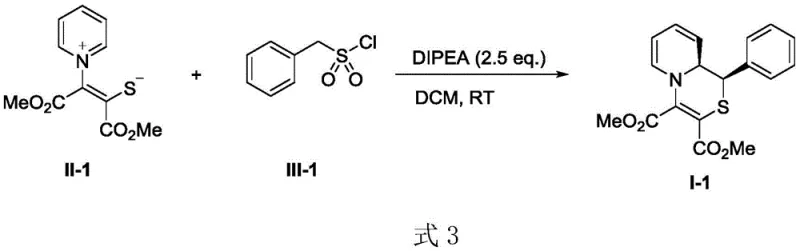
In stark contrast to these cumbersome legacy techniques, the method disclosed in the patent introduces a streamlined, two-component coupling strategy that dramatically simplifies the synthetic landscape. By utilizing readily available pyridine sulfur ylides and arylmethylsulfonyl chlorides, the process enables the rapid assembly of the target thiazine core in a single operational step. The reaction proceeds efficiently in dichloromethane using N,N-diisopropylethylamine (DIPEA) as a base, eliminating the need for expensive transition metal catalysts or specialized equipment. This novel approach not only accelerates the reaction kinetics, allowing completion within minutes at room temperature, but also ensures exceptional functional group tolerance. The absence of foul-smelling sulfur reagents and the use of stable, commercially sourced starting materials make this route inherently safer and more environmentally benign. For procurement managers, this translates to a supply chain that is less vulnerable to the volatility of exotic reagent markets, ensuring a more reliable source of high-purity pharmaceutical intermediates.
![General reaction scheme showing the synthesis of 1,9a-dihydropyrido[2,1-c][1,4]thiazine compounds from sulfur ylides and sulfonyl chlorides](/insights/img/1-9a-dihydropyrido-thiazine-synthesis-pharma-supplier-20260305225134-02.webp)
Mechanistic Insights into Sulfur Ylide-Mediated Cyclization
The mechanistic elegance of this transformation lies in the nucleophilic character of the sulfur ylide and the electrophilic nature of the sulfonyl chloride. Under the basic conditions provided by DIPEA, the sulfur atom of the ylide initiates a nucleophilic attack on the methylene carbon adjacent to the sulfonyl group, displacing the chloride ion. This initial substitution generates a reactive sulfonium intermediate which subsequently undergoes an intramolecular cyclization. The nitrogen atom of the pyridine ring, activated by the adjacent electron-withdrawing groups, facilitates the ring closure to form the stable 1,9a-dihydropyrido[2,1-c][1,4]thiazine framework. This cascade occurs with high stereocontrol and regioselectivity, minimizing the formation of side products that typically plague multicomponent reactions. The mild basicity of DIPEA is crucial here, as it deprotonates the intermediate sufficiently to drive the cyclization forward without causing decomposition of the sensitive ylide species. Understanding this mechanism allows process chemists to fine-tune reaction parameters, such as base strength and solvent polarity, to optimize yields for specific substrate combinations.
Impurity control is another critical aspect where this mechanism offers distinct advantages over traditional pathways. Because the reaction is driven by a clear two-step sequence of substitution and cyclization, the impurity profile is significantly cleaner compared to chaotic multicomponent condensations. The primary byproducts are typically inorganic salts and unreacted starting materials, which are easily removed during the aqueous workup or silica gel chromatography. The patent data indicates that even with diverse substituents on the aromatic rings, such as electron-withdrawing nitro groups or bulky tert-butoxycarbonyl groups, the reaction maintains high fidelity. This robustness suggests that the transition state is relatively insensitive to steric hindrance, allowing for the synthesis of a broad library of analogs without extensive re-optimization. For quality control teams, this predictability simplifies the validation process and ensures that the final active pharmaceutical ingredient meets stringent purity specifications required by regulatory bodies.
How to Synthesize 1,9a-Dihydropyrido[2,1-c][1,4]thiazine Efficiently
To implement this high-efficiency synthesis in a laboratory or pilot plant setting, operators should adhere to the optimized parameters established in the patent examples. The protocol involves dissolving the sulfur ylide and the sulfonyl chloride in dichloromethane, followed by the addition of DIPEA at room temperature. Reaction progress is monitored via thin-layer chromatography, with complete consumption of the starting ylide typically observed within 10 minutes. Following the reaction, the solvent is removed under reduced pressure, and the crude product is purified using standard silica gel column chromatography. The detailed standardized synthesis steps, including precise stoichiometric ratios and workup procedures, are outlined in the guide below to ensure reproducibility and safety.
- Dissolve the sulfur-containing ylide (Compound II), arylmethylsulfonyl chloride (Compound III), and N,N-diisopropylethylamine (DIPEA) in dichloromethane solvent at a molar ratio of 1.0: 2.5:2.5.
- Stir the reaction mixture at room temperature (25°C) for approximately 10 minutes until TLC monitoring confirms the complete disappearance of the starting ylide.
- Remove the organic solvent under reduced pressure and purify the resulting residue via silica gel column chromatography using a petroleum ether and ethyl acetate gradient.
Commercial Advantages for Procurement and Supply Chain Teams
From a commercial perspective, the adoption of this synthetic route offers profound benefits for cost management and supply chain resilience in the manufacturing of fine chemicals. The elimination of precious metal catalysts removes a significant cost driver, as these metals are not only expensive to purchase but also require costly recovery or disposal processes to meet environmental regulations. Furthermore, the ability to run the reaction at room temperature drastically reduces energy consumption compared to processes requiring heating or cryogenic cooling, contributing to a lower overall carbon footprint. The short reaction time enhances facility throughput, allowing manufacturers to produce larger batches in less time without compromising quality. These factors combined create a compelling economic case for switching to this technology, particularly for companies looking to reduce lead time for high-purity pharmaceutical intermediates.
- Cost Reduction in Manufacturing: The most immediate financial impact comes from the replacement of expensive catalytic systems with inexpensive organic bases like DIPEA. Since the process does not utilize transition metals, the downstream purification does not require specialized scavenger resins or complex filtration steps to remove trace metal contaminants, which are often mandated for API production. This simplification of the workup procedure reduces solvent usage and labor hours, leading to substantial cost savings per kilogram of product. Additionally, the high yields reported, reaching up to 97% in optimized examples, mean that less raw material is wasted, directly improving the material cost efficiency. For procurement managers, this translates to a more competitive pricing structure for the final intermediate, allowing for better margin management in the final drug product.
- Enhanced Supply Chain Reliability: Supply chain stability is significantly bolstered by the use of commercially available and stable starting materials. Unlike sensitive reagents that require cold chain logistics or special handling, the sulfur ylides and sulfonyl chlorides used in this process are robust and easy to source from multiple global suppliers. The reaction's tolerance to ambient conditions means that production is not dependent on specialized infrastructure, such as inert gas lines or low-temperature reactors, which can be bottlenecks in multipurpose facilities. This flexibility allows for faster scale-up and reduces the risk of production delays caused by equipment availability. Consequently, partners can rely on a more consistent supply of critical intermediates, mitigating the risk of stockouts that could halt downstream drug formulation activities.
- Scalability and Environmental Compliance: Scaling this process from gram to ton scale is straightforward due to the exothermic nature being manageable at room temperature and the absence of hazardous gas evolution. The use of dichloromethane, while requiring proper containment, is a well-understood solvent in the industry with established recovery protocols, ensuring compliance with environmental standards. The simplified impurity profile reduces the burden on waste treatment facilities, as the aqueous waste streams contain primarily organic salts rather than heavy metals. This aligns with the growing industry demand for green chemistry practices, making the technology attractive for companies aiming to improve their sustainability metrics. The ease of scale-up ensures that commercial production can meet market demand without the need for extensive process re-engineering.
Frequently Asked Questions (FAQ)
The following questions address common technical and commercial inquiries regarding the implementation of this thiazine synthesis technology. These answers are derived directly from the experimental data and beneficial effects described in the patent documentation, providing clarity on reaction scope and operational requirements. Understanding these details is essential for technical teams evaluating the feasibility of integrating this route into their existing manufacturing portfolios.
Q: What are the primary advantages of this thiazine synthesis method over traditional multicomponent reactions?
A: Unlike traditional multicomponent reactions which often suffer from low yields and complex substrate sensitivity, this patented method utilizes a direct two-component coupling that achieves yields up to 97% under mild room temperature conditions without requiring inert gas protection.
Q: Does this process require expensive transition metal catalysts?
A: No, the synthesis is entirely metal-free, relying on organic bases like DIPEA to facilitate the cyclization, which significantly reduces raw material costs and eliminates the need for costly heavy metal removal steps during purification.
Q: Is this synthetic route suitable for large-scale industrial production?
A: Yes, the process is highly scalable due to its operation at ambient temperature, short reaction times, and the use of commercially available, non-hazardous reagents, making it ideal for commercial scale-up of complex pharmaceutical intermediates.
Partnering with NINGBO INNO PHARMCHEM: Your Reliable 1,9a-Dihydropyrido[2,1-c][1,4]thiazine Supplier
As the demand for complex heterocyclic intermediates grows, partnering with an experienced CDMO is crucial for successful commercialization. NINGBO INNO PHARMCHEM possesses extensive experience scaling diverse pathways from 100 kgs to 100 MT/annual commercial production, ensuring that your project transitions smoothly from lab bench to full-scale manufacturing. Our facility is equipped with rigorous QC labs capable of meeting stringent purity specifications, guaranteeing that every batch of 1,9a-dihydropyrido[2,1-c][1,4]thiazine derivative meets the highest industry standards. We understand the critical nature of timeline and quality in drug development and are committed to providing a seamless supply chain solution.
We invite you to contact our technical procurement team to discuss how this innovative synthesis route can be tailored to your specific project needs. By requesting a Customized Cost-Saving Analysis, you can gain deeper insights into the potential economic benefits of adopting this metal-free technology. We are ready to provide specific COA data and route feasibility assessments to support your R&D and procurement decisions, ensuring a reliable partnership for your long-term success.