
Scalable Visible Light Synthesis of Alkyl Benzothiazole Derivatives for Pharma Intermediates
Scalable Visible Light Synthesis of Alkyl Benzothiazole Derivatives for Pharma Intermediates
The pharmaceutical and fine chemical industries are constantly seeking greener, more efficient pathways to synthesize complex heterocyclic scaffolds essential for drug discovery and development. A significant breakthrough in this domain is detailed in patent CN112979580A, which discloses a novel method for preparing alkyl benzothiazole derivatives under visible light irradiation. This technology represents a paradigm shift from traditional transition-metal catalyzed processes to a more sustainable, metal-free protocol. By utilizing N-(2-bromophenyl) alkylthioamide as the starting material and employing a simple household compact fluorescent lamp as the energy source, this invention eliminates the need for costly and toxic ruthenium or iridium complexes. For R&D directors and procurement managers alike, this development signals a potential revolution in how high-purity pharmaceutical intermediates are manufactured, offering a route that is not only environmentally benign but also economically superior due to the drastic simplification of the reaction setup and downstream processing.
The Limitations of Conventional Methods vs. The Novel Approach
The Limitations of Conventional Methods
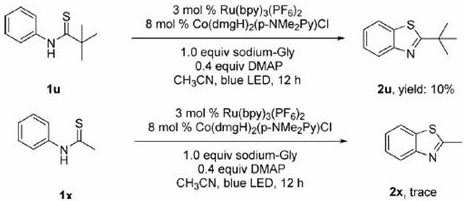
Historically, the synthesis of benzothiazole derivatives under mild conditions has relied heavily on photoredox catalysis involving precious transition metals. As illustrated in the prior art, conventional methods typically employ catalysts such as [Ru(bpy)3]2+ or [Ir(ppy)3] to drive the necessary intramolecular cross-coupling reactions. While effective, these methodologies introduce significant logistical and financial burdens to the supply chain. The primary drawback is the inherent toxicity and high cost of these heavy metal catalysts, which necessitates rigorous and expensive purification steps to ensure the final API intermediate meets stringent regulatory limits for residual metals. Furthermore, the requirement for specialized LED arrays or high-energy UV sources adds to the capital expenditure and operational complexity of the manufacturing process. These factors collectively inflate the cost of goods sold (COGS) and extend the lead time for producing critical building blocks, creating bottlenecks for reliable agrochemical intermediate supplier networks and pharmaceutical manufacturers alike.
The Novel Approach
In stark contrast to the legacy technologies, the novel approach disclosed in the patent utilizes a catalyst-free system driven purely by visible light and a mild inorganic base. The reaction proceeds efficiently at room temperature using a standard 45W household compact fluorescent lamp, which dramatically lowers the energy consumption and equipment requirements compared to specialized photo-reactors. By replacing expensive organometallic catalysts with inexpensive sodium phosphate and using dimethyl sulfoxide (DMSO) as a green solvent, the process achieves high yields without introducing heavy metal contaminants. This simplification means that the downstream workup is significantly streamlined, often requiring only basic extraction and chromatography rather than complex metal scavenging procedures. For a reliable pharmaceutical intermediate supplier, this translates to a robust, scalable process that minimizes waste generation and maximizes throughput, effectively addressing the pain points of cost reduction in fine chemical manufacturing while maintaining exceptional product quality.
Mechanistic Insights into Visible Light-Promoted Cyclization
The core of this technological advancement lies in the unique ability of the N-(2-bromophenyl) alkylthioamide substrate to undergo intramolecular cross-coupling directly upon absorption of visible light photons, facilitated by the base. Unlike traditional photoredox cycles that rely on the excitation of a metal center to transfer electrons, this mechanism likely involves the direct excitation of the electron-donor-acceptor (EDA) complex formed between the substrate and the base, or potentially a radical pathway initiated by the interaction of the thioamide moiety with light in the presence of the base. The bromine atom at the ortho-position serves as the leaving group, allowing the sulfur atom to attack the aromatic ring, closing the benzothiazole cycle. This direct activation bypasses the need for external sensitizers, reducing the number of variables that can lead to side reactions or impurity formation. The result is a cleaner reaction profile where the primary byproduct is simply the inorganic salt derived from the base and the leaving group, vastly simplifying the impurity spectrum compared to metal-catalyzed routes.
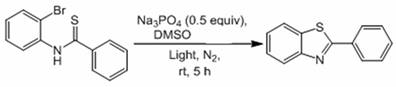
From an impurity control perspective, the absence of transition metals is a game-changer for quality assurance teams. In metal-catalyzed reactions, trace amounts of ruthenium or iridium can coordinate with the product or intermediates, leading to difficult-to-remove colored impurities or metal-organic complexes that persist through multiple purification steps. By eliminating these metals entirely, the novel method ensures that the crude reaction mixture is inherently cleaner, reducing the load on purification columns and increasing the overall recovery rate of the high-purity OLED material or pharmaceutical intermediate. The patent data indicates that even with diverse substrates, such as those containing fluorine or chlorine substituents, the reaction maintains high selectivity. For instance, the synthesis of fluoro-substituted derivatives proceeds with excellent efficiency, demonstrating that the electronic nature of the substituents does not inhibit the photon-driven cyclization. This robustness suggests a wide substrate scope, making the method applicable to the commercial scale-up of complex polymer additives and diverse medicinal chemistry libraries.
How to Synthesize Alkyl Benzothiazole Derivatives Efficiently
The operational simplicity of this synthesis makes it highly attractive for immediate adoption in pilot and production plants. The procedure involves charging a reaction vessel with the N-(2-bromophenyl) alkylthioamide starting material and sodium phosphate under an inert atmosphere, followed by the addition of DMSO. The mixture is then stirred at room temperature while being irradiated by a standard fluorescent lamp. This straightforward protocol eliminates the need for cryogenic cooling or high-pressure reactors, significantly lowering the barrier to entry for manufacturing. The detailed standardized synthesis steps, including precise molar ratios and workup procedures, are outlined below to ensure reproducibility and safety during scale-up operations.
- Charge a dry reaction vessel with N-(2-bromophenyl) alkylthioamide and inorganic base (preferably Na3PO4) under inert gas protection.
- Add dimethyl sulfoxide (DMSO) as the solvent and stir the mixture at room temperature.
- Irradiate the reaction mixture with a 45W household compact fluorescent lamp for 20-30 hours to complete the cyclization.
Commercial Advantages for Procurement and Supply Chain Teams
For procurement managers and supply chain heads, the economic implications of adopting this visible-light promoted synthesis are profound. The elimination of precious metal catalysts removes a major volatile cost component from the bill of materials, as the prices of ruthenium and iridium are subject to significant market fluctuations and geopolitical supply risks. Furthermore, the use of commodity chemicals like sodium phosphate and DMSO ensures a stable and secure supply of raw materials, enhancing the reliability of the supply chain. The simplified reaction conditions also mean that the process can be run in existing glass-lined or stainless steel reactors equipped with simple lighting fixtures, avoiding the need for costly capital investments in specialized photochemical flow reactors. This flexibility allows for rapid deployment and scaling, reducing lead time for high-purity pharmaceutical intermediates and enabling manufacturers to respond quickly to market demands.
- Cost Reduction in Manufacturing: The most significant driver of cost savings in this process is the complete removal of expensive transition metal catalysts and organic photosensitizers. In traditional methods, these reagents can account for a substantial portion of the raw material costs, and their removal often requires additional processing steps like filtration through silica or treatment with scavengers, which increases solvent usage and labor. By operating without these additives, the new method drastically reduces both direct material costs and indirect processing costs. Additionally, the use of a low-power 45W household lamp instead of high-intensity LED arrays or mercury lamps significantly lowers energy consumption, contributing to a lower carbon footprint and reduced utility bills. These cumulative efficiencies result in substantial cost savings that can be passed down the supply chain, making the final alkyl benzothiazole derivatives more competitive in the global market.
- Enhanced Supply Chain Reliability: Supply chain resilience is critically dependent on the availability and stability of raw materials. Traditional photoredox catalysts are often sourced from a limited number of suppliers, creating single points of failure in the supply network. In contrast, the reagents required for this novel method—sodium phosphate, DMSO, and the thioamide precursors—are widely available commodity chemicals produced by numerous manufacturers globally. This diversification of the supply base mitigates the risk of shortages and price spikes. Moreover, the reaction's tolerance to air and moisture, as evidenced by the patent data showing reasonable yields even under non-ideal conditions, adds a layer of operational robustness. This means that minor deviations in plant conditions are less likely to result in batch failures, ensuring consistent delivery schedules and strengthening the partnership between the chemical manufacturer and their clients.
- Scalability and Environmental Compliance: Scaling photochemical reactions has historically been challenging due to the Beer-Lambert law, which limits light penetration in large vessels. However, the use of a simple, low-energy light source and the high efficiency of this specific transformation suggest that it can be adapted for larger scales, potentially using thin-film reactors or scaled-out batch processes. From an environmental perspective, the method aligns perfectly with green chemistry principles by avoiding toxic heavy metals and reducing waste. The absence of metal residues simplifies wastewater treatment and reduces the burden on environmental compliance teams. The process generates minimal hazardous waste, primarily consisting of aqueous salt solutions and organic solvents that can be readily recycled. This eco-friendly profile not only reduces disposal costs but also enhances the corporate sustainability metrics of the manufacturing facility, appealing to environmentally conscious stakeholders and regulators.
Frequently Asked Questions (FAQ)
The following questions address common technical and commercial inquiries regarding the implementation of this visible-light synthesis technology. These answers are derived directly from the experimental data and technical specifications provided in the patent documentation, ensuring accuracy and relevance for technical decision-makers. Understanding these details is crucial for evaluating the feasibility of integrating this method into existing production lines or R&D pipelines.
Q: Does this synthesis method require expensive transition metal catalysts?
A: No, the method described in patent CN112979580A operates without any photosensitizer or transition metal catalyst, utilizing only visible light and an inorganic base.
Q: What is the typical yield for the base reaction model?
A: For the model reaction of N-(2-bromophenyl) thiobenzamide, the process achieves an isolated yield of 98% and an HPLC yield of 99%.
Q: Can this method tolerate halogen substituents on the aromatic ring?
A: Yes, the methodology demonstrates excellent tolerance for various substituents, including fluorine, chlorine, and bromine groups on the phenyl ring.
Partnering with NINGBO INNO PHARMCHEM: Your Reliable Alkyl Benzothiazole Derivative Supplier
At NINGBO INNO PHARMCHEM, we recognize the transformative potential of the visible-light promoted synthesis described in patent CN112979580A for the production of high-value heterocyclic intermediates. Our team of expert chemists has extensive experience scaling diverse pathways from 100 kgs to 100 MT/annual commercial production, ensuring that the transition from laboratory discovery to industrial reality is seamless and efficient. We are committed to delivering products that meet stringent purity specifications, leveraging our rigorous QC labs to verify that every batch is free from the heavy metal contaminants often associated with traditional catalytic methods. Our state-of-the-art facilities are equipped to handle the specific requirements of photochemical reactions, allowing us to offer this advanced synthesis route to our global partners with confidence and reliability.
We invite pharmaceutical and agrochemical companies to collaborate with us to optimize their supply chains using this innovative technology. By partnering with NINGBO INNO PHARMCHEM, you gain access to a Customized Cost-Saving Analysis tailored to your specific volume requirements and quality standards. We encourage you to contact our technical procurement team to request specific COA data and route feasibility assessments for your target molecules. Together, we can drive down costs, improve sustainability, and accelerate the delivery of life-saving medicines to the market, solidifying your position as a leader in the industry through superior chemical manufacturing excellence.
Engineering Bottleneck?
Can't scale up this synthesis? Upload your target structure or CAS, and our CDMO team will evaluate the industrial feasibility within 24 hours. Request Evaluation →