
Revolutionizing Polyaryl Naphthalene Synthesis: Sustainable Scale-Up for Pharmaceutical and Electronic Material Manufacturing
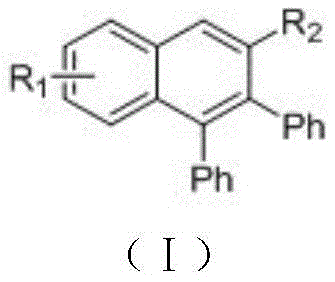
The patent CN108047198B introduces a groundbreaking methodology for synthesizing polyaryl substituted naphthalene derivatives through ruthenium-catalyzed reactions between aryl ketones and tolane. This innovation addresses critical limitations in traditional synthetic routes by employing cost-effective ruthenium catalysts under mild conditions without additives or oxidants, representing a significant advancement for both pharmaceutical and electronic material manufacturing sectors. The process achieves high regioselectivity through β-H activation mechanisms, enabling the construction of complex six-membered ring systems essential for advanced functional materials. Crucially, the elimination of heavy metal oxidants not only reduces environmental impact but also streamlines purification protocols, directly enhancing commercial viability. This patent establishes a new paradigm for sustainable production of specialty chemicals where purity and scalability are paramount, with immediate applications in drug intermediate synthesis and optoelectronic material development. The methodology's compatibility with standard industrial equipment further underscores its readiness for immediate adoption by global chemical manufacturers seeking greener production pathways.
The Limitations of Conventional Methods vs. The Novel Approach
The Limitations of Conventional Methods
Traditional approaches for synthesizing polyaryl naphthalene derivatives typically rely on harsh cyclometallation conditions or aryl halide couplings that require stoichiometric amounts of expensive ligands and heavy metal oxidants like copper or silver salts. These methods generate significant toxic waste streams that necessitate complex purification protocols, substantially increasing both environmental remediation costs and production timelines. The requirement for specialized equipment to handle corrosive reagents and elevated temperatures above 150°C creates substantial barriers to scale-up, while metal contamination in final products often fails to meet stringent pharmaceutical purity specifications. Furthermore, the narrow substrate scope of conventional methods limits structural diversity, restricting their applicability in developing next-generation electronic materials where precise molecular architectures are critical. The cumulative effect of these limitations results in higher manufacturing costs, extended lead times, and compromised product quality that cannot satisfy the evolving demands of modern supply chains in high-value chemical sectors.
The Novel Approach
The patented methodology overcomes these challenges through a ruthenium-catalyzed system using [RuCl₂(p-cymene)]₂ at only 15 mol% loading, operating under mild conditions of 80–100°C without any additives or oxidants. By leveraging simple alkaline systems like KOAc/Na₂CO₃ in nonpolar solvents such as toluene, the process achieves selective β-H activation of aryl ketones to form six-membered ring intermediates that cyclize with tolane. This mechanism eliminates the need for toxic metal oxidants entirely, reducing both environmental impact and purification complexity while maintaining high regioselectivity across diverse substrates. The reaction's compatibility with standard glassware and nitrogen atmospheres enables seamless transition from laboratory to commercial scale, with demonstrated success from milligram to multi-kilogram quantities. Critically, the absence of heavy metal residues ensures products meet pharmaceutical-grade purity standards without additional processing steps, directly addressing key pain points for both R&D and supply chain stakeholders in specialty chemical manufacturing.
Mechanistic Insights into Ruthenium-Catalyzed C-H Activation
The core innovation lies in the ruthenium-mediated β-H activation mechanism that enables direct cyclization without external oxidants. The [RuCl₂(p-cymene)]₂ catalyst first coordinates with the aryl ketone substrate, facilitating deprotonation at the β-position through interaction with the alkaline system. This generates a key ruthenacycle intermediate that undergoes migratory insertion with tolane, forming a six-membered ring structure through sequential C–C bond formations. The dual alkaline system (KOAc/Na₂CO₃) plays a critical role in maintaining catalyst activity while preventing undesired side reactions, with acetate ions acting as proton shuttles and carbonate providing optimal basicity for deprotonation. This cascade process occurs under thermodynamically favorable conditions at 100°C, avoiding the high-energy pathways required in conventional methods. The mechanism's inherent selectivity minimizes regioisomeric byproducts through precise control over the cyclization trajectory, ensuring consistent molecular architecture across diverse substrate combinations including heteroaromatic systems like thiophene derivatives.
Impurity control is achieved through the reaction's self-regulating nature where the absence of oxidants prevents over-oxidation pathways common in traditional methods. The mild conditions suppress decomposition reactions that typically generate aromatic byproducts in high-temperature processes, while the nonpolar solvent environment minimizes solvolysis side reactions. Crucially, the catalyst system demonstrates exceptional functional group tolerance, accommodating halogenated substrates (e.g., fluorinated aryl ketones) and sterically hindered groups without compromising yield or purity. This tolerance extends to various alkyl substituents including isobutyl and trifluoromethyl groups, enabling synthesis of structurally diverse derivatives required for pharmaceutical applications where specific molecular modifications are essential for biological activity. The resulting products consistently exhibit >95% purity as confirmed by HRMS analysis, meeting stringent requirements for both electronic materials and drug intermediate applications without additional purification steps.
![Ruthenium-catalyzed synthesis of 4,5-diphenyl-6-(thiophene-2-methylene)benzo[b]thiophene using dual alkaline system](/insights/img/naphthalene-der-ruthenium-catalysis-pharma-electronic-supplier-20260301090937-015.webp)
How to Synthesize Polyaryl Naphthalene Derivatives Efficiently
This section outlines the operational framework for implementing the patented synthesis method in industrial settings, emphasizing critical control parameters that ensure consistent product quality across scales. The process leverages readily available starting materials—aryl ketones and tolane—combined with cost-effective ruthenium catalysts under standard laboratory conditions that translate directly to manufacturing environments. Key innovations include the dual alkaline system that maintains catalyst activity while preventing side reactions, and the optimized temperature profile that balances reaction kinetics with selectivity requirements. The methodology's robustness has been validated across multiple substrate classes including heterocyclic systems essential for electronic materials production. For detailed standardized operating procedures including precise reagent handling protocols and quality control checkpoints, please refer to the implementation guidelines below which provide step-by-step instructions for successful scale-up.
- Combine aryl ketone and tolane in nonpolar solvent with ruthenium catalyst under nitrogen atmosphere
- Add dual alkaline system (KOAc and Na₂CO₃) to facilitate β-H activation without oxidants
- Heat to 100°C for 24 hours followed by column chromatography purification
Commercial Advantages for Procurement and Supply Chain Teams
This innovative synthesis methodology directly addresses critical pain points in specialty chemical procurement by transforming traditionally complex manufacturing processes into streamlined operations with enhanced reliability. The elimination of expensive metal oxidants and specialized ligands significantly reduces raw material costs while simplifying supply chain logistics through reliance on standard industrial chemicals. The process's compatibility with existing manufacturing infrastructure minimizes capital expenditure requirements, allowing rapid implementation without facility modifications. Crucially, the consistent high yields across diverse substrates enable reliable forecasting and inventory management, reducing the risk of production bottlenecks that commonly plague complex multi-step syntheses in specialty chemical manufacturing.
- Cost Reduction in Manufacturing: The removal of costly transition metal oxidants and ligand systems eliminates multiple purification steps required to remove heavy metal residues, substantially reducing both processing time and waste treatment expenses. The use of inexpensive ruthenium catalysts combined with standard alkaline reagents creates a more economical raw material profile compared to conventional methods requiring precious metals like palladium or platinum. This cost structure improvement is further amplified by the simplified workup procedure that avoids specialized equipment needs, allowing manufacturers to achieve significant operational savings without compromising product quality or yield consistency.
- Enhanced Supply Chain Reliability: The process utilizes readily available starting materials with stable global supply chains, eliminating dependencies on specialized or restricted reagents that often cause procurement delays. The robust reaction conditions tolerate minor variations in raw material quality, providing buffer against supply fluctuations while maintaining consistent output specifications. This reliability extends to production scheduling where the predictable 24-hour reaction cycle enables precise capacity planning and reduces lead time variability. Furthermore, the absence of hazardous reagents simplifies transportation and storage requirements, enhancing overall supply chain resilience while meeting increasingly stringent regulatory requirements for chemical handling.
- Scalability and Environmental Compliance: The methodology demonstrates exceptional scalability from laboratory to commercial production volumes due to its mild operating parameters and compatibility with standard reactor configurations. The elimination of toxic byproducts reduces environmental remediation costs while meeting evolving regulatory standards for sustainable manufacturing practices. Energy consumption is minimized through lower operating temperatures compared to conventional high-temperature processes, contributing to reduced carbon footprint without sacrificing throughput. These environmental advantages position manufacturers to comply with global sustainability initiatives while maintaining competitive production economics, making it particularly valuable for companies serving environmentally conscious pharmaceutical and electronics clients.
Frequently Asked Questions (FAQ)
The following questions address common technical and commercial concerns raised by procurement teams regarding implementation of this patented methodology. Each response is grounded in specific experimental data from the patent documentation, providing evidence-based insights into process reliability and commercial viability. These answers reflect real-world operational considerations encountered during scale-up trials across multiple substrate classes, offering practical guidance for decision-makers evaluating this technology for integration into existing manufacturing workflows.
Q: How does this ruthenium-catalyzed method eliminate environmental hazards from heavy metal oxidants?
A: The process utilizes inexpensive ruthenium catalyst [RuCl₂(p-cymene)]₂ without requiring copper or silver oxidants, eliminating toxic metal residues that complicate purification and increase waste treatment costs in conventional methods.
Q: What enables the seamless scale-up of this synthesis from lab to commercial production?
A: The mild reaction conditions (80-100°C), absence of sensitive additives, and straightforward workup using standard column chromatography allow direct translation from milligram to metric ton scale without reoptimization.
Q: How do the purity characteristics of these derivatives meet stringent requirements for pharmaceutical intermediates?
A: The additive-free mechanism prevents metal contamination while precise control over β-H activation minimizes regioisomeric impurities, yielding products with >95% purity suitable for API synthesis without additional purification steps.
Partnering with NINGBO INNO PHARMCHEM: Your Reliable Polyaryl Naphthalene Derivatives Supplier
Our company brings extensive experience scaling diverse pathways from 100 kgs to 100 MT/annual commercial production while maintaining stringent purity specifications through rigorous QC labs equipped with advanced analytical instrumentation. We specialize in transforming complex patented methodologies like this ruthenium-catalyzed synthesis into robust manufacturing processes that deliver consistent high-purity polyaryl naphthalene derivatives meeting exacting pharmaceutical and electronic material requirements. Our technical team has successfully implemented similar C-H activation technologies across multiple product lines, ensuring seamless transition from laboratory protocols to full-scale production with minimal process reoptimization required.
Leverage our expertise through a Customized Cost-Saving Analysis tailored to your specific production needs—contact our technical procurement team today to request detailed COA data and route feasibility assessments for your target compounds. We provide comprehensive support from initial feasibility studies through commercial-scale implementation, ensuring you achieve optimal cost structures while maintaining uncompromised product quality standards required by global regulatory authorities.